
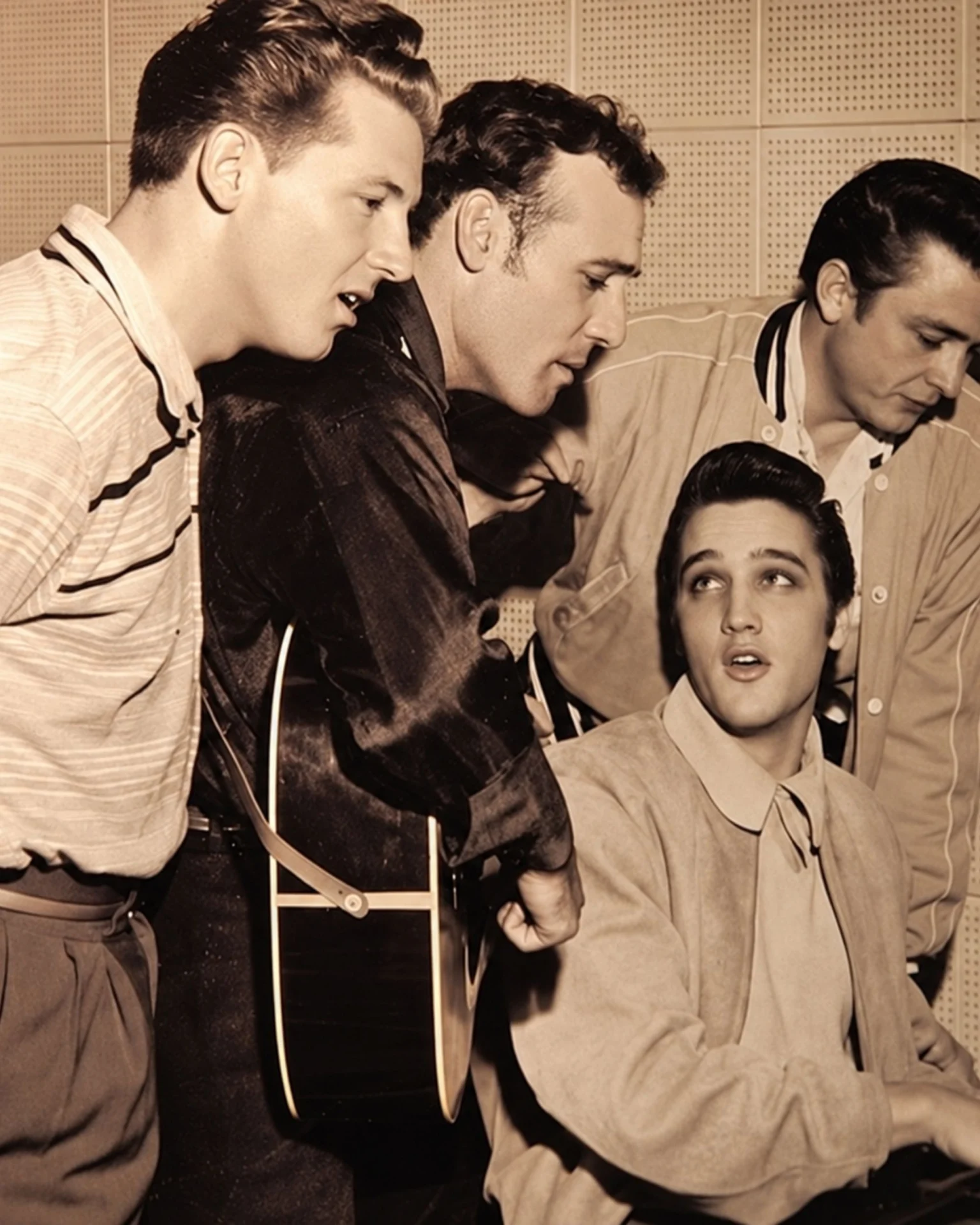
The small Memphis studio hummed with the ordinary rhythm of a workday. Carl Perkins, still chasing the echo of “Blue Suede Shoes,” had come to cut “Matchbox.” Piano player Jerry Lee Lewis sat at the keys, his fingers barely contained. Then the door opened. Elvis Presley stepped in — a returning king in a room that once believed in him. Johnny Cash followed. Sam Phillips let the tape roll. What began as a simple session became something no one planned: an unscripted gathering of four voices that would be frozen in time as the Million Dollar Quartet.
The Meeting That Was Never Supposed to Happen
By December 1956, each man stood at a different point in his trajectory. Elvis had already exploded beyond Sun Records into a national phenomenon. Cash was building the brooding identity that would become the Man in Black. Lewis was still raw and hungry, fighting for recognition. And Perkins — the session’s host — was trying to prove that his one big hit was not his only statement. No promoter, no press release, no grand plan brought them together. They simply showed up. And the room did the rest.
Four Roots, One Well
They had all drunk from the same Southern well — gospel, country, blues, and the rhythmic fire that Sun Records had turned into rockabilly. When the formal recording dissolved into a loose jam, they reached for songs that lived in their bones: old spirituals, country weepers, blues riffs. Their voices did not clash; they wove together because the soil beneath them was identical. A photographer caught the scene, and the next morning the Memphis Press-Scimitar gave it the name that stuck: Million Dollar Quartet.
It was not polished. It was not staged. It was not a formal coronation. It was Sun Records caught in its natural state — a small Memphis room where country boys, gospel memories, blues feeling, and rockabilly fire could all gather around one piano and sound like they had always belonged together.
What the Tapes Really Reveal
For years, the recordings remained largely unheard. When they finally surfaced, they showed something humbler than the legend. This was not a super-session of perfectionists hitting every note. It was four young men — still close enough to tease, to share a microphone, to sing old songs they had carried since childhood. The imperfections made it precious. The informality preserved the moment before fame, tragedy, and mythology separated them into different destinies.
Perkins’ Session Became Everyone’s Memory
There is a quiet irony for Carl Perkins. He came to record “Matchbox,” yet the day is remembered for the gathering that grew around him. But that does not diminish him. It places him at the center — his working session, his band, his rockabilly world. Elvis, Cash, and Lewis entered a room Perkins was already shaping. The accident around his single track became larger than any one song, capturing a time when the architects of American music were still close enough to share one piano and one microphone. For one afternoon, history did not pose. It just sang.