
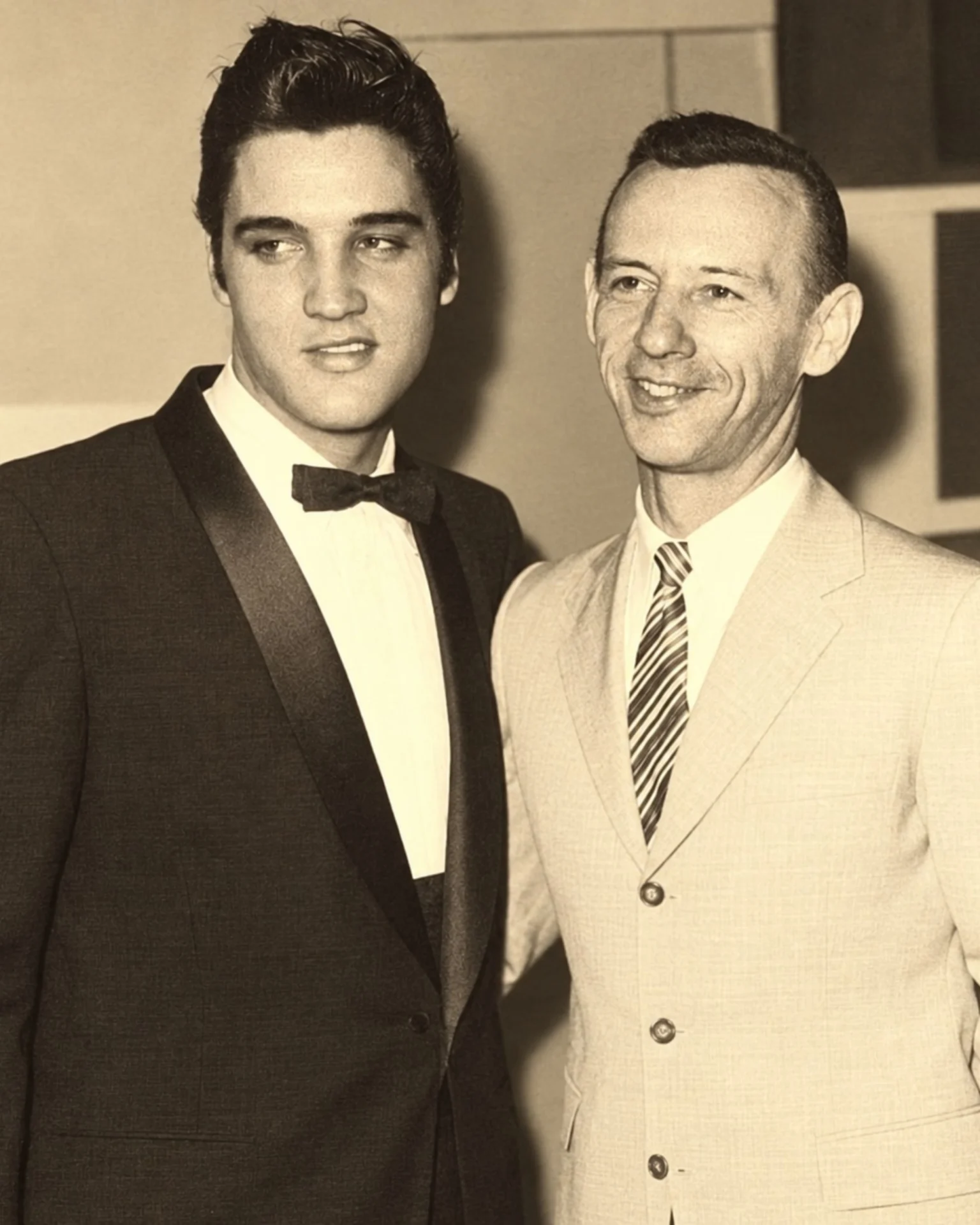
One poster captured the last moment before history rearranged the names—Hank Snow in big letters, Elvis Presley underneath.
The spring of 1955 held a truth that now feels impossible to believe. On country package show advertisements, Hank Snow’s name dominated the headline. Below it, in smaller type, a twenty-year-old from Memphis appeared as an “extra added” attraction. No one knew then that this arrangement would crumble within months—and that the young singer would become the biggest force in American music.
Hank Snow wasn’t just any established star. He was a seasoned country veteran with years of No. 1 hits, a steady presence on the Grand Ole Opry, and a booking partnership with Colonel Tom Parker called Hank Snow Enterprises and Jamboree Attractions. Elvis Presley began appearing on their package tours, and his crowds grew louder, younger, and harder to contain. Snow’s family later recalled the magnetic stage presence Elvis had—something rare even among stars.
On August 15, 1955, Elvis signed a management agreement with Hank Snow Attractions, a company equally owned by Snow and Parker. The deal seemed to cement Snow’s connection to the rising star. But Graceland’s own chronology documents what happened next with blunt precision: Parker became Elvis’s exclusive manager, and Snow was soon out of the picture.
Three months later, Parker negotiated the $35,000 sale of Elvis’s Sun contract to RCA—an extraordinary sum for an artist whose national breakthrough hadn’t yet occurred. That deal rocketed Elvis into national fame, while Parker built his entire business around the younger singer. Snow, the man who helped provide the touring machinery, was left behind.
Hank Snow never viewed the separation as ordinary business. In his autobiography, he accused Parker of deception. Snow’s son Jimmie insisted his father believed the original partnership entitled him to share in Elvis’s management. While other accounts show a more complicated paper trail, Snow’s interpretation remains his side of a disputed history—but the emotional truth is clear: he stood near the door when the world was about to rush through, then watched it close without him.
Snow didn’t disappear. He stayed at the Opry for decades, recorded more than 100 albums for RCA, and added classics like “I’ve Been Everywhere” and “Ninety Miles an Hour (Down a Dead End Street)” to his catalog. But those 1955 posters preserve a fleeting configuration: Hank Snow in large type, with Elvis Presley still underneath. A snapshot of the moment before rock and roll shattered the old order, and the future exploded beyond any poster’s capacity to contain it.