
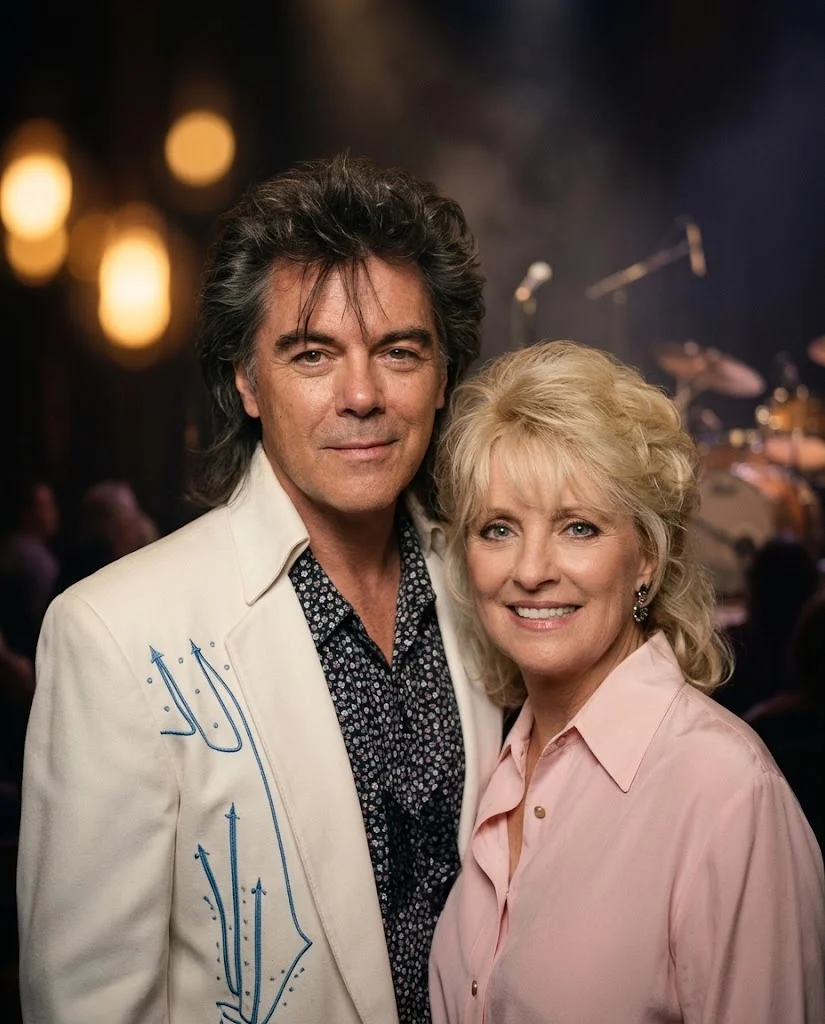
Long before Nashville knew her voice again, a faded photograph carried a promise made in the backseat of a car. Marty Stuart did not propose with a glittering industry spectacle. He opened a memory and let Connie Smith see the boy in the yellow shirt who had loved her music from the fairground crowd. That quiet gesture broke through years of caution and turned a childhood vow into a marriage on July 8, 1997.
But the story began in the summer of 1970. Connie Smith arrived at the Choctaw Indian Fair in Philadelphia, Mississippi, already one of country music’s most powerful traditional voices. In the audience stood 12-year-old Marty Stuart. He had asked his mother, Hilda, for the loudest yellow shirt he could find because he hoped the singer would notice him.
After the set, Hilda found a way to get close enough for a quick backstage picture. The image captured a shy boy beside the woman he admired. On the drive home, Stuart made a vow that sounded impossible at that age.
“I am going to marry Connie Smith someday,” Stuart told his mother.
Most young crushes vanish. Stuart built a path instead. He became a teenage mandolin prodigy on the road with bluegrass legend Lester Flatt, spent years in Johnny Cash’s backing band, and grew into a chart-topping solo artist. He did not chase fate with shortcuts. He earned a career large enough to bring him into the same room as the star he had once watched from the crowd.
By the mid-1990s, the small-town fairground boy had become a respected Nashville force. Connie Smith had stepped back from heavy recording while raising her five children. Stuart saw a generational voice that had been silent too long. He asked to produce her 1998 self-titled comeback album, and the old distance between fan and star disappeared. They worked over acoustic guitars and lyric sheets, rejecting polished pop-country trends and honoring their Mississippi roots and traditional instrumentation.
As collaboration softened into romance, Smith still had doubts. The 17-year age gap and the glare of public attention made caution reasonable. Stuart understood that grand gestures could feel like performance. He chose proof from a life that had not yet begun when he first saw her.
He brought out the backstage photograph from 1970. In that faded image, she could see the 12-year-old boy in the bright yellow shirt. It was not a marketing stunt or a fleeting celebrity courtship. It was devotion that had waited through decades of work, loss, and reinvention.
They married on July 8, 1997, and the promise made in a car ride became a partnership. Decades later, their bond still shows most clearly on stage. When they perform together, Stuart often steps aside with his guitar so Connie Smith can take the center stage she once left behind. He kept the childhood promise, and he built a life strong enough to protect the woman behind the voice.