
Before the platinum record changed country music, two exhausted rebels stood on opposite sides of a broken industry and chose honesty over polish.
In the early 1970s, Music Row ran like a controlled factory. Executives selected songs, hired players, added glossy strings, and told singers how to dress and cut their hair. For traditional artists, that smooth machine felt like a cage.
Willie Nelson broke first. After years of frustration and a house fire in Tennessee, he left Nashville in 1972 and returned to Austin, Texas. At the Armadillo World Headquarters, he grew his hair long, wore faded denim, and drew traditional country listeners and anti-war hippies into the same room.
“He turned divided crowds into one audience by refusing to be anything but himself”
Waylon Jennings fought from inside the studio system. When his contract with the Radio Corporation of America Victor label reached renewal in 1972, he hired Neil Reshen, a tough New York manager known for rock acts. Their pressure produced a rare deal that gave Jennings complete creative control over producers, songs, and recordings.
He insisted on playing with his touring band, The Waylors, instead of Nashville’s polished session workers. That independence was almost unheard of on Music Row.
Nelson soon gained similar freedom from Columbia Records. His 1975 concept album Red Headed Stranger was recorded cheaply at Autumn Sound Studios in Garland, Texas. Label executives first dismissed its spare sound as unfinished, yet the record climbed to the top of the charts.
By 1976, the underground rebellion had become a movement. Producer Jerry Bradley gathered tracks from Jennings, Nelson, Jessi Colter, and Tompall Glaser into Wanted! The Outlaws. The album became country music’s first certified platinum record, selling more than one million copies.
“Raw authenticity proved it could outsell polished conformity”
The bond between the two men did not end with sales. Through the late 1970s and 1980s, conservative radio pushed back and major labels sidelined veteran artists, but Nelson and Jennings continued to support each other.
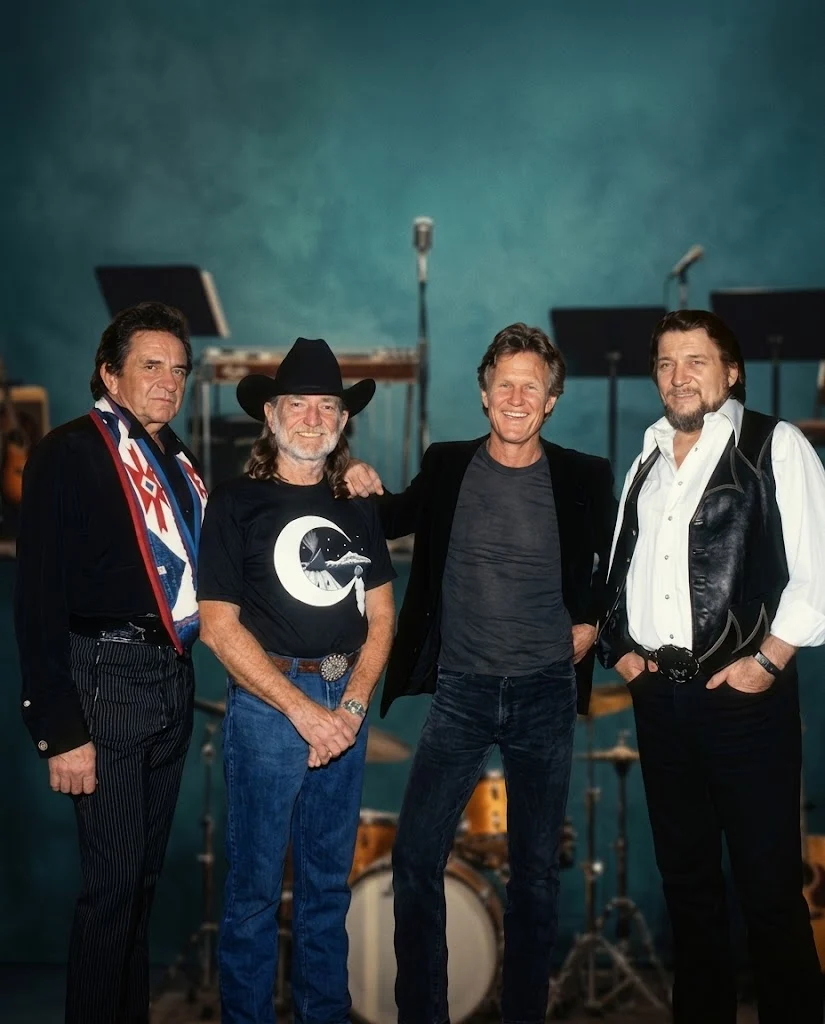
In 1985, during a television taping in Montreux, Switzerland, their circle widened. Johnny Cash and Kris Kristofferson joined Nelson and Jennings to form The Highwaymen. Four scarred voices and decades of hard living shared the spotlight, reviving Cash’s career when the industry had grown cold.
They sang Jimmy Webb’s Highwayman with weathered conviction, blending outlaw pride, cowboy memory, and human stubbornness into one story.
Their private studio battles and contract standoffs helped reshape American music. Creative freedom outlasted the corporate machine, and the outlaw sound became a lasting promise that a battered voice could still find a massive audience.