
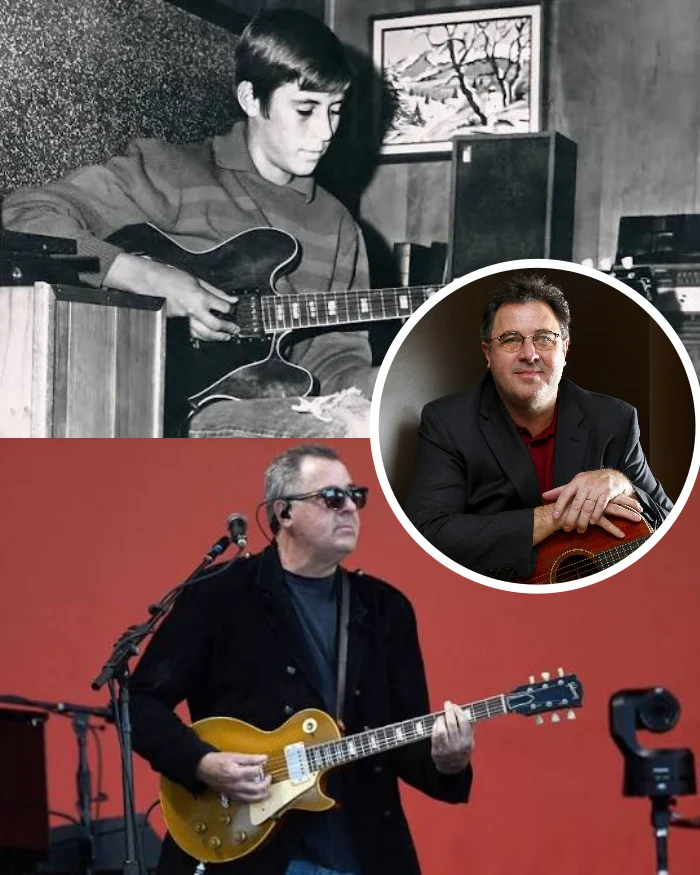
The scratched cherry finish tells a story no catalog could promise. It began in 1967 inside an Oklahoma City music store when Stan Gill asked for the best equipment available for his ten-year-old son.
Stan was a lawyer and appellate judge who loved acoustic music. He did not know the technical specs of a semi-hollow body electric guitar, but he refused to buy his son a toy. The salesman handed him a Gibson ES-335 and a Fender Super Reverb amplifier.
That rig was expensive, heavy, and built for touring professionals. Young Vince Gill could barely wrap his arms around the wide Gibson body to reach the strings. The Fender amp packed four ten-inch speakers that could rattle windows. Most parents would have started with a cheap beginner instrument. Stan made a massive financial stretch instead.
He bought his son a professional voice before the boy had earned a single paying gig.
The leap of faith became the foundation of a musical identity. Through the 1970s, Vince moved through the Oklahoma bluegrass scene and toward the national spotlight. The ES-335 traveled with him to Los Angeles and into Pure Prairie League, where he worked as lead singer and guitarist while building a reputation as an elite instrumentalist.
The pairing Stan chose accidentally anchored a legendary sound. The warm resonant wood of the semi-hollow Gibson met the sharp clean power of the Fender amp. It gave Gill a smooth articulate tone that could bridge traditional country, blues, and rock.
By the 1980s, that tone became his currency in Nashville. Long before the industry crowned him a solo country star, he became a highly sought-after session player. He carried his guitar chops across Music Row, played on records for established veterans, and earned respect from the city’s most demanding musicians.
He toured with Rodney Crowell and joined Emmylou Harris’s backing band. He proved his worth as a sideman before he ever asked for the center microphone. His proficiency was so widely acknowledged that rock star Mark Knopfler eventually asked him to join Dire Straits. Gill declined, choosing to stay the course in country music.
When his solo career broke open in the 1990s, country radio leaned toward slicker production and vocal-heavy frontmen. Gill remained an anomaly. Even as he swept CMA Awards and began headlining arenas, he was one of the few mainstream superstars who still played his own complex lead guitar breaks on stage. The man delivering the pristine tenor vocals was the same man anchoring the band’s groove.
Childhood instruments are usually outgrown, traded, sold, or left in closets. Gill kept his. Over a half-century, the 1967 Gibson traveled from small local dance halls to elite Nashville recording sessions, onto the Grand Ole Opry stage, and under the lights of the Grammy Awards.
Today the frets carry the wear of a Hall of Fame career. The finish is scratched and faded where a teenager’s arm rested against the wood for thousands of hours. The guitar has absorbed decades of sweat, stage lights, and the vibrations of countless performances.
The transaction in that music store was never just about buying a guitar. It was a father recognizing a calling before the rest of the world could hear it. When Vince Gill stands on a stadium stage today, stepping back from the microphone to let his hands take over, he is still striking the strings of the exact investment his father made fifty years ago.