
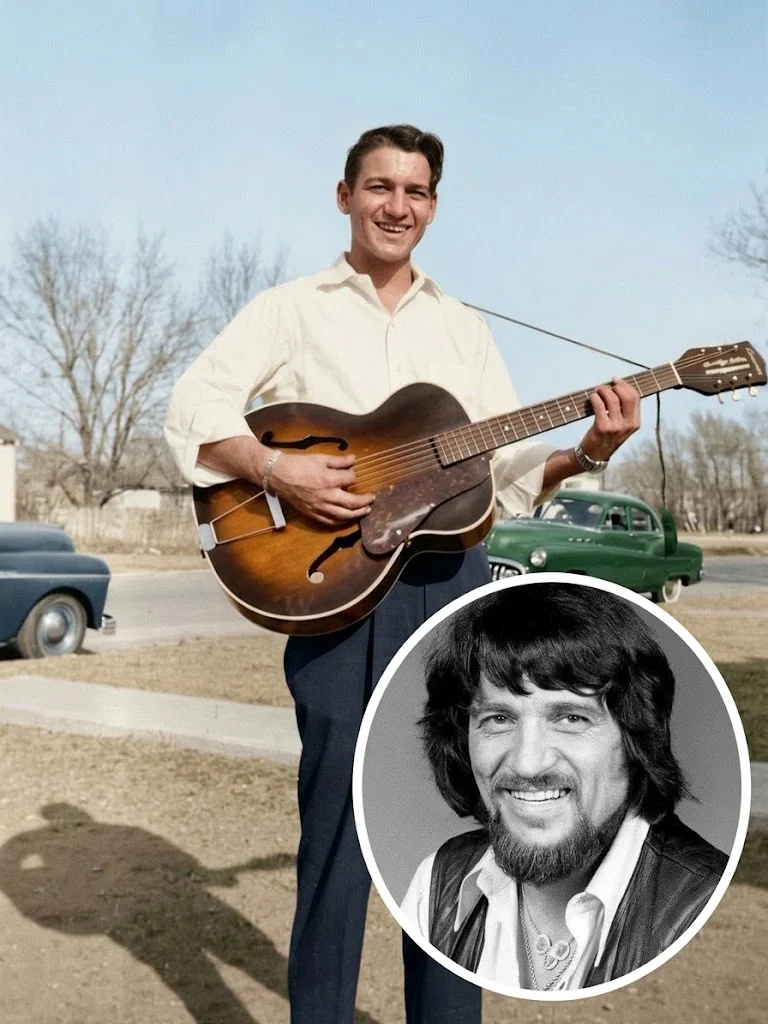
The night Nashville finally claimed Waylon Jennings, the legendary outlaw wasn’t there to claim it back. In October 2001, the Country Music Hall of Fame opened its doors to honor the man who had torn apart the polished production of Music Row. But as the black-tie crowd watched, the spotlight found an empty chair.
Jennings had sent his twenty-two-year-old son, Shooter, to step to the microphone and accept the medallion. It was a move that echoed decades of rebellion, a deliberate choice to stay home while the industry that once tried to tame him bowed to his legacy.
The refusal wasn’t a sudden act of defiance. For years, Jennings had waged war against Nashville’s commercial machinery. In the 1970s, he risked everything to use his own road band, The Waylors, in the studio, refusing to let background strings sweeten his gritty sound. He insisted on raw, thumping tracks that spoke directly to the working class.
The music was a direct line to the people, he often said, and it had to stay pure from the politics of Music Row.
By the time the Hall of Fame came calling, Jennings’ health was failing fast. A brutal battle with diabetes had taken his mobility, and he spent his final days in a wheelchair at his Chandler, Arizona home. Yet even as he recorded stripped-back tracks from his chair, his spirit remained unbroken.
In the quiet conversations before induction, he made it clear he saw no reason to start playing the industry game now. He had skipped the CMA Awards in 1975 even after winning Male Vocalist of the Year. Twenty-six years later, facing his own mortality, he stayed true to that unyielding independence.
He never needed a trophy to prove his worth, those close to him said, especially to the fans who lived inside his songs.
On February 13, 2002, Waylon Jennings passed away at sixty-four. The Hall of Fame induction had been a closing bookend to a turbulent career, but his refusal to show up cemented his legend even further. He left the world acknowledged by an industry he had fought, yet completely unowned by it. Nashville had finally carved his name into its history, but Waylon Jennings chose not to take a seat.