
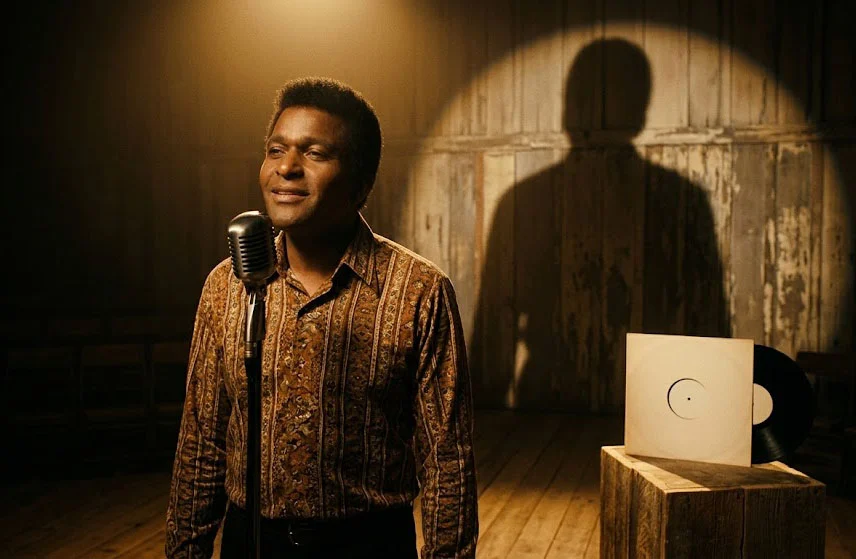
Before America saw Charley Pride’s face, his voice had already crossed a forbidden line.
In 1965, RCA Records brought him into the country music world, then tried to hide him from the world. The label kept his photograph off record sleeves and press materials sent to radio stations. Its executives feared that white listeners would turn away from a Black singer performing their most beloved music.
They expected rejection. They received love instead.
Charley’s story began far from the bright lights of Nashville. He was born in Sledge, Mississippi, and raised as the fourth of eleven children in a sharecropping family. Cotton fields defined his childhood. Segregation defined the rules of his society. Still, a battery-powered radio carried the Grand Ole Opry into his home, and the songs of Hank Williams and Roy Acuff gave him a dream he could not ignore.
He sang because country music made him feel at home, even when the country around him did not. After chasing baseball for years, his voice pulled him toward Nashville. The industry recognized his gift but struggled to accept his skin.
So his early records traveled anonymously. Radio hosts announced him as just another country singer from the heartland. Listeners met his pain and hope before they met his identity. By the time many discovered the truth, his voice had already found its place in their homes.
By 1970, the song “(Is Anybody Goin’ to) San Antone” turned that hidden journey into a national moment. The tune followed a weary traveler hitchhiking through rain, searching for a place where life could begin again. It carried no sermon. It carried no threat.
He knew what it felt like to spend a lifetime standing in the rain, looking for a place to finally belong.
That ache was personal. Pride had walked into rooms where strangers stared. He had carried the burden of being underestimated while proving that a voice could travel farther than a label could hide it.
He did not fight with rage. He fought with steady artistry, self-respect, and the kind of dignity that makes listeners lower their defenses.
The song became his third straight Number One hit. The photograph could no longer be removed. The man could no longer be ignored. People who had been taught that Black singers did not belong in country music bought his records, sang his lyrics, and welcomed him into their kitchens.
Charley Pride was no longer a carefully managed secret. He was a pioneer. He pushed open one of Nashville’s heaviest doors by refusing to disappear, song after song, until the truth in his voice became impossible to deny.
The deepest revolutions do not always come with loud declarations. Sometimes they move down a lonely highway, carrying a brokenhearted traveler home.
Sometimes, the greatest defiance is making the world love you before it realizes it was taught to fear you.