
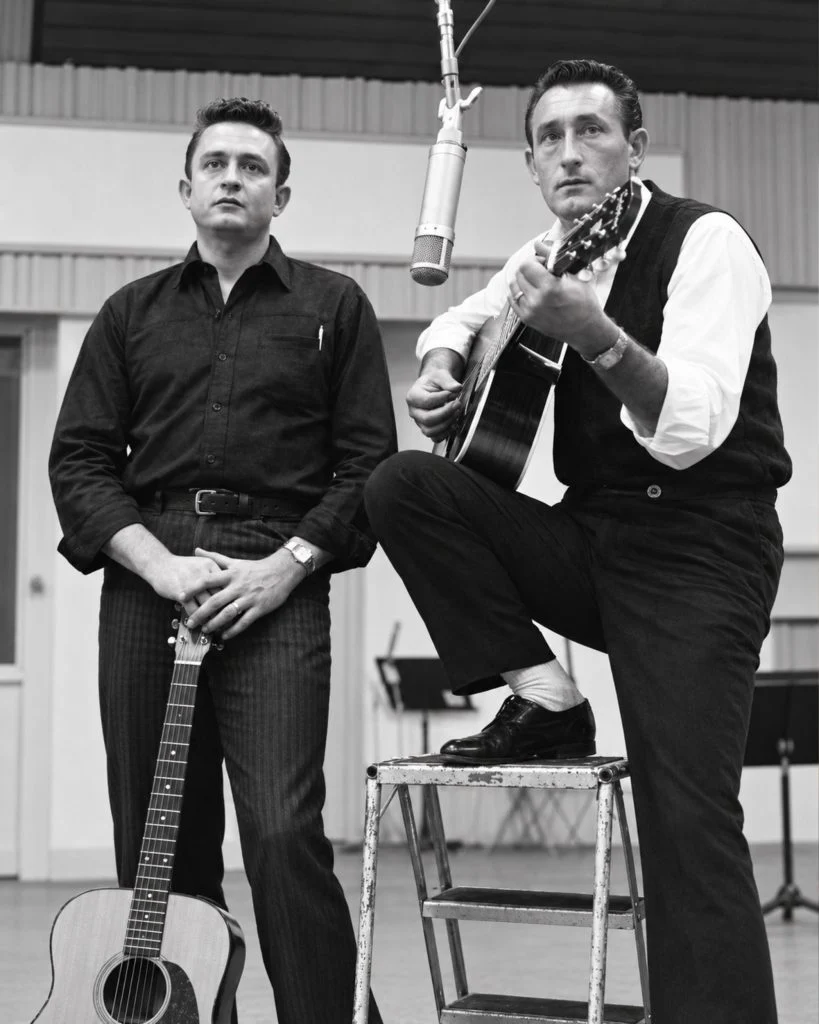
Johnny Cash walked into Folsom Prison on a cold January morning in 1968 and the world held its breath. Behind him stood a quiet guitarist whose fingers had barely moved across the strings for over a decade. Those few muted notes had already made Cash unmistakable before a single lyric was sung.
Luther Perkins did not need speed or flash to change country music. He played with so much restraint that the empty space between notes became part of the arrangement. That approach followed Cash from the first Sun records through I Walk the Line, Folsom Prison Blues, and Ring of Fire.
He helped prove how powerful restraint could be
When Cash, Perkins, and Marshall Grant began rehearsing in Memphis in the mid 1950s, none considered themselves great musicians. Grant later remembered their limitations forced them into something simpler—bass and guitar hitting the same basic movement with Cash adding rhythm. The dry repetitive pulse became the Tennessee Two signature sound.
Perkins’s muted picking sat at the center. He left space for the voice to loom larger. He gave the lyrics room to land. The Country Music Hall of Fame preserves one of his Fender Jaguars noting its use on Ring of Fire. That detail places Perkins inside the broader Cash sound even when production moved beyond the bare Sun formula.
By January 1968 Perkins was still there for the Folsom Prison album that revived Cash’s career. Three months later he played San Francisco’s Carousel Ballroom with the same band. Then later that year a fire at his Tennessee home took his life.
The timing was brutal When The Johnny Cash Show premiered on ABC in June 1969 Carl Perkins filled the guitar chair temporarily. Bob Wootton became the permanent replacement. The television audience saw Cash entering his largest period with a new guitarist beside him.
The sound continued because it had to. Wootton learned the parts. The Tennessee Three carried on. But something foundational had changed. A replacement could play the notes but only Luther Perkins had made their emptiness feel original.
Decades later guitarists like Duane Eddy still singled him out as one of the players who showed how much could be done on the low strings without filling every space. Perkins gave permission to play less and mean more. He showed that repetition with the right feel could become hypnotic rather than dull.
In a music culture that rewards visible brilliance his gift was almost invisible. Until someone tried to remove it. Then the space felt different. Luther Perkins left behind no need for virtuoso mythology. A few muted notes were enough.