
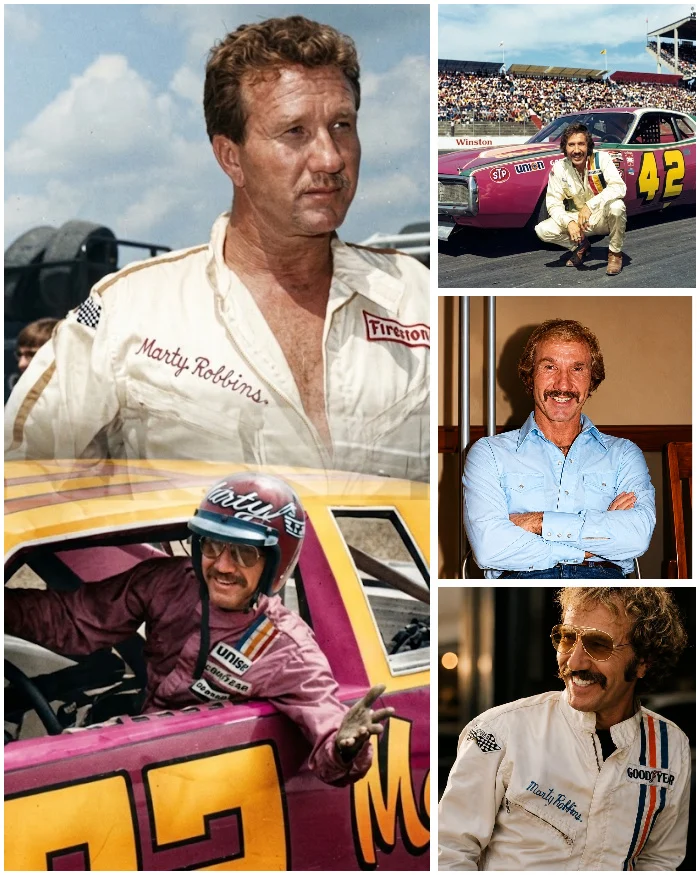
In a split second on October 6, 1974, country music legend Marty Robbins made a choice that defined his legacy forever. With the roar of engines echoing through Charlotte Motor Speedway, Robbins deliberately steered his purple-and-gold No. 42 Dodge Charger into a concrete wall at over 145 miles per hour. The alternative was unthinkable: broadsiding fellow driver Richard Childress’s stalled car.
By that autumn afternoon, Robbins was already a household name. A Grammy-winning singer with more than a dozen chart-topping country records and a regular spot on the Grand Ole Opry stage, he was a star who could have enjoyed the celebrity treatment. Instead, he paid tens of thousands of dollars out of his own music earnings for cars, engines, and crew mechanics, all just to compete on weekends. He turned down corporate sponsorships, preferring to fund his racing passion purely from his own pockets.
Robbins’ journey into NASCAR began years earlier on short tracks around Nashville. He eventually approached the legendary builder Cotton Owens, towing a wrecked Plymouth and asking Owens to transform it into a Dodge. For more than a decade, Owens prepared Robbins’ purple-and-gold machines from his Spartanburg, South Carolina shop.
Inside the garage, full-time drivers quickly realized Robbins was no dilettante. Bobby Allison noted that Robbins drove good equipment, asked serious technical questions, and listened intently to those who raced for a living. In June 1974, just four months before the Charlotte race, Robbins recorded his career-best NASCAR finish, driving an Owens-built Dodge from 22nd place to fifth at the Motor State 400.
Even when he ran near the front, Robbins remained mindful of independent drivers trying to feed their families. In May 1972, after knocking restrictors out of his carburetor to pass Richard Petty and run significantly faster, he voluntarily pulled into the pits, declined the Rookie of the Race award, and confessed the modification to NASCAR officials. He didn’t want to take prize money from full-time competitors.
That deep respect for his fellow drivers defined the fateful moment at Charlotte. Coming through Turn 4 on the second lap of the National 500, a multi-car tangle involving Neil Castles and Richard Childress left Childress’s No. 96 Chevrolet sitting sideways across the banking, its driver-side door exposed to oncoming traffic.
Robbins came out of the corner with nowhere to pass. Rather than T-bone the exposed door of the 29-year-old independent driver, he yanked his steering wheel hard to the right and drove headlong into the outside wall.
The impact crushed the front of the No. 42 Dodge and sent Robbins to Charlotte Memorial Hospital with cracked ribs, a bruised sternum, a fractured tailbone, and a deep facial laceration requiring 32 stitches. When he woke up bandaged and battered, he joked to doctors and reporters that the wreck might have made him look handsomer.
Childress walked away uninjured and publicly credited Robbins with saving his life. Reflecting on the wreck the following year, Childress recalled seeing the No. 42 car hurtling toward his door with no way to escape injury or death until Robbins turned right into the barrier. He called it an act of self-sacrifice he could still barely believe.
Although another fiery crash at Talladega in May 1975 briefly led Robbins to announce his retirement, he returned to the track and continued racing alongside his concert tours. Over 35 career NASCAR Cup starts between 1966 and 1982, he logged six Top 10 finishes.
Childress retired from driving in 1981 to focus on running his own team, Richard Childress Racing, which went on to capture six NASCAR Cup Series championships with Dale Earnhardt. Whenever the conversation turned to his early years as an independent owner-driver, Childress pointed back to the afternoon in Turn 4 when Robbins took the concrete wall for him.
In October 1982, Robbins was inducted into the Country Music Hall of Fame. Less than a month later, on November 7, 1982, he climbed into a Junior Johnson-built Buick Regal at the Atlanta Journal 500 for his final NASCAR start, just four weeks before he passed away in Nashville on December 8 at age 57 following heart surgery.
The following season, NASCAR honored its longtime garage brother by renaming the annual Cup Series event at the Nashville Fairgrounds the Marty Robbins 420. Meanwhile, Cotton Owens preserved one of Robbins’ purple-and-gold No. 42 Dodges for display at the International Motorsports Hall of Fame in Talladega.
Marty Robbins chose the wall over a fellow driver’s life, and in doing so, cemented his place as a true brother of the NASCAR garage.