
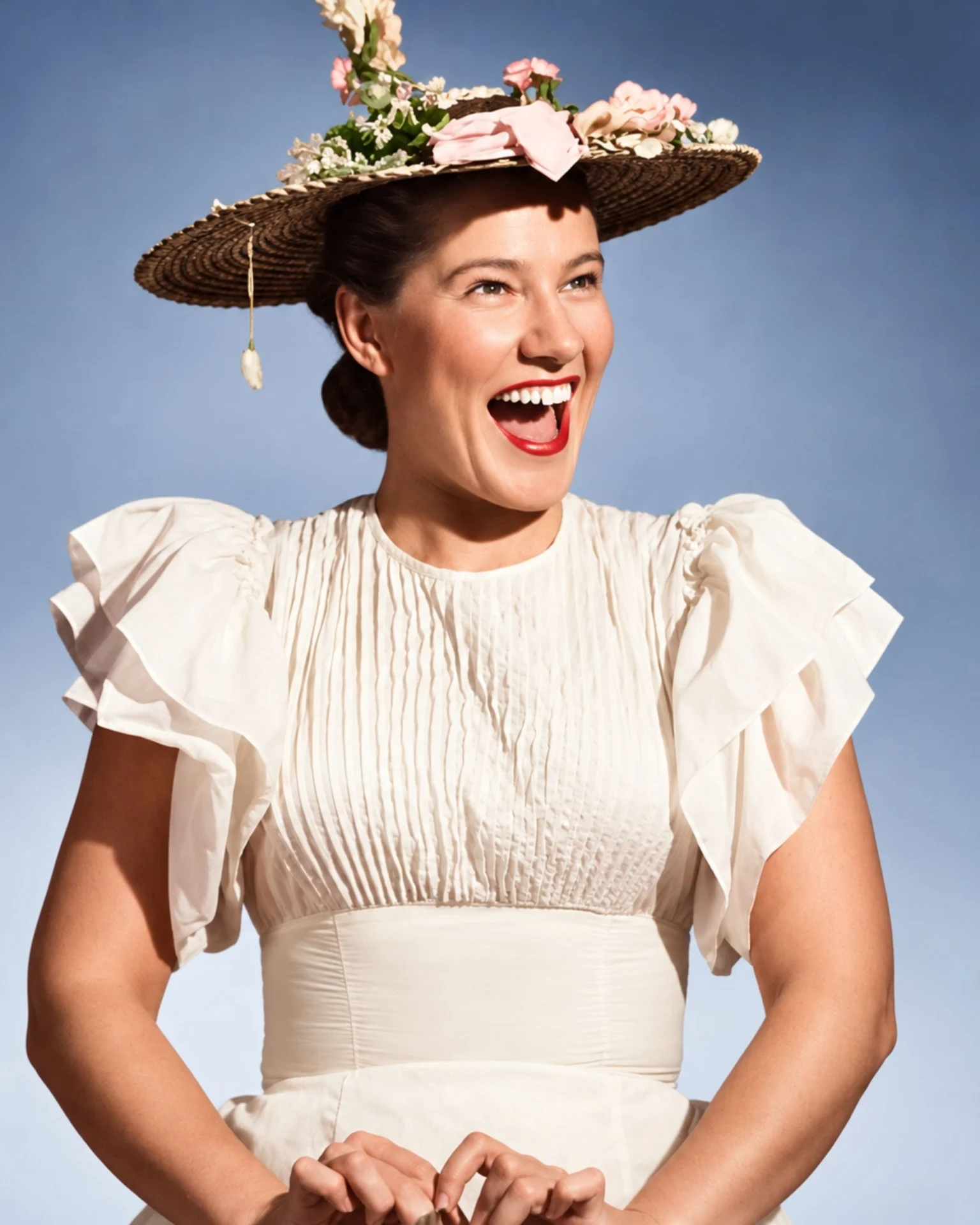
Within a week of her first Grand Ole Opry performance, more than three hundred letters arrived addressed to a woman who did not exist. They came for Minnie Pearl. But the woman behind the character, Sarah Ophelia Colley, had spent years listening to the real women who would become Minnie.
Sarah Colley studied theater and dance at Ward-Belmont College in Nashville. She graduated in 1932, expecting a serious acting career. Instead, the Great Depression led her to a job with the Wayne P. Sewell Producing Company. She traveled across the South, helping small communities stage local plays.
The job placed her among women whose lives rarely reached a professional stage. While arranging rehearsals and fitting costumes, Colley listened. She heard their family stories, courtship memories, regional expressions and unguarded humor. An elderly woman in North Alabama left a lasting impression.
“Minnie Pearl was not a direct copy of one rural woman. She was a composite of voices Colley gathered from those quiet encounters.”
From those voices, Colley constructed a character. Minnie wore secondhand dresses, thick stockings, worn shoes and a flowered straw hat. A price tag dangled from the brim, suggesting a woman who had forgotten one small detail. The tag became her most visible joke, symbolizing human frailty.
Minnie made her professional debut in April 1939 at a women’s club in Aiken, South Carolina. The following year, Colley performed at a bankers’ convention in her hometown of Centerville, Tennessee. WSM executives heard the act and invited her to the Grand Ole Opry. She debuted on November 30, 1940.
Within a week, more than 300 cards and letters arrived. The audience had recognized someone.
Colley later described the price tag as a sign of human frailty. Minnie had dressed for the occasion but overlooked the evidence still hanging from her hat. For more than fifty years, that forgotten tag remained exactly where Sarah Colley had deliberately placed it.
Sarah Colley maintained a life beyond the costume. In 1947, she married Henry Cannon. In Nashville social circles, she was Sarah Cannon, intelligent and gracious. The separation between Sarah and Minnie was never a fraud. It was the foundation of the craft.
In 1975, she became the first female solo performer inducted into the Country Music Hall of Fame. In 1992, she received the National Medal of Arts.
The deepest joke was not that Minnie looked poor. It was that she wanted what everyone wants. She wanted to be welcomed, admired and loved. She arrived delighted to see the audience, making it difficult for them to reject her.
“Colley had learned while working with amateur performers that people could be awkward without being worthless. Minnie carried that permission onto the Opry stage.”
The women in those rehearsal rooms never stood beside Minnie Pearl at the Opry. But something of their lives did. Beneath the flowers on Sarah Colley’s carefully constructed hat, a $1.98 tag kept reminding the audience that the smallest overlooked detail may be the one that makes a person feel entirely real.