
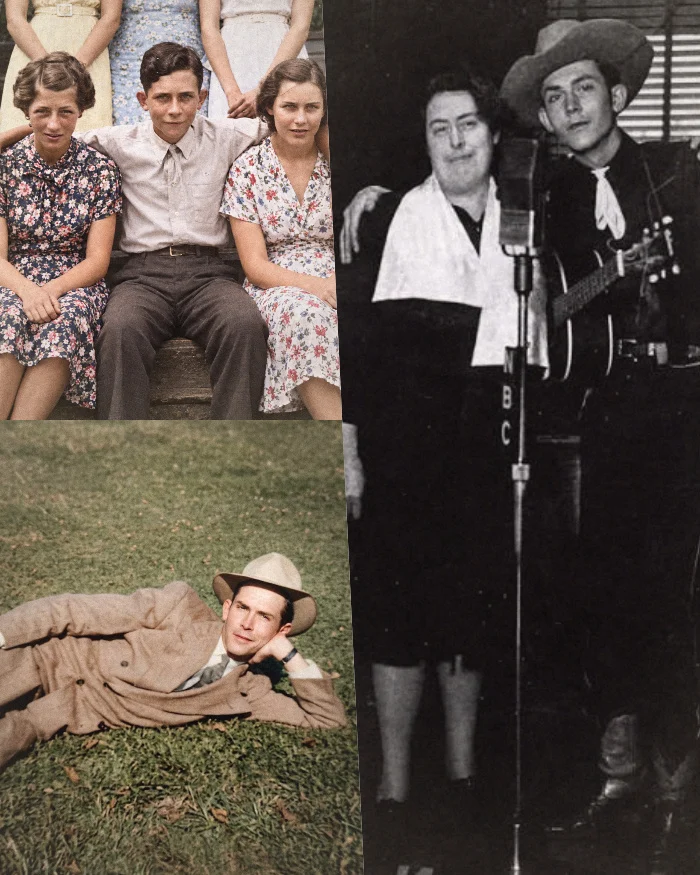
Late in the 1930s, a teenage Hank Williams walked into a southern Veterans Administration hospital and came face to face with the father he had barely known. The man waiting there was Elonzo Lon Williams, a World War I veteran whose body and mind had been battered by service, illness, and long institutional care. No warm embrace arrived. No flood of memories unlocked the room. The two stood in an awkward silence, strangers tied only by blood.
That brief meeting did not heal the absence. It deepened it. Lon had been a locomotive engineer before his health fractured. He suffered partial facial paralysis and severe neurological trauma. Hank’s mother, Lillie Skipper Williams, raised her son with rigid authority and rarely spoke of her husband except as a missing source of money. The young boy grew up across Butler and Montgomery counties with a hollow space where a father should have stood.
When Hank left that hospital, he carried the silence back to south Alabama. In Georgiana and Greenville, church and railroads became his first music. Lillie played the organ at Mount Olive West Baptist Church, and Hank sat beside her on the bench. Rural shape-note hymns and frontier revival songs taught him how a simple voice could carry grief.
A boy without a father learned to let a guitar speak where words could not.
His technical awakening came on the sidewalks of Georgiana. Rufus Tee-Tot Payne, a Black street musician who played acoustic guitar and sang blues for spare change outside dry-goods stores and train depots, agreed to teach Hank. In exchange for meals or small chores, Payne showed him how to slide chords, dampen strings, and drive a rhythm. The lessons carried more than technique. They opened a path into the twelve-bar blues and the raw emotional delivery of the Black working-class South.
By 1937, Hank had moved to Montgomery and formed the Drifting Cowboys. Still a teenager in an oversized fedora, he won a regular fifteen-minute slot on radio station WSFA. Listeners noticed a high, cracking tenor that sounded older than its years. He played rural roadhouses, sawdust dance halls, and high school auditoriums across central Alabama.
Those rooms demanded songs that struck fast. Before timber workers, cotton farmers, and shipyard laborers heading toward Mobile, Hank built material from plain speech, abandoned love, and cold highways. The institutionalized father, the strict mother, and the pressure of the Depression pressed his melodies into stark direct weight.
When Nashville publisher Fred Rose later discovered him, the core of Hank Williams was already forged. The hospital silence had become the loneliness at the heart of his writing. His unresolved sorrow found release on bandstands and back-road venues, shaping the haunting voice that would become part of American country music.