
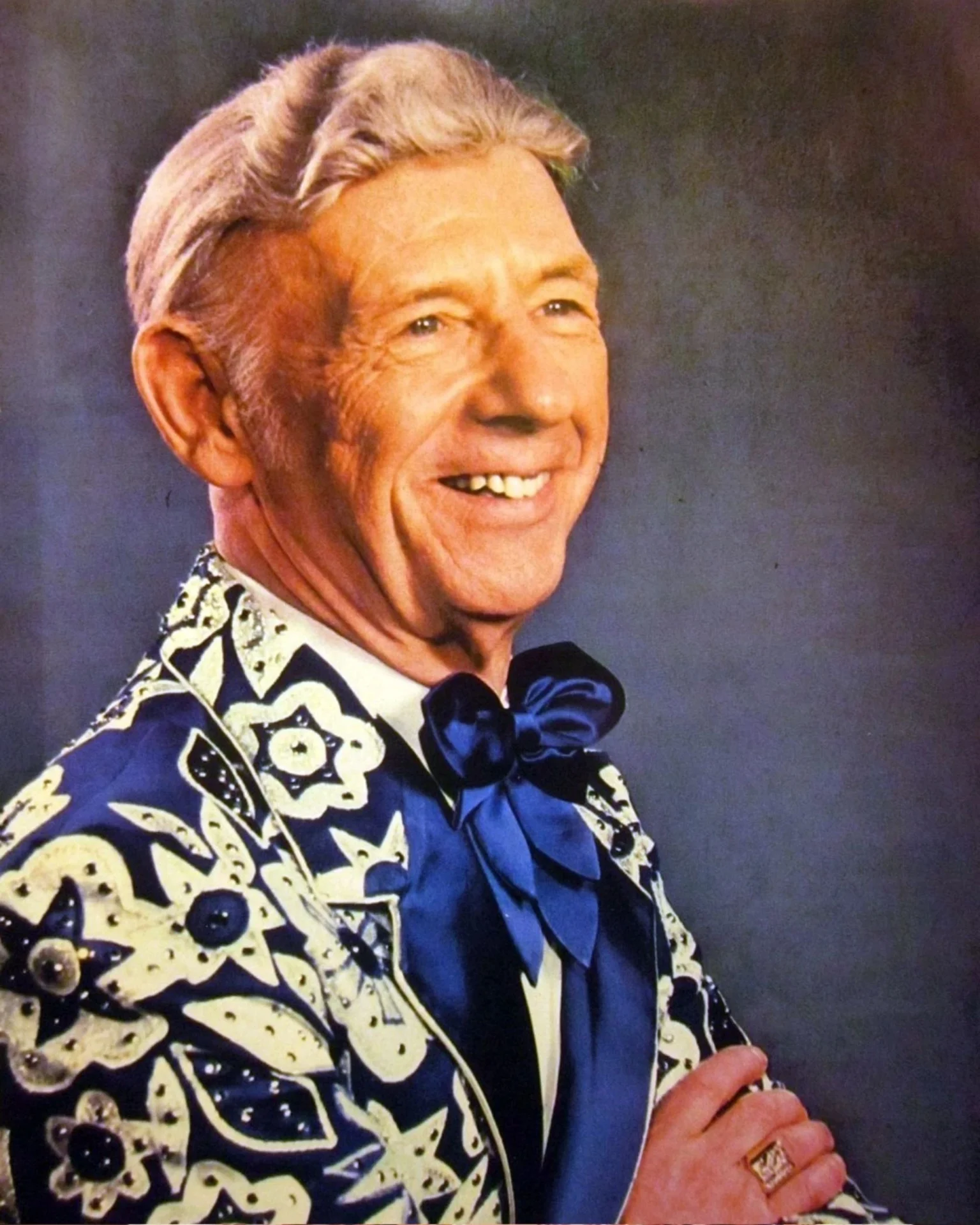
For seven minutes in 1980, Hank Snow stood before the Grand Ole Opry audience not as a country legend but as a man begging for help. The cause was not music — it was the Hank Snow International Foundation for the Prevention of Child Abuse and Neglect, running dangerously short on funds.
Snow had founded the organization two years earlier, driven by a childhood that left permanent marks on his back and a determination to prevent other children from suffering in silence. The foundation aimed to support a refuge for endangered children and fund abuse-prevention training. But by 1980, its money was almost gone.
Snow used his Opry airtime to make an emotional appeal. He admitted he could not secure a major star for a benefit performance. Fellow Opry members later said they had not known he needed help. The awkward exchange exposed a painful truth: even a famous man struggled to keep neglected children in the public eye.
This was not his first time speaking out. Snow had described his own abuse in interviews and his autobiography. He did not soften the account. His parents separated when he was eight. After returning to his mother’s household, he lived with a stepfather whose beatings he later recalled without euphemism.
He treated me like a dog, Snow said. The scars on my back never faded.
At twelve, Snow found an escape route that did not rely on adult rescue. He signed onto a fishing vessel as a cabin boy. The Atlantic offered distance from the violence, but it demanded a man’s labor from a child. Snow hauled gear, cleaned fish, and endured the North Atlantic weather. Onboard, he sang and played harmonica for the crew, planting seeds for a future that would carry him far beyond the Nova Scotia coast.
After returning ashore, he taught himself guitar by listening to Jimmie Rodgers records. He worked his way into Canadian radio, adopting the name Hank the Yodeling Ranger before shortening it to the Singing Ranger. By 1950, he had joined the Grand Ole Opry and released I’m Movin’ On, a song that spent twenty-one weeks at number one and became the anthem of a career built on movement.
But Snow never treated movement as proof that the past had disappeared. When Nashville child-abuse cases drew public attention around 1980, he renewed his fundraising campaign. The foundation was struggling, and Snow said he had been unable to secure a major star for a benefit. Other Opry members responded that they had not known he needed them. The awkward exchange became its own evidence: even a famous man could have difficulty keeping neglected children in public view.
Snow continued the work for years. Near the end of his life, he called the foundation — not the chart records, the long RCA career, or the halls of fame — his finest achievement. As a boy, he had climbed aboard a schooner because no organized rescue was waiting. As an old man, he kept asking Nashville to help build one.
His legacy is not a train song or a highway anthem. It is a call to action for those who cannot leave.