
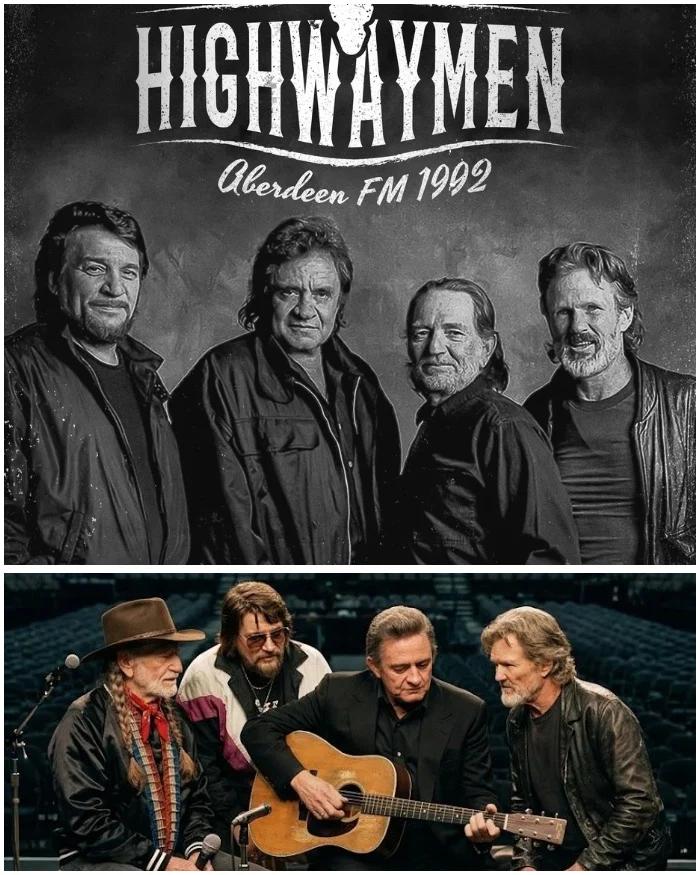
In 1985 four weary outlaws stood before a camera and let their faces bleed into one another. That was not a trick. It was a confession. Johnny Cash, Willie Nelson, Waylon Jennings, and Kris Kristofferson had spent decades walking separate roads. Then they stepped into The Highwaymen and made their egos smaller than the song.
Nashville was chasing glossy pop country in that moment. The rougher outlaw sound was being pushed to the edge. Against that trend the four men chose unity over rivalry. Their debut single and its video arrived like a weathered sermon. They sang about reincarnation and survival while the screen showed lifetimes passing through their eyes.
They were no longer solitary outlaws outrunning the Nashville machine. They were brothers holding the line together.
The brotherhood did not begin in a boardroom. It began in late 1984 in Montreux, Switzerland. Cash was filming a television Christmas special. The others were nearby. Between takes they sat around a hotel room, traded stories, passed acoustic guitars, and sang. In that quiet space they heard something none of them had alone. Four voices became a collective weight.
Producer Chips Moman later guided them into the studio. The test was obvious. Four monumental stars could have turned the session into a contest of vanity. Instead they checked pride at the door. Jimmy Webb had written a complex narrative about a soul moving through different lives. The parts were not assigned by chart rank or ego. They were matched to persona.
Willie Nelson became the highwayman. Kris Kristofferson became the sailor. Waylon Jennings became the dam builder. Johnny Cash became the starship captain. Each man carried the physical toll of his own rebellion. Deep lines told the story of tours, fights, losses, and survival. The camera did not need flashy sets. It needed their faces.
Each man carried the physical toll of his own respective rebellions.
The video used a pioneering superimposition technique for country music. Nelson’s quiet stoicism faded into Kristofferson’s rugged gaze, then into Jennings’s steady defiance, and finally into Cash’s deep presence. The visual did more than follow the song. It stood against the polished pop-country mood of the decade. It pulled viewers back to lived-in storytelling.
The result was a rare portrait of older artists finding absolute harmony in later chapters of their lives. The single climbed the Billboard country chart, but the real prize was not the number. They did not need to prove anything to the world. They only needed to sing for each other. The collaboration became a lasting tribute to mortality, endurance, and shared legacy.
The outlaw movement was built on courage to stand alone. Its greatest masterpiece arrived when four legends chose to stand together.