
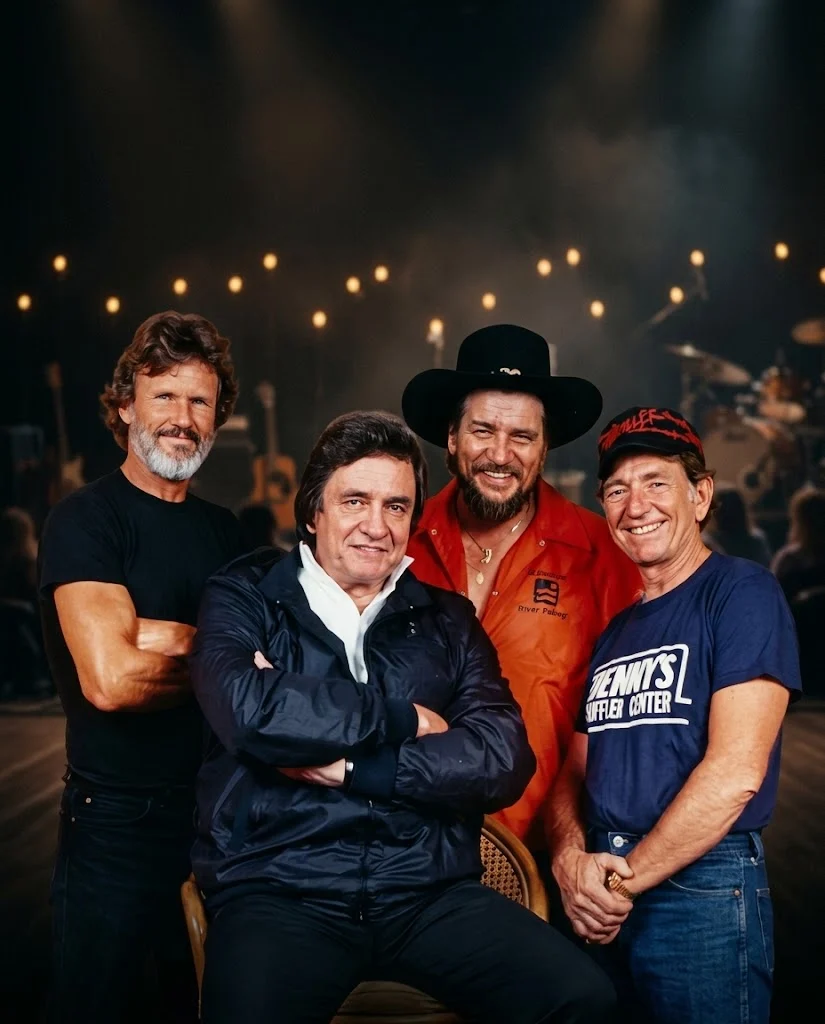
When Johnny Cash, Willie Nelson, Waylon Jennings, and Kris Kristofferson stood around a single microphone, the moment felt less like a concert and more like four wounded warriors laying down their armor. They had survived Nashville battles, broken marriages, addiction, and personal storms. Their union became the Highwaymen, and their shared voice turned survival into song.
In 1985, country music witnessed a supergroup that felt almost impossible. Cash, Nelson, Jennings, and Kristofferson formed a band that no one had imagined before and few have matched since. Across a ten-year span and three studio albums, they carried Jimmy Webb’s “Highwayman” to the top of the Billboard charts and won a Grammy in 1986.
Their bond began far from Nashville. In 1984, the four men gathered in Montreux, Switzerland, while filming a Johnny Cash Christmas television special. In quiet hotel hours, they traded stories and songs. Cash brought a reincarnation-themed ballad that Webb had written years earlier. Glen Campbell had already recorded it, yet the song had waited for a stronger moment. Campbell believed in its architecture and urged Cash to cut it. When Cash played it for the others, the match became obvious.
Webb built “Highwayman” with four distinct verses, each following a soul reborn into a new life. Four voices were exactly what the song needed. The decision to sing it together came almost instantly, not as a marketing stunt but as an emotional recognition. These were men who had lived as travelers, sailors, builders, and captains in their own ways.
Back in Nashville, producer Chips Moman guided sessions that surprised everyone who expected ego clashes. The atmosphere stayed warm because respect sat at the center of the room. Young Marty Stuart, then playing guitar in Cash’s backing band, added the driving acoustic riff that opens the track. That simple and relentless progression gave the song its rolling highway momentum.
The live performances revealed the true power of the Highwaymen. Four of the largest egos in American music stepped back so every voice could shine. They chose one center microphone instead of separate spotlights. They refused bitter billing fights and stage-time demands. Cash’s steady gravity, Nelson’s effortless phrasing, Jennings’ gritty defiance, and Kristofferson’s ragged poetry merged into a single soul.
Waylon Jennings later compared their union to the Mount Rushmore of country music, a fitting image for four legends who made their scars sound like strength.
Each assigned verse mirrored the man singing it. Nelson opened as the highwayman, a road-worn traveler always chasing the next town. Kristofferson became the sailor, matching his literary and adventurous spirit. Jennings took the dam builder who meets a tragic end, carrying the line with stubborn outlaw grit. Cash closed as the starship captain, and his booming baritone made the final verse feel like a man who had faced darkness and returned with authority.
The Highwaymen proved that the fiercest outlaws were strongest when they stood together. The song gave them a name and a No. 1 hit, but it also gave four weary legends a shared place to stand. Their legacy remains a testament to humility, endurance, and the power of voices that were meant to echo alongside one another.