
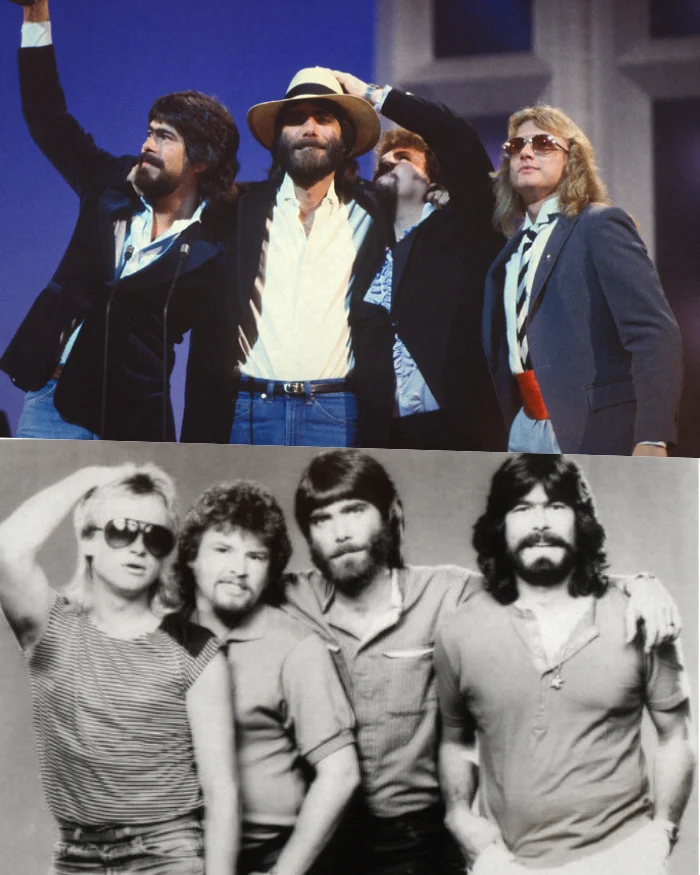
Backstage at the Grand Ole Opry House on October 11, 1982, Randy Owen, Teddy Gentry, and Jeff Cook held a silver trophy that answered years of lean winters, busted van rides, and tip jars rattling with loose change.
Alabama had just become the first self-contained group to win Entertainer of the Year at the 16th Annual Country Music Association Awards, and the win rewrote Nashville’s rulebook in one emotional night.
In sixteen years, no self-contained group had ever won the genre’s highest honor.
Music Row executives had still believed that country music belonged only to solo vocalists.
Alabama changed that belief in a single evening. The cousins from Fort Payne, joined by drummer Mark Herndon, had already taken Vocal Group and Instrumental Group of the Year earlier in the broadcast.
When their name was called for the top prize, beating out established solo stars like Barbara Mandrell and Willie Nelson, the moment signaled a fundamental shift in how country music was produced, performed, and sold.
The road to that stage began thirteen years earlier in Fort Payne. Formed in 1969 under the original name Wildcountry, the three cousins spent days hanging drywall, picking cotton, and working local textile mills while practicing three-part harmonies rooted in Appalachian gospel and church hymnals.
In 1973, they made a risky decision to leave their day jobs and move toward the Atlantic coast. They landed a steady residency at The Bowery, a rowdy beer parlor in Myrtle Beach, South Carolina.
The club charged no admission, so the band survived entirely on whatever dollar bills and loose change patrons dropped into tip jars.
For seven consecutive summers, they played six nights a week from five in the afternoon until well past midnight.
The band kept packing its battered van and playing six nights a week until the industry could no longer look away.
The roar of crowded barrooms forced them to push their sound, blending electric Southern rock guitars with traditional country fiddle and driving rhythms that could cut through heavy noise.
Whenever they took time off to visit Nashville, record labels rejected them immediately.
Executives argued that country listeners only bought records by lone singers backed by anonymous studio players, insisting that a self-contained group with long hair and loud amplifiers had no commercial future on country radio.
Rather than abandoning their setup, the musicians borrowed money to press their own records and officially changed their name to Alabama in 1977.
Two years later, they added drummer Mark Herndon to complete their rhythm section, solidifying the four-piece lineup that would tour the nation.
Their persistence paid off when producer Harold Shedd caught their live energy and took their self-financed single to RCA Records executive Jerry Bradley.
RCA signed the band in spring 1980, and the commercial response was immediate.
Their label debut ‘Tennessee River’ reached number one that August, starting a historic streak of chart-topping radio singles.
By the time of their 1982 CMA victory, Alabama had transformed the live country music circuit.
Multi-platinum albums ‘Feels So Right’ and ‘Mountain Music’ were filling cavernous sports arenas that had previously been reserved for major rock acts.
Their triumph broke the traditional Nashville studio system wide open.
By proving that a self-contained band could write, play, and headline on its own terms, Alabama paved the way for future groups like Shenandoah, Restless Heart, and Diamond Rio.
Holding the silver trophy backstage, the cousins remembered the rusted van that had broken down on rural highways and the long winters spent wondering if the tips would cover their rent.
The award confirmed what the cousins from Fort Payne had believed through a decade of empty pockets.
The same calendar date carried deeper roots in country history.
Dottie West was born on October 11, 1932, in Tennessee, and she overcame a childhood of severe poverty to win country music’s first female Grammy Award.
Gene Watson was born on October 11, 1943, in Texas, and he spent his early years picking cotton before his honest working-class tenor found its way to the radio.
These milestones echo the bittersweet perspective running through John Conlee’s classic ‘Rose Colored Glasses’.
Country music was never built in boardrooms. It belonged to working people who pushed through heat, sawdust, and empty pockets, holding onto songs that chose perseverance over despair.
When Alabama lifted that trophy, the moment answered every lean winter and broken-down van ride they had endured.
Along with the paths walked by West and Watson, it proved that musicians shaped by stubborn loyalty and hard labor could reshape the sound of America on their own terms.