
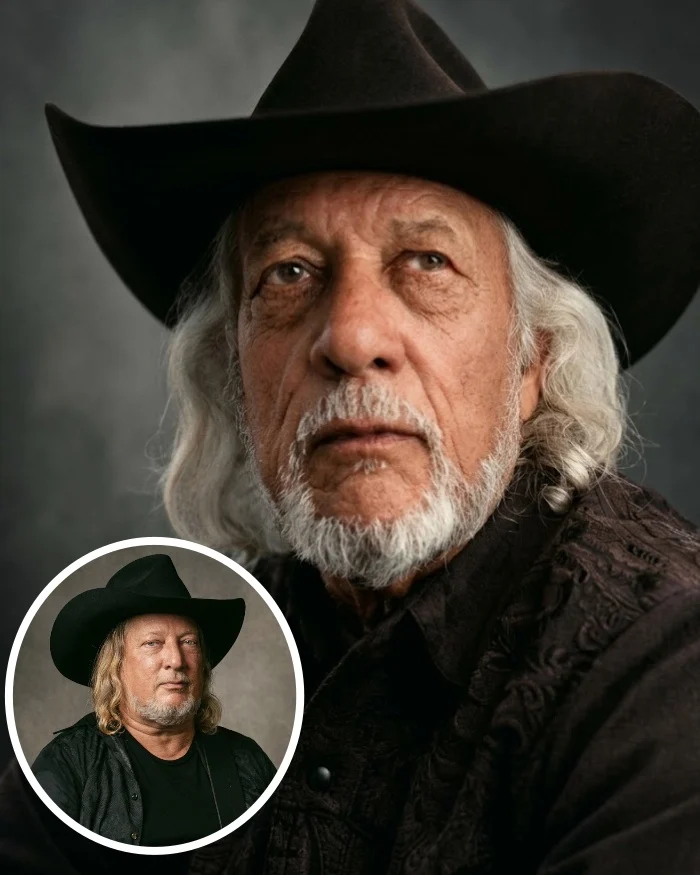
He stood before the microphone in Nashville and admitted the truth out loud. He had barely sung in more than a year and he did not know if his voice was still there. His two friends looked back at him with calm certainty and told him they believed he could do it. In that trembling instant, John Anderson stepped forward to reclaim the sound that had carried him through four decades of country music.
The road back had begun sixty miles west of the city, on a quiet farm in Smithville, Tennessee. Anderson had not sung into a studio microphone in four years when he made that drive to Dan Auerbach’s Easy Eye Sound studio in 2019. Between 2017 and 2018 a severe medical crisis lasting eighteen months had drained his strength, made swallowing difficult, and damaged both his inner ear and his vocal cords. The unmistakable baritone behind Wild and Blue, Swingin’, and Seminole Wind could no longer clearly hear musical pitch or trust his own throat.
After canceling his touring calendar, Anderson retreated to the DeKalb County land near Center Hill Lake where he had lived with his family for more than thirty years. He rebuilt his stamina with slow daily walks through the timber and along the water, quietly wondering if his singing days were finished. While he healed, his friend David Fergie Ferguson reached out with a gentle invitation. Ferguson was a longtime Nashville engineer known for his work on Johnny Cash’s American Recordings series.
Ferguson had recently joined forces with The Black Keys frontman Dan Auerbach at Easy Eye Sound, where the pair were matching veteran Nashville session players with country and roots songwriters. Knowing Anderson was still recovering and protective of his voice, they never pitched an album contract. They simply asked if he would come into town for a single afternoon just to write a song together.
That first afternoon changed everything. Anderson and Auerbach sat down with hit songwriter Paul Overstreet and wrote I’m Still Hangin’ On, an honest reflection on surviving hard seasons. What began as a one day trial soon grew into a series of relaxed writing sessions that produced between fifteen and twenty new songs.
A week after that opening session, Anderson, Auerbach, and Ferguson joined songwriter Pat McLaughlin to write Years, a meditation on time passing that became the anchor of the project. Across the remaining writing days, Anderson and Auerbach welcomed longtime friends from every corner of his career, including Joe Allen, who had co-written Anderson’s early singles in the 1970s, along with Larry Cordle, keyboardist Bobby Wood, and young Alabama singer Dee White.
Anderson and Auerbach also wrote two tracks entirely on their own, including Celebrate, a song born on the morning Anderson realized his health was finally turning a corner.
I had been very, very sick for at least 18 months. ‘Celebrate’ was part of my exclamation of just getting well again and a renewed appreciation of waking up feeling good every day.
Anderson shared those words with Wide Open Country in April 2020.
Once the team narrowed the new compositions down to ten songs, Auerbach and Ferguson assembled the Easy Eye Sound house band in the tracking room. The lineup featured Memphis Boys drummer Gene Chrisman and pianist Bobby Wood alongside bassist Dave Roe, guitarist Billy Sanford, steel guitarist Russ Pahl, harmonica veteran Charlie McCoy, fiddler Stuart Duncan, and mandolinist Ronnie McCoury.
When the arrangements were ready for lead vocals, Anderson paused before the microphone and spoke honestly to his two producers about his fear. Ferguson answered with simple faith in his friend. Anderson then stepped into the vocal booth and sang live while Auerbach and Ferguson preserved every weathered breath and fragile edge in his phrasing instead of polishing them away. Harmony guests later joined the recordings, with Blake Shelton on Tuesday I’ll Be Gone, Tyler Childers on Wild and Free, and Molly Tuttle on Slow Down.
Released on April 10, 2020, as his twenty-second studio album, Years became the defining critical comeback of the sixty-five-year-old singer’s late career. Two years later, Auerbach and Ferguson released the tribute album Something Borrowed, Something New, featuring John Prine, Gillian Welch, David Rawlings, Sturgill Simpson, and Sierra Ferrell. Anderson himself was then inducted into the Country Music Hall of Fame in October 2024.
Before passing away at age seventy-one on October 21, 2026, Anderson made his final public appearance in Nashville on October 18 at the Country Music Hall of Fame Medallion Ceremony. Sitting in the rotunda, he welcomed into the Hall the same songwriter who had sat across from him on his very first day back inside Easy Eye Sound, Paul Overstreet.