
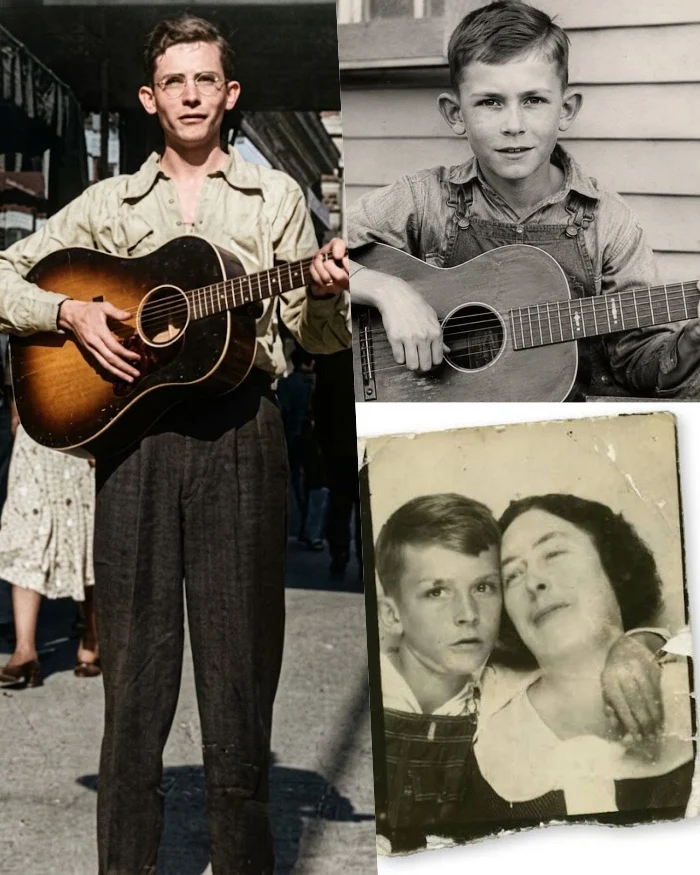
Before the world heard his voice, a frail boy in Alabama clung to a cheap guitar that became his first doorway out of pain.
In 1931, the Great Depression pressed hard on Georgiana, Alabama, and a $3.50 acoustic guitar sat in a hardware store like a distant dream for a family barely able to eat.
Lillie Skipper, a mother trying to feed her children, agreed to a layaway plan that demanded 50 cents every month. She knew the debt would require grit, but she also watched her eight year old son Hiram “Hank” Williams suffer from an undiagnosed spinal defect called spina bifida occulta.
The condition left him weak, aching, and shut out from the rough games of other boys. His mother wanted him to have something that could steady his spirit, even if it meant working her hands to the bone.
Together, mother and son walked dirt streets, selling peanuts and shining shoes to scrape together loose change. Every penny carried weight. Every coin represented hours of bending, rubbing, and walking in a town where survival came before comfort.
When the small wooden guitar finally came home, it did more than sit in a corner. It pulled a physically restricted child into the public squares and changed the path of his life.
That guitar was not a luxury. It was a lifeline.
With the instrument in hand, Hank gravitated toward the train depot, busy sidewalks, and street corners. There he met Rufus “Tee Tot” Payne, a Black street musician who played for tips and saw something serious in the boy.
Payne agreed to teach him. In exchange for meals from Lillie or whatever small change Hank could offer, the older musician showed him blues structure, chord voicings, string strikes, and the timing needed to make his voice rise above street noise.
Hank soaked up every lesson. Before he was even ten, he played on the streets beside Payne, learning how to hold an audience and command a corner. The guitar gave him a way to belong in a world that pain had tried to close off.
In 1937, Lillie moved the family north to Montgomery, Alabama, searching for better work. Hank carried the same stubborn drive with him. As a teenager, he took the guitar to the sidewalks outside the WSFA radio studios and played loudly enough for the broadcasters inside to notice.
Station executives saw the lanky teenager drawing crowds. They invited him in, and soon he earned a 15 minute radio slot twice a week, carrying his voice across the surrounding region.
He used that steady radio income to form his first backing band, the Drifting Cowboys. The boy who once shined shoes to afford his instrument was now booking shows at schoolhouses, movie theaters, and rural dance halls across southern Alabama.
The guitar also unlocked his writing. Because he could not rely on heavy manual labor like many young men of the era, he built lyrics on the chord progressions Payne had taught him. He turned childhood isolation into straightforward and devastating verse, developing the songwriting voice that later won him a contract with Fred Rose and MGM Records in 1947.
Hank Williams would go on to release a catalog of hits that permanently reshaped the American songbook. Yet the foundation of that career was not laid in a polished Nashville studio. It was built on Alabama sidewalks, carried by a mother’s 50 cent monthly sacrifice and a cheap wooden guitar he simply refused to put down.