
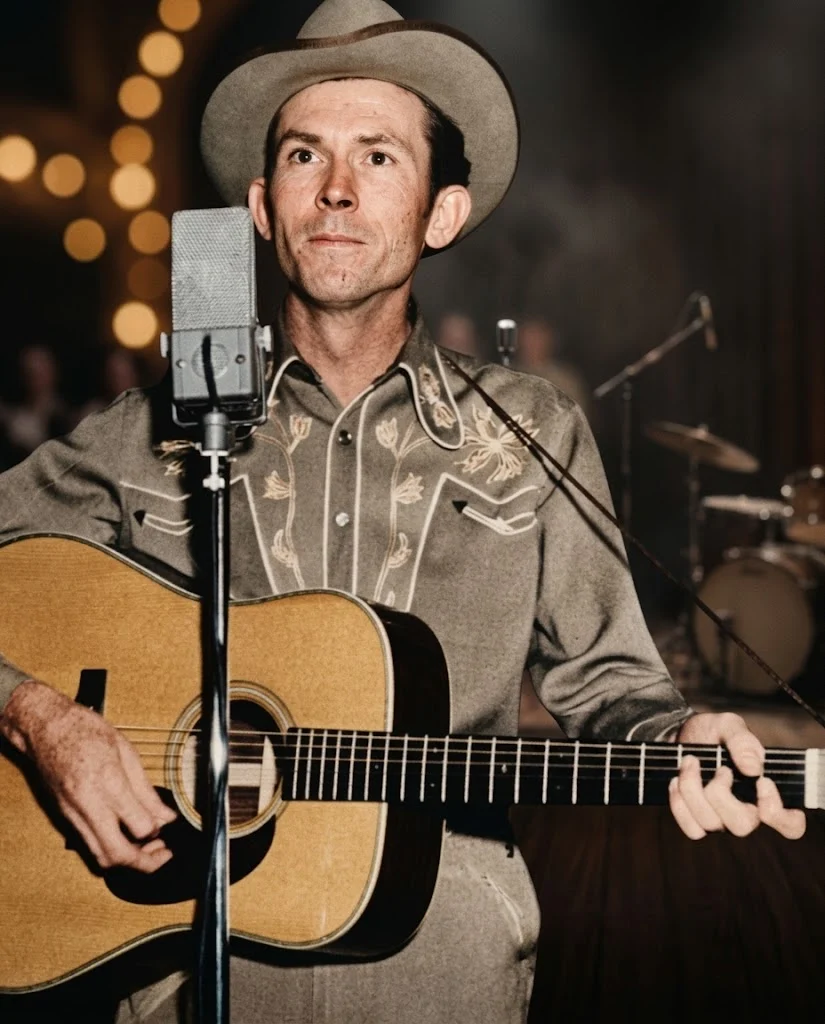
The baby-blue Cadillac rolled through the dark Ohio night with a heavy silence. In the back seat lay Hank Williams, gone at 29, on the way to a show in Canton, Ohio. The boy who once sang for pennies on Alabama sidewalks had finished his journey. But the music did not die with him. It had been born years earlier when a mother spent $3.50 on a guitar.
During the Great Depression, Lillie Williams worked as a seamstress. For her son Hiram King Williams, born in 1923, she scraped together every penny to buy that guitar. He was born with spina bifida occulta, a spinal defect that left his body in constant pain. While other children ran and played in Georgiana, Alabama, he had to find another way to escape. The worn guitar became his refuge from the limitations of his own body.
Young Hank took the instrument to the streets. He sang for change in Montgomery and Georgiana to help his family survive. There he met Rufus “Tee Tot” Payne, a Black blues street musician. In a time of deep racial division, Payne took the boy under his wing. He showed him how to play the 12-bar blues, bend notes, and let raw emotion cut through the noise of a crowded street. Williams later said Payne was his only real music teacher.
Rufus Payne was my only real music teacher.
Those street lessons became the heartbeat of a new sound. The rhythmic bounce Payne taught him shaped songs like “Move It On Over.” The sorrowful blues phrasing found its way into “Honky Tonk Blues.” By blending folk storytelling with street blues, Williams created the honky-tonk style that would make him a star. He made his Grand Ole Opry debut in 1949 and earned encore after encore.
But the pain in his spine never stopped. After a hunting accident in 1951, he underwent spinal surgery that brought little relief. The agony drove him to alcohol, morphine, and prescription painkillers. His marriages crumbled and he was often dismissed from the stages he once ruled. Yet the suffering poured into his singing. Audiences heard a real sob in his voice. They heard a man exhausted in body and mind, and they trusted him because he was not performing the pain. He was living it.
That authenticity made him the voice of a struggling generation. He turned his limitations into a sound that spoke for millions of hardworking people. His final ride ended on New Year’s Day 1953 in the back seat of a car, but the melodies he learned from a street musician on a Depression-era corner never faded. They still echo through country music today. Music historians still trace those early street lessons in his recordings today.