
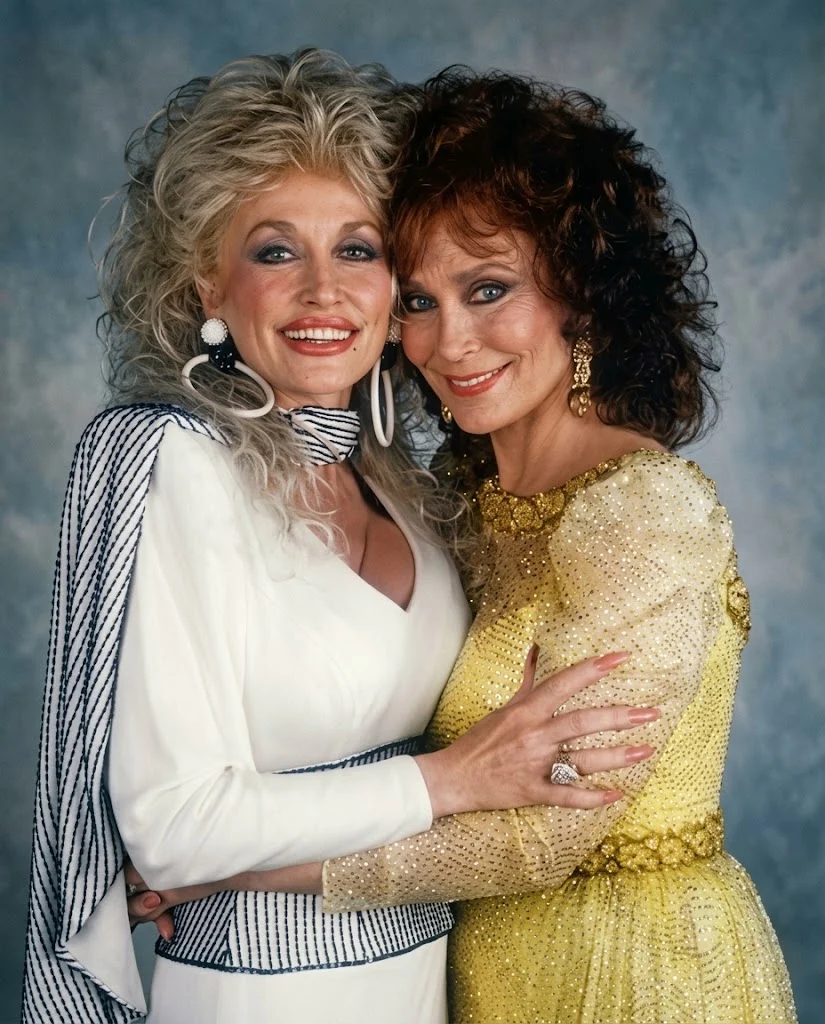
When Loretta Lynn died peacefully at her Hurricane Mills home in October 2022 at age 90, Dolly Parton did not lose a rival. She lost a sister who had walked the same hard road from Appalachian poverty to the brightest country stages.
That grief revealed something rare in show business. Two women from coal hollows and mountain cabins had reached the top of Nashville without tearing each other down.
Loretta grew up in the coal mining hollows of Butcher Holler, Kentucky. Dolly was raised with eleven siblings in a one room cabin near Tennessee’s Little Pigeon River. They arrived in town during an era that expected female stars to fight for the same narrow spotlight. Radio programmers often refused to play two women back to back, and executives seemed to feed rivalry like fuel.
Instead they chose loyalty. Their bond grew from the same dirt roads, the same hunger, and the same mountain pride. They knew what it cost to carry a family, survive on the road, and demand respect inside boardrooms controlled by men.
In 1972 Loretta made history as the first woman to win the Country Music Association’s Entertainer of the Year award. Dolly celebrated her loudly and proudly. Six years later in 1978 Dolly stood on the same stage to accept the same honor. They had not crossed a finish line. They had widened the road for every woman who came after them.
Their sisterhood deepened behind studio doors. In 1993 they entered the studio with Tammy Wynette for the landmark album Honky Tonk Angels. They shared hard earned advice about royalties, publishing rights, and the exhausting demands of touring. Their humor became armor. Their candor became a lifeline.
Through changing trends, pop crossovers, stadium tours, and personal losses, neither woman dimmed the other. They swapped home remedies, talked about their roots, and checked in quietly when health struggles or grief arrived.
They proved that two artists could reach the summit without ever letting go of each other’s hands
Long before Nashville crowned them as icons, the mountain girls had already chosen each other. That quiet loyalty remains one of country music’s most powerful chapters.