
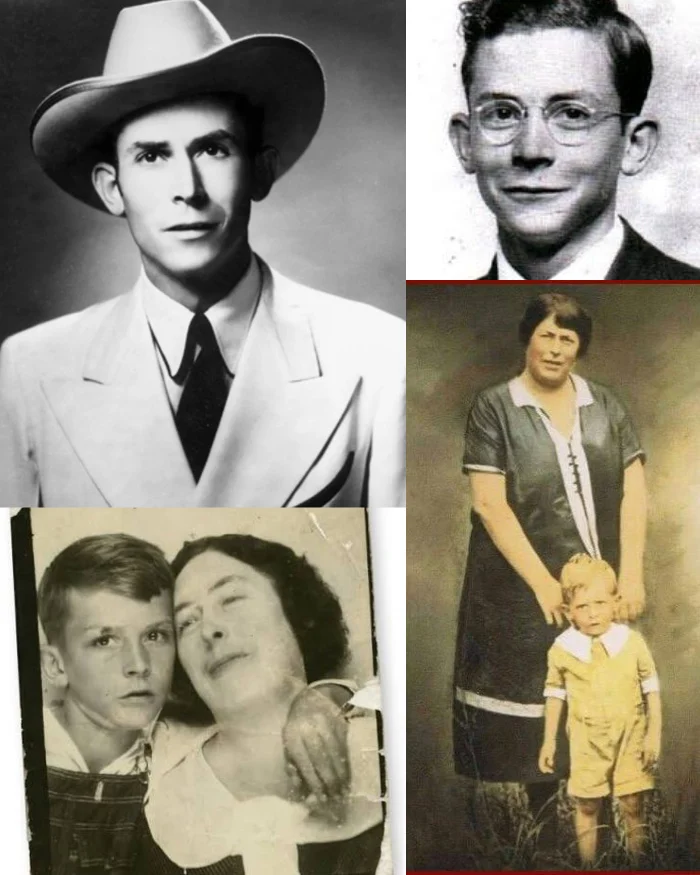
At seven years old, Hank Williams learned a grief that never belonged to a child. He believed his father was dead. He believed the grave was the place where Elonzo Huble Lon Williams had gone forever. In truth, Lon was alive, hidden hundreds of miles away inside a Veterans Affairs hospital in Alexandria, Louisiana.
That secret began in 1930, when the Great Depression crushed the timber towns of south Alabama and broke the Williams household. Lon had served in France during World War I. Years later, severe neurological damage, facial paralysis, and brain aneurysms left him unable to work or live normally. Medical officials sent him to long-term psychiatric and physical care far from his children, and the family lost its only provider.
Hank and his older sister Irene were left with their mother, Jessie Lillybelle Lillie Skipper Williams, inside a drafty rental house in Butler County. With no savings, no stable wages, and sawmills shedding payrolls, Lillie faced the threat of starvation. She filed paperwork declaring her living husband dead so federal military pension benefits could reach her children. Young Hank understood the result as simple fact. His father had passed away.
The monthly checks bought groceries and paid rent, yet each payment carried a private cost. For eight years, Lon remained alive in a distant ward while Hank grew up mourning a man who was still breathing. The boy sat on porch steps because running caused pain. He carried an undiagnosed case of spina bifida occulta, and his spine made ordinary childhood movement cruel. He watched roads and wondered why the father he loved had vanished without goodbye.
Music became his shelter. Around age eight in Georgiana, Hank met Rufus Tee-Tot Payne, an African American street musician who walked the railroad tracks with a battered guitar. Payne taught him open chords, blues phrasing, and the courage to sing across street traffic. In exchange for hot meals from Lillie or small change from errands, the boy learned to turn ache into melody.
When Lillie moved the family to Montgomery in 1937 and opened a rooming house on North McDonough Street, Hank took his secondhand guitar to sidewalks. He shined shoes, sold newspapers outside the Montgomery Advertiser, and later set his shoe box aside to sing near the WSFA radio studios. His raw sixteen-year-old voice earned a regular live broadcast slot and the wages to hire his first backing band, the Drifting Cowboys.
By the late 1930s, Lon survived the hospital stay, recovered enough for outpatient care, and lived quietly in southern Alabama, sometimes working on farms. The truth surfaced, but it could not erase a decade of formative grief. The father Hank had mourned became a stranger, and their relationship stayed distant even as Hank rose toward the stage of the Grand Ole Opry.
The country records Hank Williams later made in Nashville were never theatrical inventions. They were the sound of a child who learned loneliness before he learned fame.