
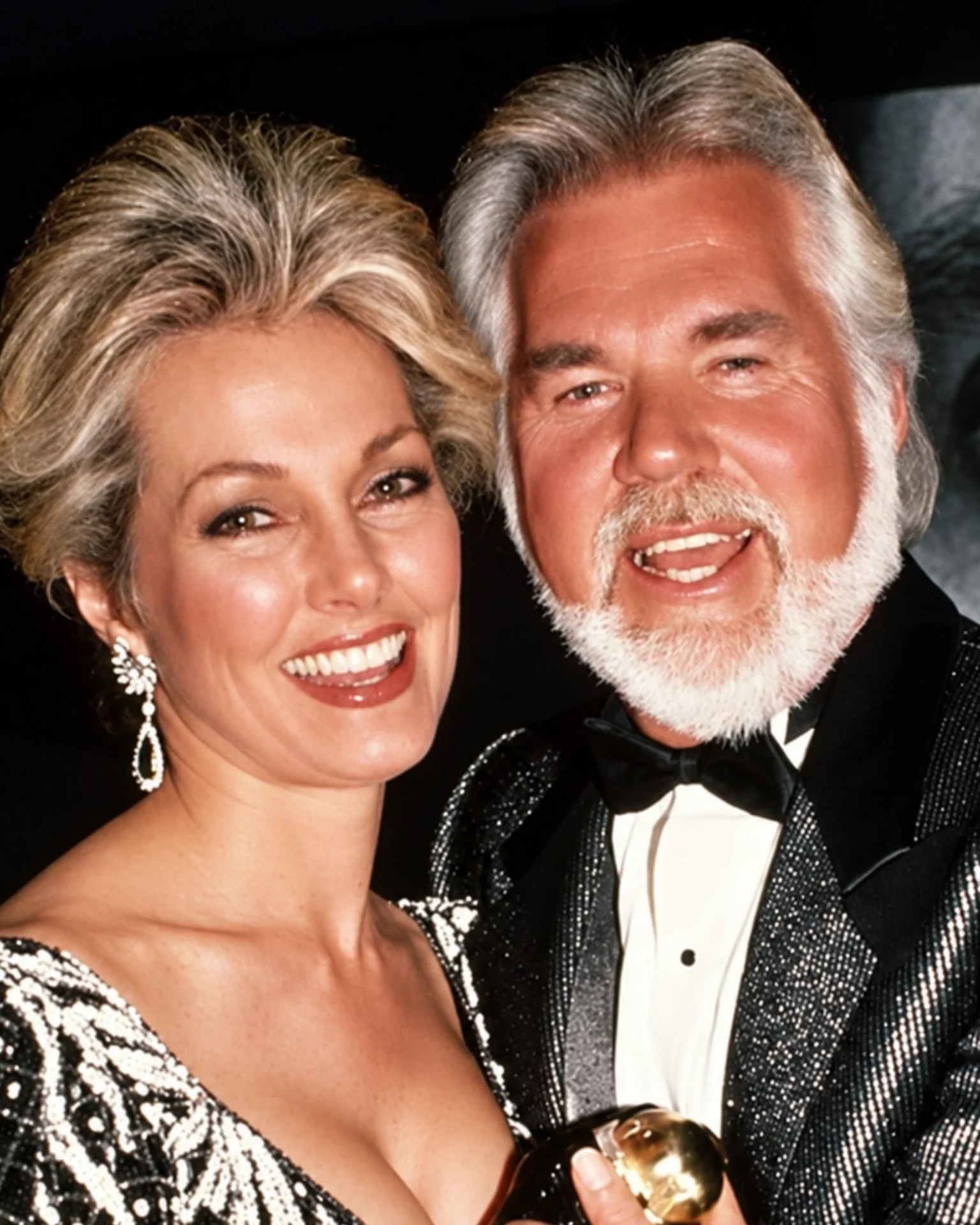
In the dim amber light of a darkroom a face does not arrive all at once. It drifts up from the blank surface like a memory returning after years. Kenny Rogers stood over the tray and watched the image appear. He could not hurry it. He could only wait for the photograph to decide how much of him would be left in it.
The camera gave him a second place where the result had to be earned
That second place began as a Christmas gift in 1984. Marianne Rogers did not hand her husband another camera. She gave him John Sexton, a photographer who had served as Ansel Adams’ technical assistant. Kenny Rogers already owned equipment and had a habit of diving into interests with obsessive focus. He wanted to know how good he could become when no one was watching and no one would applaud.
At the time Rogers was one of the most recognizable entertainers in America. The Gambler, Lady and Islands in the Stream had carried his name beyond country radio. His beard, silver hair and lined face were as familiar as his voice. Celebrity could open doors backstage but it could not open a shutter or fix a bad negative.
Sexton introduced him to the zone system and the discipline of large format film. Every frame required a decision about light, focus and exposure before the shutter moved. A sheet of film cost more than a casual snapshot and offered no safety net. The singer learned that charm could not rescue an underexposed negative. The darkroom waited in silence while the chemistry did its work.
Teacher and student stayed close for years. They traveled together, carried a 4 by 5 view camera along the shores of British Columbia and spent long hours printing. Rogers did not treat photography as a brief amusement. He treated it as another profession that demanded the same patience he once gave to a song.
A concert ran on a clock. A photograph ran on light. Rogers carried the bulky camera on tour and used the empty hours between shows to leave the arena behind. He drove into the countryside with companions and asked local residents what might be worth seeing. A town became more than a hotel and an auditorium. It became a place with roads, buildings, fields and a particular way of holding the afternoon sun.
You cannot persuade a landscape to perform
The big camera forced him to slow down. The image appeared upside down beneath a dark cloth. The instrument had to be fixed on a tripod and the focus made with care. He could not collect dozens of casual pictures. He had to remain still until the world arranged itself. Sometimes the light never cooperated and the image never appeared. That was part of the lesson too.
In 1986 Rogers published Kenny Rogers’ America. The book had none of the glamour of an album package. It held black-and-white landscapes and scenes that showed the country beyond the concert route. Yousuf Karsh wrote the foreword and George Hurrell added advice. The project could not be dismissed as a famous man playing with a toy.
A year later Your Friends and Mine shifted his attention from the land to the faces he knew well. Actors, musicians and public figures sat for him. Many of them had spent their careers in front of cameras. Rogers had spent his life in the same position. He understood the practiced expression, the preferred angle and the small fear of being inspected.
He designed three possible approaches to a portrait. He could show someone as that person saw himself, as the public saw him, or in a way neither had imagined. The choice depended on the face and the moment. He tried to make each portrait feel like a conversation rather than an examination.
He knew what the chair felt like because he had sat in it
Nearly two decades later Rogers turned the camera toward country music itself. This Is My Country appeared in 2005 and contained fifty-eight studio portraits made with a Linhof Master Technika large-format camera. The artists ranged across generations. Veterans sat with newcomers and the group portrait of an entire musical family took shape through a viewfinder.
Large-format portraiture demands cooperation. A sitter cannot be captured in passing. The camera must be positioned, the lighting shaped and the exposure held long enough for a deliberate moment. Rogers was not collecting publicity shots. He was asking his fellow artists to enter the same slow process he had learned from Sexton.
The honors arrived after decades of quiet work. Professional Photographers of America gave him an honorary master’s degree in 2014. In 2017 the International Photography Hall of Fame and Museum presented its first Lifetime Achievement Award to Rogers. The recognition did not depend on his voice. It rested on photographs made with large-format film in a darkroom he operated himself.
After Rogers died in 2020 the photographs kept traveling. The Booth Western Art Museum displayed nearly sixty of them in 2022 and invited viewers to see the America that existed between the concerts. The direction of attention had changed. For most of his life a picture of Kenny Rogers announced the singer. In the museum, the pictures were identified as his work.
Kenny Rogers spent decades in rooms where every eye already knew where to look. The stage, the spotlight and the camera all faced him. Photography reversed the arrangement. He stood behind the instrument and studied another face or another stretch of land. Under the dark cloth his own famous features did not matter. The exposure did not care who he was.
Music taught the world to recognize him and photography taught him to look outward
The two arts never fought for the same space. They grew from the same hunger for story and character. A song asked him to enter a narrator and make that life believable. A photograph asked him to wait until a face or a road revealed something true. He did both with the same curiosity and the same readiness to fail.
In the darkroom the final moment never arrived quickly. The paper moved through the chemistry and the image surfaced like a photograph remembering itself. Rogers could not control that emergence. He could only make the exposure, place the paper in the tray and wait for what he had seen to become visible. That patience was the gift Marianne gave him in 1984 and the gift he gave himself for the rest of his life.