
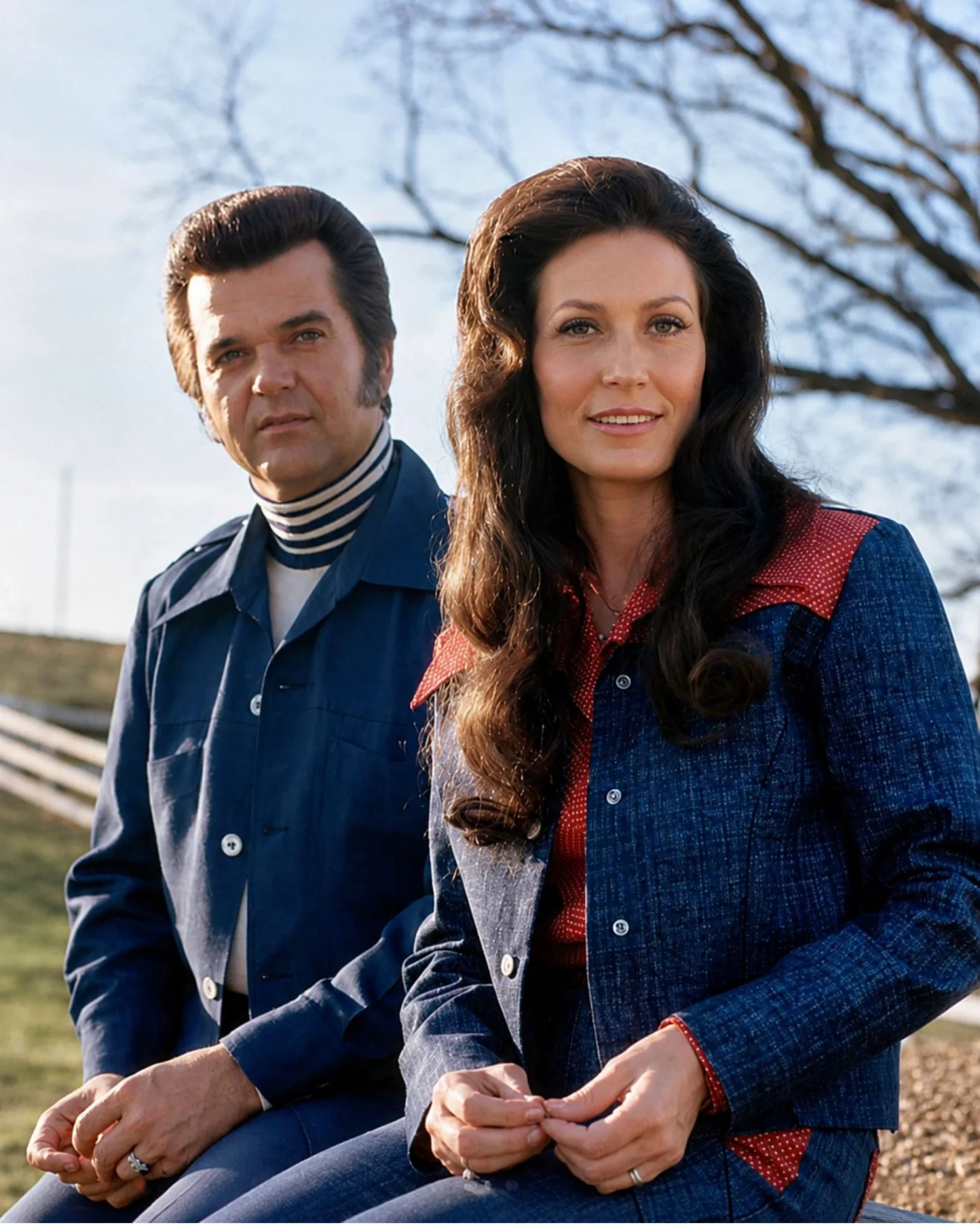
It was supposed to be just another studio session. Two solo stars already ruling country music — Conway Twitty with his velvet baritone, Loretta Lynn with her fearless honesty — met over a song about two married people finding forbidden comfort in each other. The first take of After the Fire Is Gone laid bare a chemistry so startling that fans would spend decades wondering if the love songs were real.
By 1971 neither Conway nor Loretta needed a duet partner. Loretta had already become one of country music’s strongest female voices singing women’s lives with startling directness. Conway had shifted from pop to country and stacked up No. 1 records of his own. Putting them together was not a rescue plan. It was a gamble.
“We never planned to become a duet team,” Loretta later recalled. “It just happened. The song needed two people who could argue without leaving the room.”
The song After the Fire Is Gone described a dangerous kind of closeness: two married people finding in each other what had faded at home. Loretta’s sharp plainspoken delivery pushed against Conway’s smoother heavier phrasing. She sounded like a woman telling the truth out loud. He sounded like a man failing to hold the feeling in. Together they did not sound like two stars politely trading lines. They sounded like the argument inside the song.
The record went to No. 1 in 1971 and later earned them a Grammy. So they kept going. Lead Me On followed. Then Louisiana Woman Mississippi Man, As Soon as I Hang Up the Phone, Feelin’s and more. The partnership became so successful that Conway and Loretta won the CMA Vocal Duo of the Year award four times straight from 1972 through 1975.
But the records created another problem. People believed them. Onstage Conway and Loretta could lean into a lyric trade looks and deliver a cheating song with enough tension that audiences began assuming something must be happening away from the microphones too. Loretta repeatedly dismissed the idea. Her marriage to Oliver Doolittle Lynn was famously complicated but Conway was a close friend not a secret lover. Their families knew each other. Doolittle himself was part of the world around their touring and recording partnership.
Still the rumors did not disappear. In a strange way the misunderstanding became proof of what made the duo work. Country audiences were hearing two experienced solo singers who knew how to make every line sound personal. Even when the story belonged only to the song.
“They didn’t need a real affair to make country fans feel the heat,” a music historian once said. “They had timing trust contrast and the ability to make fiction sound like it had just happened.”
Conway and Loretta recorded together for more than a decade while both continued successful solo careers. They were not two fading acts leaning on each other for relevance. They were two major artists choosing to meet in the middle then building a body of work strong enough to stand beside everything they did alone.
When Conway died suddenly in 1993 Loretta lost more than an old duet partner. She lost the one singer whose voice had spent years sitting directly across from hers. That is a specific kind of loss. A duet partner is not just another collaborator. It is someone who knows how to answer your phrasing where to leave space when to push when to soften and how to make the listener believe the room contains only two people.
For Loretta Conway had been that voice. Decades later when After the Fire Is Gone plays the mystery is still part of the magic. Not because listeners need the rumors to be true but because Conway and Loretta sang it so well that the line between stage and life still feels dangerously thin.