
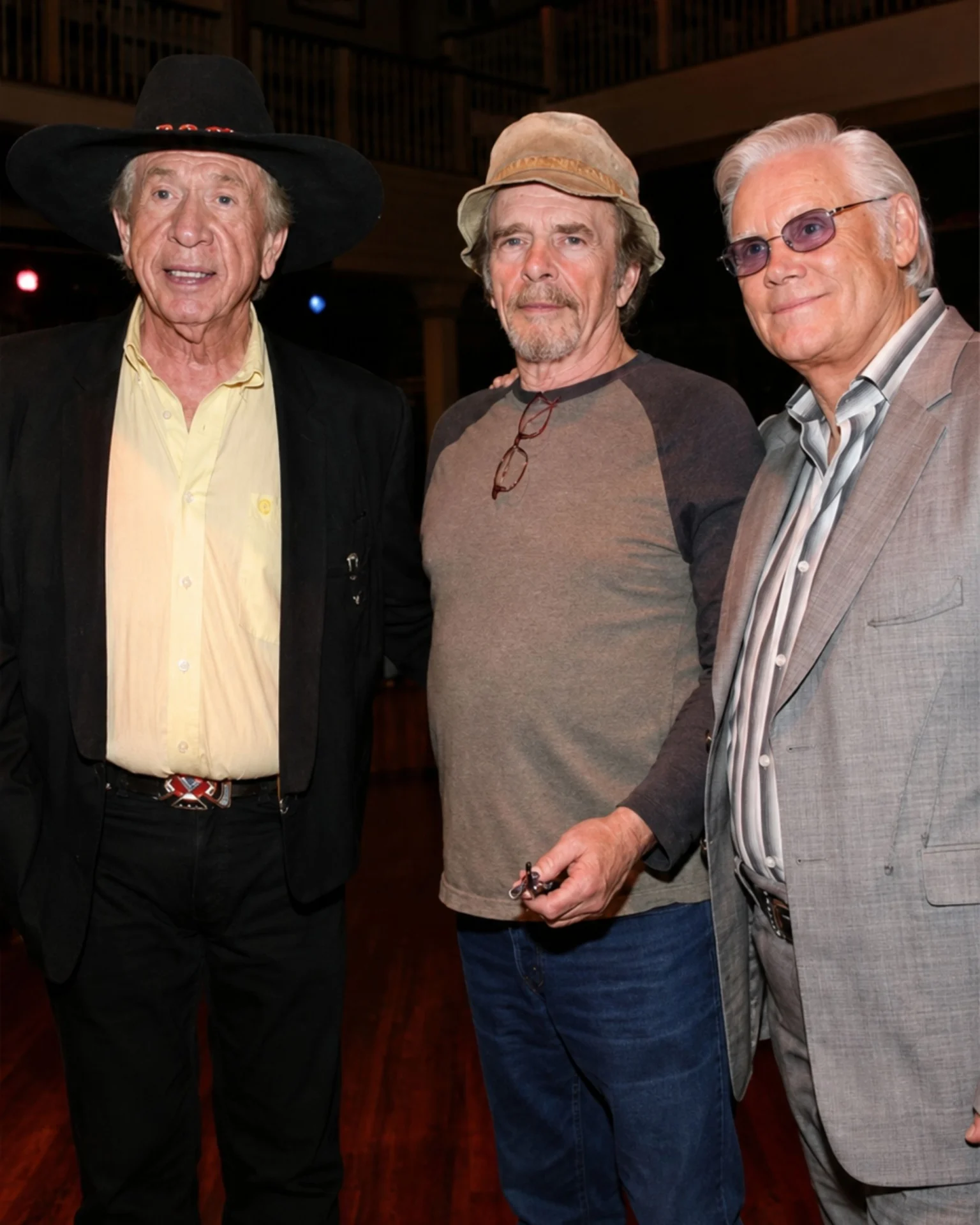
In 1995, after decades of mutual silence, Buck Owens and Merle Haggard finally shared a Bakersfield stage once more. Dwight Yoakam joined them. The night ended with Streets of Bakersfield. For anyone who followed the story, it was a moment that settled an old question. Bakersfield was big enough for two giants. It had been for years, but the public needed this visible proof.
When Merle Haggard walked out of San Quentin, he returned to a city already claimed by a country king. Buck Owens had transformed the Central Valley into a national force. The Buckaroos were polished, the records were bright, and the sound carried the weight of California. Merle came back with little but a voice and a past. There was no welcome party, no record deal waiting. There was only a choice between surrender and work.
Merle later described his life in those early years as a series of awkward compromises. He dug ditches during the day. At night, he played four nights a week at High Pockets for about $10 per show. He considered himself a second-rate musician, grateful that better players tolerated him only long enough to teach him a few licks. Buck Owens’ influence was unavoidable. So was the sound of Wynn Stewart and Lefty Frizzell. But Merle absorbed it all without yet knowing what he would become.
That period of imitation eventually gave way to invention. Merle began writing songs that reached deeper into his own history. Sing a Sad Song gave him his first national audience. Next came (My Friends Are Gonna Be) Strangers. Then Swinging Doors, The Bottle Let Me Down, and Branded Man. He admitted later that even with Swinging Doors in 1966, the influence of Buck Owens and Wynn Stewart was still plain. But each record moved further away from the bright clatter of Bakersfield’s original blueprint. Merle was carving a new path.
Bakersfield no longer had one giant star. It had two.
By the late 1960s, the city had given the world two distinct country voices. Buck Owens continued to deliver hits built on drive and precision. Merle’s songs leaned into shame, prison memory, loneliness, and the ragged edges of working-class life. Both were Bakersfield. Neither could have replaced the other.
Because they had both risen from the same soil, the public invented a rivalry. Things grew more tangled when Merle married Bonnie Owens, Buck’s former wife. The two men spent decades without sharing a stage. Rumors that Buck resented Merle or that Merle had been pushed out of town circulated for years. Buck flatly dismissed the notion. He made it known that the split between himself and Bonnie had nothing to do with Merle. There was no real feud between them, only a difference in temperament.
Buck Owens was disciplined and commercially precise. Merle Haggard was looser, more unpredictable, and willing to follow a song wherever it led.
That contrast defined them. Buck made Bakersfield sound like a well-oiled machine. Merle made it sound like a man recovering from jail, bad decisions, and the kind of honesty that did not fit on a pop chart. Together, they proved something essential. The city could hold both the mechanized and the wounded.
Buck Owens built one road out of Bakersfield. Merle Haggard spent years learning how not to follow it. In the end, he widened the road for everyone coming after. The 1995 handshake on stage was more than a ceremony. It was the final chapter of a story that was never a war. It was an expansion.
Buck Owens built one road out of Bakersfield. Merle Haggard spent years learning how not to follow it.