
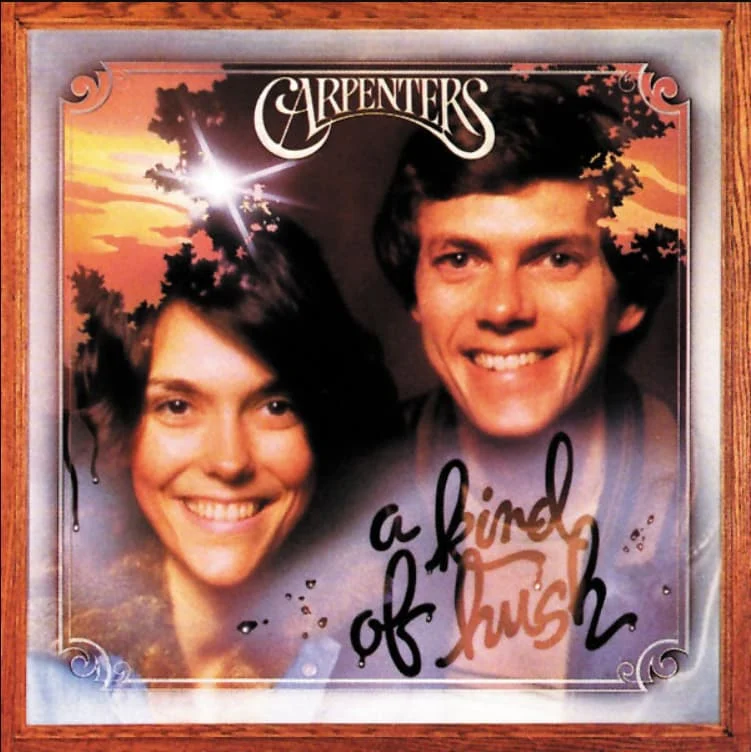
In the soft amber glow of a mid-70s Los Angeles evening, a voice could transform the ordinary into something sacred. Few understood this better than The Carpenters. When the duo released their interpretation of “There’s a Kind of Hush (All Over the World)” in 1976, they didn’t simply cover a song—they re-invented a feeling. Almost five decades later, that feeling remains intact, preserved in the vinyl grooves and digital playlists that carry its elegant melody forward. It is a masterclass in restraint, a lesson in how less can truly become more.
Karen Carpenter’s voice sits at the center of it all—warm, impossibly assured, and deeply human. Richard Carpenter’s arrangement wraps around her like a tailored suit, never tight, never loose. Together, they turned a sprightly 1967 Herman’s Hermits hit into an adult-contemporary standard that still sounds like a conversation held in golden light. This was more than a remake. It was a re-imagining so complete that it claimed the song as their own.
The album and its atmosphere arrived at a pivotal moment in the duo’s career. Their seventh studio record for A&M Records, also titled A Kind of Hush, followed the critically lauded Horizon from 1975. Whereas Horizon carried a contemplative, almost audiophile stillness, the new album leaned toward something lighter and more immediate—less nocturnal, more sunlit. It balanced original compositions with carefully selected covers, serving as a temperature reading of where The Carpenters stood in the mid-70s: still impeccably arranged, still devoted to songcraft, but increasingly attuned to material that suited Karen’s evolving interpretive maturity. Alongside the title track, listeners encountered “I Need to Be in Love”, one of Karen’s personal favorites, and the quirky throwback “Goofus”, which revealed the pair’s affection for pre-rock pop idioms. In this sequence, “There’s a Kind of Hush” served as the album’s ambassador—melodic, inviting, emotionally direct—a perfect bridge between AM radio warmth and the fidelity of a good living-room stereo.
Reimagining rather than mimicking was the key artistic decision that shaped this recording. Herman’s Hermits had popularized the tune in 1967 with cheerful rhythm-guitar strums, bright handclaps, and a forward-pushing backbeat. The Carpenters inherited the melody but completely rethought the arrangement. Tempos tucked inward. Harmonic colors deepened. The groove relaxed into a supple sway that felt less like a teenage wink and more like a shared, adult understanding of quiet. Richard Carpenter cleared away the fizzy top-end energy of late-60s beat pop to make room for an intimate vocal narrative—one that treated “hush” not as flirtation but as the enveloping stillness two people create when love becomes presence rather than noise.
Instrumentation played a vital role in achieving that signature Carpenters sound. Fans who know the duo’s textures can identify their records within seconds, and this track is a concise showcase of that craft. The rhythm section breathes with Karen’s phrasing—soft kick, finessed snare, light ride patterns—never pressing against the voice but moving alongside it. Subtle percussion accents, like a shaker or tambourine, surface in transitions and choruses to add sparkle without serration. The bass guitar is melodic yet disciplined, providing legato motion that tethers the harmonic movement while answering the vocal in miniature phrases. A gently picked acoustic guitar sets the tactile foundation, while a discreet electric rhythm track adds midrange body. Here, the Carpenters privilege warmth over twang, warmth over jangle.
Keyboard textures further define the recording. An electric piano—likely a Wurlitzer or Fender Rhodes—delivers bell-like chords and delicate arpeggios, while an acoustic piano dots cadences with classical economy. A few notes suffice to suggest both direction and repose. Above everything, Richard’s hallmark string pads appear not as syrup but as air—sustained violins and violas that bloom under choruses, with possible woodwind filigrees tracing counter-melodies in the instrumental breaks. They are mixed to feel like light through curtains, not a spotlight. Karen’s lead vocal is centered, intimate, and likely subtly doubled in places for dimension, while the backing vocals—multitracked stacks of Karen and Richard—form close, buttery harmonies that enter and exit phrases with remarkable precision.
The cumulative effect is quintessential Carpenters: every instrument serves the singer, every frequency band—low bass bloom, midrange warmth, top-end shimmer—is apportioned with painstaking care.
Karen Carpenter’s interpretive center is where the recording finds its soul. Great Carpenters records are, at their core, lessons in vocal empathy. Karen sings the word “hush” not as a command but as an observation, almost a smile behind the syllables. She loosens the line so it seems to arrive a half-beat after the listener anticipates it, a micro-delay that carries tenderness. On consonants—“k” in “kind,” “t” in “tight”—she never punches; she shades. Her tone sits low and round, with a hint of grain that keeps sweetness from tipping into sentimentality. It conveys a quiet confidence in the story being told: love can still the noise not by force, but by presence.
Harmonically, Richard’s arrangement slopes across familiar I–IV–V territory, but tasteful suspensions and secondary dominants lengthen the breaths between phrases. Modest key-center lifts in the chorus help convey that “the world’s in love” is more than a line—it’s a change in the song’s weather. Rather than dramatic modulations or showy guitar breaks, the arrangement opts for incremental intensifications: a high harmony line sprinkled into the second chorus, a tighter string cushion beneath the bridge, a slightly more forward electric piano in the final refrain. It is a study in patience and precision.
One hallmark of mid-70s A&M recordings is the sensation of a real room captured with polish, and this track embodies that aesthetic. Reverb tails linger with short plate settings on the voice, while a wider but controlled ambience on strings creates a halo around Karen without making her distant. Compression is present but invisible—you feel it only in the way bass and drums remain gentle yet legible even on small speakers. This attention to micro-dynamics allows the arrangement to breathe. The song sounds comfortable at low volume on radio, but it scales up on hi-fi without revealing harsh edges. Space itself becomes an instrument.
If the lyric seems straightforward—when you’re with the right person, the world quiets—it gains resonance through Karen’s delivery. The Carpenters, who lived both the exhilaration and the cost of celebrity, found special poignancy in themes of privacy. In their hands, the song suggests a sanctuary carved out amid noise, a stillness two people create rather than stumble upon. It aligns with the lyrical economy: simple words chosen for sound as much as meaning, a design that rewards a singer who can make small vowels feel like shelter.
Positioning within the catalog matters here. By 1976, the duo had already delivered career-defining singles like “(They Long to Be) Close to You”, “We’ve Only Just Begun”, “Superstar”, and “Rainy Days and Mondays”. “There’s a Kind of Hush” doesn’t aim to surpass those records; it extends their aesthetic into a classic that fits their voice. It helped maintain the group’s presence on adult-contemporary playlists and offered a widely recognizable anchor track for the album. The single’s radio life illustrates a broader truth about The Carpenters: they could take canonical pop and caress it into something that sounded indisputably theirs.
Three qualities keep this recording fresh decades later. First, economy—nothing is over-arranged, even the strings appear as a breath rather than a blanket. Second, texture—acoustic elements ground the track in human touch while electric piano and orchestrations add soft luminance. Third, proportion—the mix prioritizes Karen’s voice without starving the band, creating ensemble unity rather than a featured singer with accompaniment. These values align remarkably well with contemporary listening habits. In playlists that move from modern indie-folk to lo-fi R&B to classic soft pop, the Carpenters’ version sits comfortably as a model of calm clarity in a compressed media landscape.
Because the recording is an interpretation of a pre-existing composition, it also illustrates the ecosystem of music licensing that allows standards to travel across generations. The respectful latitude afforded by licensing—new arrangement, same core composition—explains why certain melodies endure. They can be reframed to match the sound of an era while preserving their emotional DNA.
For attentive listeners, three micro-details reward close listening on good headphones. The breath before the first verse serves as a thesis statement about conversational singing. The bass rounds into the second chorus with a sliding motion rather than stepping, making the harmony feel like a glide path. And the fade—rather than a dramatic cutoff—recedes as if dimming lamps, underscoring the lyric’s thesis about hush. These choices are part of why audiophiles still reach for well-pressed A&M vinyl: the records reward attention without ever demanding it.
Culturally, the Carpenters’ treatment has settled into the canon of “evening soundtrack” classics—songs that cue presence, that politely escort the day out. Tribute acts and symphonic pops programs love it because the chart scales beautifully from small combo to string-augmented ensembles. It earns warm applause at concert halls because everyone recognizes it by bar three—and because, by bar three, the room itself seems quieter.
For those interested in arrangement details, a quick instrument map reveals the recording’s architecture. The intro pairs acoustic guitar and electric piano to set the pulse, with low-mix strings entering as a pad after the first phrase. The verse features the lead vocal with sparing backing-vocal shadows, bass marking roots with tasteful passing tones, and drums holding a whispering pattern. The chorus widens the harmony stack—likely three to four parts in close voicings—while strings rise and percussion adds light shimmer. The bridge or instrumental section floats a woodwind or string countermelody, with keyboards voicing chords in a higher register to lift the texture. As the final chorus arrives and fades, doubling on the lead thickens subtly, harmonies sustain longer, and the arrangement begins its graceful exhale.
Pairing “There’s a Kind of Hush” with other Carpenters highlights builds a meaningful sequence. Follow it with “I Need to Be in Love” from the same album for a one-two of tenderness and melodic grace. Reach back to “We’ve Only Just Begun” for open-sky hope, or “Superstar” for nocturnal drama. In each, you’ll hear how Richard calibrates arrangement density to match lyrical weight—and how Karen can suggest entire backstories with a single held note. Similar moods can be found in the faster, jollier original by Herman’s Hermits, the soft-rock warmth of Bread’s “Make It with You”, the elegant pacing of Anne Murray’s “You Needed Me”, the folk-pop poise of The Seekers’ “I’ll Never Find Another You”, the late-70s glow of Captain & Tennille’s “Do That to Me One More Time”, and the sweeping romanticism of Barry Manilow’s “Weekend in New England”.
The final verdict is clear: The Carpenters’ “There’s a Kind of Hush” endures because it understands how great pop songs can be re-voiced to fit new emotional climates. Richard’s arrangement turns the brightness of the late 60s into the gentle radiance of the mid 70s, while Karen’s voice does what it always did best—tell the truth softly. The result is a track that feels both inevitable and newly discovered each time it plays, proof that taste, restraint, and fidelity to feeling can outlast fashion cycles. In the larger shape of A Kind of Hush, the single acts as a thesis: tenderness first, with studio craft marshaled toward human proportions. You don’t come to this record for fireworks; you come for equilibrium.
In an era of maximalist pop, The Carpenters remind us that a few right instruments—a guitar that breathes, a piano that converses, strings that support, drums that respect silence—can do more than a crowded mix. It is that balance, that specific blend of care and craft, that makes this version definitive for so many listeners. Put simply, “There’s a Kind of Hush” isn’t a relic; it’s a room. Step into it, and you’ll remember how luxurious quiet can sound. And once you’ve spent time inside that quiet, the wider world may feel a little softer, too.