
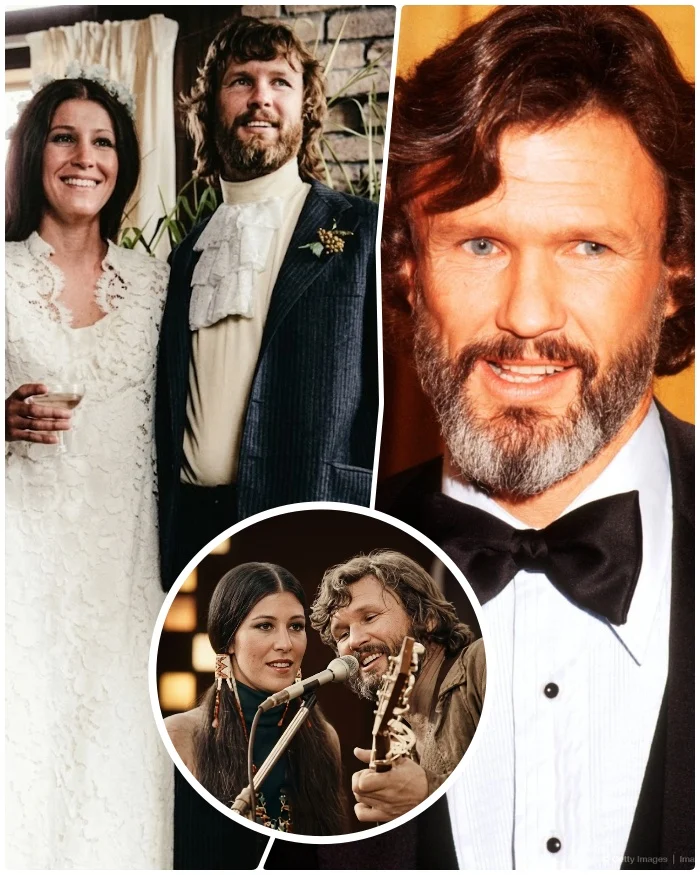
When Kris Kristofferson died at eighty-eight in September 2024, Rita Coolidge did not reach for grand words about fame or chart success. She remembered the father of her daughter as a close friend, a voice that had harmonized with hers ever since the day he walked off a plane in Memphis for her.
She remembered him simply as a close friend whose voice had harmonized with hers since the day he walked off that plane in Memphis.
Late in 1970, the thirty-four-year-old songwriter walked up to a Los Angeles airport ticket counter to board a flight to Nashville. In the cabin he met twenty-five-year-old singer Rita Coolidge, and over a few hours in the air the two talked without stopping.
He was still hollowed out by grief after the sudden October 1970 passing of Janis Joplin. Coolidge brought a quiet calm that reached him at once. Born in Lafayette, Tennessee, to a Baptist minister father and a mother of Cherokee and Scottish heritage, she was known as the Delta Lady for her warm contralto voice. She had already toured with Joe Cocker and his Mad Dogs and Englishmen revue and had sung backing vocals for Eric Clapton and Stephen Stills.
When the plane touched down in Tennessee for a layover, Kristofferson picked up his guitar case, set aside his business obligations in Nashville, abandoned his connecting ticket, and followed a woman he had just met into the Memphis terminal. That sudden choice sparked one of the defining musical partnerships of the 1970s.
Soon after that Memphis stopover, the two moved in together in California and began blending his rough-hewn baritone with her smooth contralto on stage and on record. Because Kristofferson recorded for Monument Records and Coolidge was signed to A&M Records, the two labels reached a special agreement to alternate releases so the pair could record their first full-length duet album, Full Moon.
Stepping away from the Nashville studios where he had cut his early solo albums, Kristofferson joined Coolidge and her producer, David Anderle, at Sunset Sound Recorders in Los Angeles in 1973. The sessions felt like an extended family gathering inside the studio. Coolidge’s sister Priscilla had recently married Memphis soul organist Booker T. Jones, who sat in on keyboards alongside Kristofferson’s longtime road band, including Donnie Fritts, Michael Utley, Stephen Bruton, and drummer Sammy Creason.
At home and in the studio, Coolidge often sat at the piano working out chord structures and melodies before calling Kristofferson into the room to write the lyrics with her. That partnership produced two co-written tracks for Full Moon, ‘It’s All Over (All Over Again)’ and ‘I’m Down (But I Keep Falling)’, alongside his calypso-tinged ‘A Song I’d Like to Sing’ and their lively duet ‘From the Bottle to the Bottom’. Inspired by the sudden turn in his life, he also wrote songs for her including ‘A Song I’d Like to Sing’ and ‘Loving Her Was Easier’.
Along with multi-instrumentalist David Bromberg, fiddler Vassar Clements, and A&M co-founder Herb Alpert on trumpet, the couple recorded twelve tracks that bridged country storytelling and California pop.
Just weeks before A&M released Full Moon in September 1973, Kristofferson and Coolidge were married on August 19, 1973, in a small ceremony at her father’s Baptist church in Malibu, California. Her minister father officiated as Kristofferson stood in faded jeans and an embroidered shirt beside Coolidge in a simple white dress.
Full Moon climbed to number one on the Billboard country album chart, reached gold certification, and earned the newlyweds the 1974 Grammy Award for Best Country Performance by a Duo or Group for ‘From the Bottle to the Bottom’. Two more duet albums followed, 1974’s Breakaway, which brought a second Grammy for ‘Lover Please’, and 1978’s Natural Act.
Months after Full Moon arrived, the couple welcomed their only child together, daughter Casey Kristofferson, in 1974. When Casey was just seven weeks old, her parents brought her onto their tour bus for her first road run, raising her inside backstage dressing rooms and recording studios across North America.
As Kristofferson’s Hollywood film career accelerated with Alice Doesn’t Live Here Anymore and 1976’s A Star Is Born, his heavy drinking and the 1977 miscarriage of their second child placed heavy strain on the marriage. When Coolidge filed for divorce in 1980, she declined to ask for alimony or a share of his songwriting royalties, choosing instead to walk away cleanly while preserving their relationship as Casey’s parents.
After the divorce was finalized in June 1980, both remained actively involved in raising Casey, who grew up spending time between her mother’s home and her father’s growing family after he married Lisa Meyers in 1983. Years later, after pursuing classical ballet and working outside the music business in North Carolina, Casey followed her parents onto the stage, fronting the Casey Kristofferson Band and releasing her own country-rock album, Dirty Feet, in 2019.
Over the four decades that followed their split, Coolidge and Kristofferson spoke warmly of each other in interviews and reunited for family milestones with Casey. Though the weight of his heavy drinking and the loss of an unborn second child eventually led to their divorce in 1980, the years that began on that Memphis layover remained one of the most creative chapters of his life.