
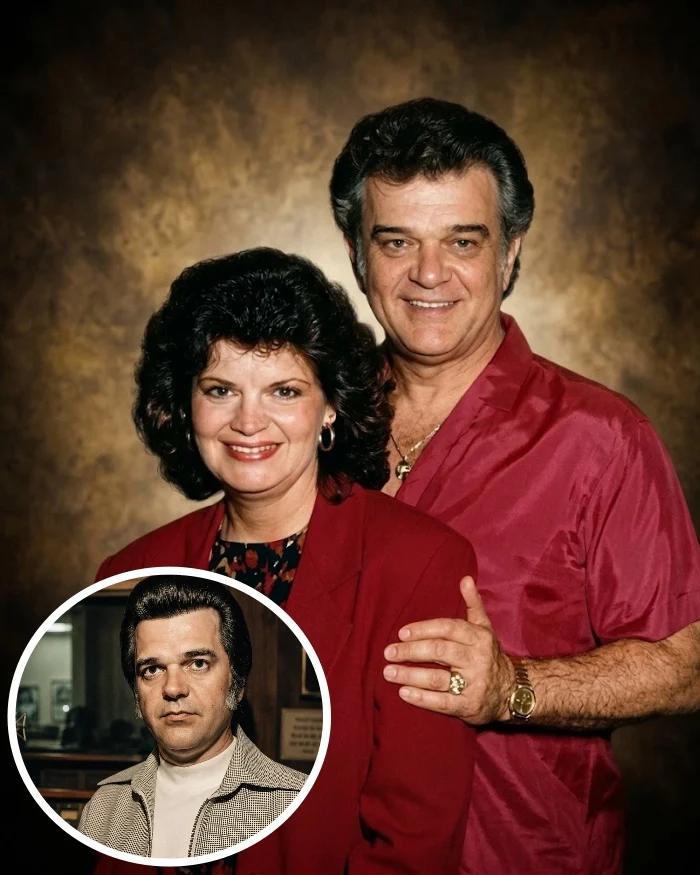
Delores “Dee” Henry wept on the witness stand in Gallatin as lawyers read aloud the handwritten love notes her husband had left for her on tour buses and on their bedroom dresser. The private words Conway Twitty had scribbled in quiet moments far from the stage were now being examined line by line, not for their tenderness, but for their financial weight.
He had promised to slow down his relentless touring and to make sure she was cared for in their old age.
The man who had spent a career singing intimate ballads to millions had never finished the paperwork required to protect the quiet promises he made at home. That painful gap between love and law would soon decide the fate of everything he had built for his family.
While he was alive, Twitty had fiercely guarded their domestic life from the Nashville press and kept the family compound running. That privacy vanished after he collapsed aboard his tour bus following a June 4, 1993 performance at the Jim Stafford Theatre in Branson, Missouri. He died the next morning in Springfield, Missouri, at age 59 from an abdominal aortic aneurysm, and the story of his marriage suddenly belonged to Sumner County Chancery Court.
On June 14, 1993, nine days after his death, longtime business manager Hugh Carden and accountant Donald Garis walked into the Sumner County probate court in Gallatin, Tennessee, to file a last will and testament drafted back in 1980. That thirteen-year-old document left a $50,000 bequest to Twitty’s mother, Velma Jenkins, and divided the remainder of his fortune among his four adult children, Michael, Kathy, Joni Lee, and Jimmy. It contained no mention of Henry, the former Twitty City office secretary who had married the singer in 1987.
Henry then petitioned the court under Tennessee probate law to claim a surviving spouse’s elective one-third share of the estate. Her claim collided directly with the financial structure of Twitty City, the place Twitty had built to gather his wife and children under one roof. Opened in Hendersonville in June 1982 at a cost of more than $3.5 million, the nine-acre complex was both a commercial tourist attraction and a family compound. Inside its gates stood his 24-room brick mansion, exhibition halls, gift shops, and separate houses built specifically for his mother and his children.
As lawyers for the estate and the children challenged Henry’s claim to a full one-third share against earlier prenuptial agreements, the 1994 courtroom proceedings before Judge Tom E. Gray turned to the couple’s domestic life. Attorneys entered Twitty’s handwritten love notes to Henry into the public record, reading aloud lines scribbled on tour buses and left on their bedroom dresser. On the witness stand, Henry wept as lawyers examined the private pages to argue over their legal and financial weight, even though he had never completed the formal legal updates to his 1980 will.
Outside the courtroom, the estate faced immediate financial pressure. Most of Twitty’s wealth was tied up in real estate, stage equipment, and a complex 1990 song catalog agreement with Sony/ATV rather than liquid cash. With mounting tax obligations, ongoing maintenance costs for the Hendersonville grounds, and no cash reserves available to pay out Henry’s spousal share, the family reached an impasse.
In June 1994, the probate court ordered the full liquidation of the physical estate to settle the debts and divide the proceeds. The Trinity Broadcasting Network stepped in to purchase the nine-acre Twitty City complex for roughly $2.75 million, requiring the family members living on the grounds to vacate the homes Twitty had built for them.
Ten days before the personal property auction began, Twitty’s 82-year-old mother, Velma, died on October 6, 1994, shortly after leaving her residence on the compound. Her passing added another layer of grief to a family already losing its home.
From October 14 through October 16, 1994, auctioneers erected tents on the Hendersonville grounds to sell off more than 2,000 lots of Twitty’s personal possessions. Across three days, collectors and fans bid more than $1 million on his stage suits, acoustic guitars, tour buses, household furniture, gold records, and personal correspondence.
Even old letters written between Twitty and his second wife, Mickey Medley, were cataloged and placed on the block alongside the furniture from the mansion. While three of Twitty’s children declined to bid on their father’s belongings, Henry sat among the crowd in the auction tent. By the time the final gavel fell on Sunday afternoon, she had spent nearly $80,000 of her own money buying back a car, a jukebox, and pieces of jewelry from the home they had shared.
In the end, the court-ordered sale scattered the physical pieces of the sanctuary Twitty had promised her in those handwritten notes. The love letters survived in the public record, but the home they described, the rooms, the music, and the quiet life together, was gone.