
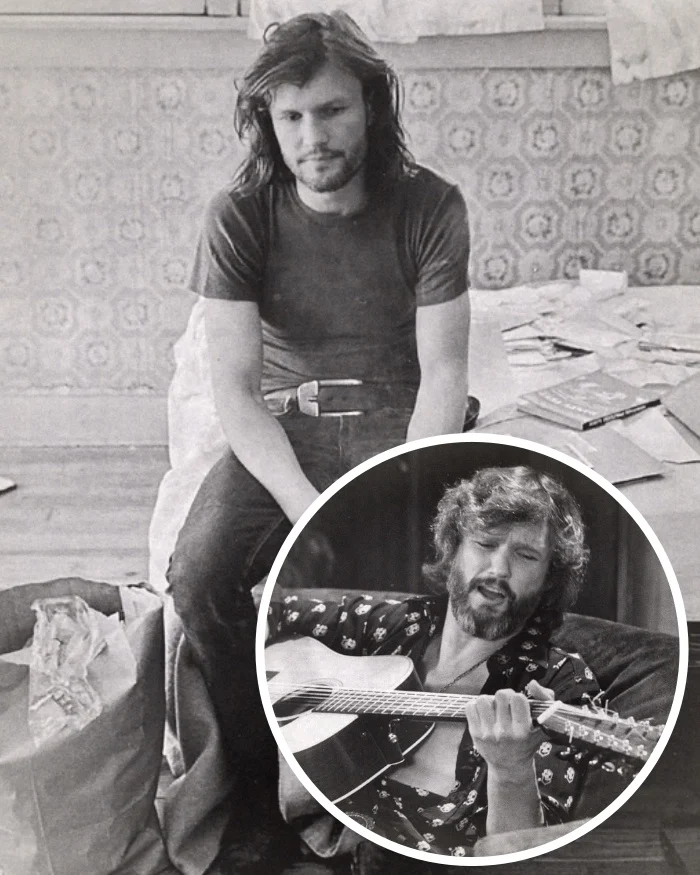
The lights of the Ryman Auditorium burned hot in July 1970 as Johnny Cash stepped forward with a guitar in his hands and a forbidden line on his lips. Network executives had already told him to soften it. He had already told them no. High in the balcony sat the man who had written those words in a lonely attic room, a former janitor named Kris Kristofferson, holding his breath as Cash turned toward the television camera and sang the verse exactly as it had been written. The crowd roared. The cameras kept rolling. And a life that had seemed broken beyond repair suddenly began to turn.
Only five years earlier, Kristofferson had seemed to have everything mapped out. He was an Oxford-educated Rhodes Scholar and a United States Army helicopter pilot, a man raised in a proud military family and offered a three-year appointment to teach English literature at West Point. In 1965 he walked away from that future. He resigned his commission and headed for Nashville to chase songs.
His father, Major General Henry Kristofferson, and his mother saw the choice as a disgrace. They cut off contact with their son. The applause he had once known in classrooms and cockpits was replaced by the quiet scrape of a broom.
On Music Row, Kristofferson swept floors, changed lightbulbs and emptied ashtrays at Columbia Recording Studios for roughly fifty-eight dollars a week. Between sessions he slipped demonstration tapes to anyone who might listen, hoping one voice might carry his words beyond the studio walls. To pay child support and mounting medical bills for his young son Kris, who had been born with a damaged esophagus, he also flew helicopters to offshore oil rigs in Louisiana for Petroleum Helicopters International on alternating weeks.
While he was away, his marriage to his longtime high school sweetheart Fran Beer collapsed. She left with their two children, and Kristofferson found himself alone in Nashville in a cramped and dilapidated upstairs room at the Tally Ho Apartments on 17th Avenue South, just above the neighborhood tavern. Plaster was missing from the walls. Sundays hurt most of all.
While the rest of the city dressed for church and gathered for family dinners, he walked empty sidewalks with an aching head and a heavy heart. From that solitude he shaped a quiet and painfully honest portrait of a solitary man waking groggy and exhausted, pulling a wearable shirt from the closet, smelling neighborhood families cooking chicken through an open window and watching a father push his daughter on a park swing as church bells echoed across town.
That portrait became Sunday Mornin’ Comin’ Down. In 1969, at thirty-three years old and still working as a janitor and still trying to prove he had not ruined his life, Kristofferson carried the newly finished ballad into Nashville’s Tally Ho Tavern to play it for his songwriting hero Mickey Newbury.
Do not change a single line.
Newbury believed in the song so deeply that he took Kristofferson across town to play it for publisher Fred Foster and singer Ray Stevens. Stevens recorded it first in the summer of 1969 and carried it to number fifty-five on the Billboard country chart. It was modest, but it was proof. Someone beyond that attic room was finally listening.
Getting the song to Johnny Cash proved harder. For months Kristofferson passed demos to June Carter without success. Determined not to be ignored, he borrowed a National Guard helicopter during a weekend training flight and landed it directly on the front lawn of Cash’s lakeside house in Hendersonville. Cash later exaggerated the story for years, claiming the songwriter had stepped from the cockpit with a beer in one hand and a tape in the other. Kristofferson later admitted the truth was quieter and stranger. Cash was not even home that afternoon. Yet the bold landing finally forced the star to listen.
By July 1970, Cash had chosen the song for a live taping at the Ryman Auditorium for his ABC network variety program The Johnny Cash Show. Before the cameras rolled, ABC broadcast standards executives warned him that a chorus line about wishing to be intoxicated on a Sunday morning was unacceptable for prime-time family television. They wanted it changed.
Cash refused to alter a syllable of the younger writer’s work. Before the guitar intro began, he spoke directly to the audience about his own father hopping freight trains during the Great Depression.
He framed the song around good people drifting across America in search of peace of mind.
Then, from the balcony, Kristofferson watched Cash reach the chorus, look straight into the television camera and deliver the original line with deliberate emphasis. The Ryman crowd erupted in applause, and ABC aired the performance intact.
Released as a single from the live television album, Cash’s recording climbed to number one on the country charts that fall. Weeks later, in October 1970, Kristofferson returned to the Ryman stage in a velvet suit to accept the Country Music Association Award for Song of the Year.
That one composition changed everything. As Kristofferson later noted, it finally allowed him to quit working day jobs for a living. The loneliest mornings in a dilapidated apartment on 17th Avenue South had opened the door to a lifelong career, proving that the ache he had once carried alone could become a song the whole country recognized as its own.