
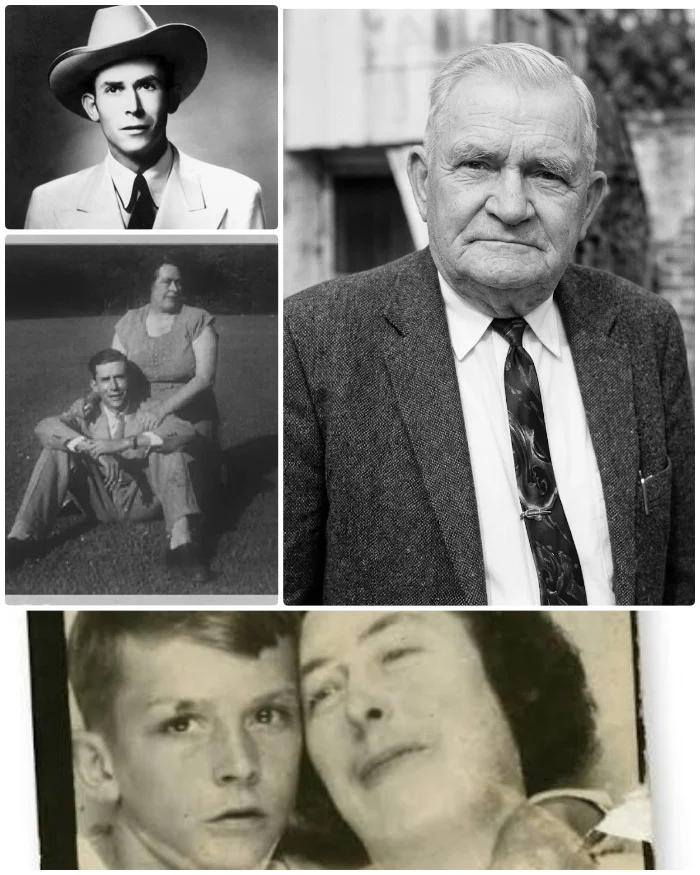
He climbed the steps in August 1938 with a limp and a face that illness had changed beyond recognition, and the boy waiting inside had already learned to live as if he were gone. At 114 South Perry Street in downtown Montgomery, Alabama, fourteen-year-old Hiram Williams came face to face with Elonzo Huble “Lon” Williams, a father he had been told would never return.
There was no embrace in the parlor of the boarding house. There was only silence, eight years thick, between a frail former railroad man and a rising teenage singer who now called himself Hank. They sat across from each other like strangers, and in that quiet room the rest of Hank Williams’ life began to make a painful kind of sense.
Before the silence, Lon had been strength itself. He drove logging trains for the W.T. Smith Lumber Company across southern Alabama, a locomotive engineer whose hands knew the timber country and the rail lines that cut through it. That strength had been tested long before his son understood what war could do to a man.
Between July 1918 and June 1919, Lon served in France with the United States Army. He fell from a military truck, broke his collarbone and suffered a severe blow to the head. The wound did not end when he came home. By the time Hiram was seven years old, the lingering injuries had left Lon with facial paralysis, his face motionless and his speech barely able to form.
Doctors at a Veterans Administration clinic in Pensacola, Florida, diagnosed a brain aneurysm. Lon was transferred to the VA Medical Center in Alexandria, Louisiana, where he remained institutionalized for the next eight years.
While her husband lay hundreds of miles away in Louisiana, Jessie Lillybelle “Lillie” Williams took complete command of the household in the worst years of the Great Depression. She moved her children, Irene and Hiram, from Georgiana to Greenville and Garland. She worked night shifts as a hospital nurse, took jobs in a local cannery and opened a succession of boarding houses to keep the family fed.
When the Veterans Administration stalled on releasing Lon’s full disability compensation, young Hiram approached Alabama Congressman J. Lister Hill during a campaign stop in Georgiana. The boy explained that his mother needed help securing his hospitalized father’s pension. After Hill intervened, the monthly government checks began to arrive, and Lillie used that steady income to stabilize the household.
That same steady hand that saved the family also closed a door. Lillie cut off communication with Alexandria, hid Lon’s letters and led the children to believe their father was either dead or never coming back. The story she built protected the home she controlled, and it erased the man who had once led it.
Eight years of letters never reached the children, and eight years of silence did the work of a lifetime.
In July 1937, Lillie moved the family to Montgomery. There Hiram began calling himself “Hank,” won a talent contest at the Empire Theater and landed a twice-weekly fifteen-minute afternoon slot on radio station WSFA for fifteen dollars a week. By August 1938, when the Alexandria hospital granted Lon a temporary release, Lillie was already acting as her teenage son’s booking agent and business manager.
Walking with a limp and carrying the physical toll of his aneurysm and long hospitalization, Lon stepped into a Montgomery boarding house where he had no authority left. Hank and his father sat in the parlor with almost nothing to say, separated by eight years of silence and by a household built entirely around the boy’s rising music career.
Unwilling to surrender control of the home or the pension money she had managed throughout the 1930s, Lillie refused to let Lon reclaim his place as head of the family. Lon stayed at the South Perry Street house only long enough to see Hank turn fifteen on September 17, 1938, before packing his belongings and returning to the veterans hospital.
Soon after that brief visit, Lillie formalized their separation by divorcing him. Following his final discharge from Alexandria, Lon settled quietly in rural south Alabama near McWilliams in Wilcox County. While his father lived out of sight in the Alabama timber country, Hank formed the Drifting Cowboys, rose through the Louisiana Hayride in Shreveport and made his debut on the Grand Ole Opry in Nashville on June 11, 1949, singing “Lovesick Blues” to six encores.
Even after Hank reached the Grand Ole Opry and bought a spacious home on Franklin Road in Nashville, the distance between father and son never closed. During the rare, brief visits they shared in the late 1940s and early 1950s, including occasional stops in Alabama and backstage encounters when Lon came to see his son perform, the two men remained polite strangers. They could not bridge the years Lillie had erased or the commanding presence she still held over Hank’s career.
He became the voice of heartbreak for millions, yet the man who might have taught him how to heal remained a stranger at the edge of his fame.
When Hank died of heart failure in the back seat of his Cadillac on January 1, 1953, at age 29, Lillie took charge of the massive public funeral at the Montgomery Municipal Auditorium alongside his widow, Billie Jean, and his ex-wife, Audrey. Lon Williams outlived both his former wife and his famous son by nearly two decades, living quietly in Wilcox County until his death at age 78 in October 1970. He was buried beside a small country church in McWilliams, fifty miles south of the Montgomery boarding house he had walked away from in 1938.
The father who returned too late never truly left Hank’s songs, and the ache of that unfinished reunion echoed in his voice until the very end.