
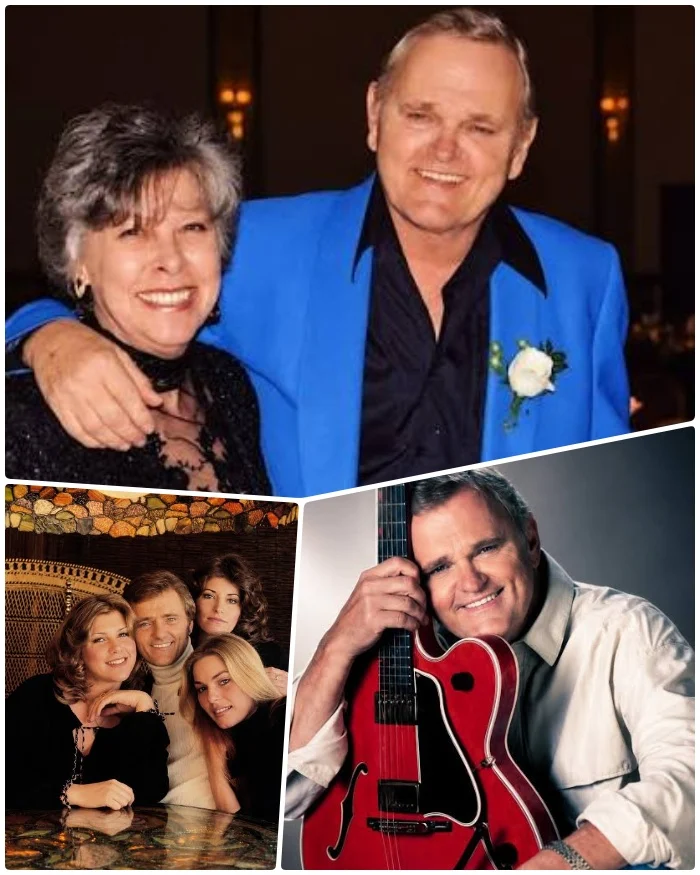
When the spotlight called, one country music pioneer chose a different path entirely, sacrificing her own solo ascent so her children would never have to grow up without a mother at the kitchen table.
Priscilla Mitchell reached the absolute pinnacle of the Billboard country chart in 1965, a full six years before her famous husband, Jerry Reed, ever claimed a number-one hit of his own. Yet as Reed’s career exploded onto national radio stations and Hollywood film sets, Mitchell willingly stepped back from solo touring, taking steady studio session work in Nashville so their two daughters would always have a parent at home every single night.
Long before Music Row knew either of their names, Mitchell’s musical journey began early. Born in Marietta, Georgia, on September 18, 1941, she made her professional radio debut at just four years old on local station WFOM. By her teenage years, she was deeply embedded in the Atlanta music scene managed by producer Bill Lowery, recording early tracks and providing backup vocals for local pop and rock acts.
That exact Atlanta studio circuit introduced her to Jerry Reed Hubbard, a young cotton-mill worker and guitar player whose early rockabilly singles for Capitol Records had failed to gain traction. They married in Georgia on July 9, 1959, when Reed was 22 and Mitchell was only 17, just as Capitol dropped him from their roster. Weeks later, Reed entered the U.S. Army for a two-year commitment at Fort Campbell, separating the newlyweds while their first daughter, Seidina Ann, was born in April 1960. Financial relief finally arrived when Brenda Lee recorded Reed’s composition ‘That’s All You Gotta Do,’ providing enough royalty money for the family to reunite and relocate to Nashville in 1961.
In Tennessee, Mitchell’s incredible vocal talent opened doors rapidly. She performed with the folk group The Appalachians, became a regular fixture on the syndicated television program ‘The Arthur Smith Show,’ and caught the attention of producer Jerry Kennedy at Mercury Records. While Reed spent the early 1960s working primarily behind the scenes as a songwriter and session guitarist, Mitchell stepped into the spotlight.
In 1965, Mercury paired her with Grand Ole Opry icon Roy Drusky for ‘Yes, Mr. Peters,’ a clever duet about an affair disguised as a late-night phone call. The track dominated the Billboard country chart for two solid weeks, becoming the biggest chart success either artist ever experienced. Over the next three years, Mitchell and Drusky collaborated on three full-length duet albums and returned to the charts with additional hits like ‘Slippin’ Around’ and ‘I’ll Never Tell on You.’
During this same creative window, Mitchell recorded pop singles under the name Sadina for Mercury’s Smash subsidiary and cut solo country tracks written by her immediate circle. Reed penned her 1967 charting single ‘He’s Not for Real,’ while a young Dolly Parton wrote Mitchell’s 1968 release ‘Your Old Handy Man.’
The dynamic within the household transformed dramatically at the end of the decade. After Chet Atkins began producing Reed at RCA Victor and Elvis Presley cut Reed’s ‘Guitar Man’ and ‘U.S. Male’ in 1967, Reed’s solo career skyrocketed. Crossover smashes like ‘Amos Moses’ in 1970 and his Grammy-winning 1971 chart-topper ‘When You’re Hot, You’re Hot’ cemented him as a national headliner.
By the mid-1970s, Reed’s touring schedule spanned Las Vegas showrooms and Hollywood movie sets alongside Burt Reynolds in box-office hits like ‘Smokey and the Bandit.’ With her husband away for months at a time, Mitchell evaluated the intense demands of two competing touring careers and made a quiet, permanent choice for the wellbeing of daughters Seidina and Charlotte Elaine, affectionately known as Lottie.
She walked away from life on the road and built a daytime career inside Nashville’s recording studios, staying close to Music Row while making sure she was home by supper. Credited occasionally under her married name, Priscilla Hubbard, she sang background vocals for legends like Waylon Jennings and Jim Reeves, and became an indispensable fixture on Reed’s own recordings, including his 1978 album ‘Sweet Love Feelings’ and his 1995 release ‘Flyin’ High.’
Even in later years when they shared stages again, she remained an integral part of his touring band, playing keyboards on his 2005 live album. Both daughters ultimately followed their talented parents into the country music industry.
Reed never hid how deeply he relied upon the woman he affectionately called ‘Prissy.’ Known in the studio as a perfectionist who could spend days perfecting a single guitar riff, he frequently credited her calm demeanor with keeping his life grounded through decades of intense fame and changing musical trends. When severe emphysema took his breath away and forced him off the stage for good, Mitchell remained right by his side at their Nashville home next to his oxygen tank until he passed away on September 1, 2008, at age 71.
She had reached the top of the country charts before her husband ever did, then spent the rest of a 49-year marriage making sure he had a home to come back to when the road ran out.
Six years later, on September 24, 2014, Mitchell passed away in Nashville following a brief illness, just six days after celebrating her 73rd birthday, having completely fulfilled the heartfelt promise she made to a broke young guitarist in Atlanta nearly half a century earlier.