
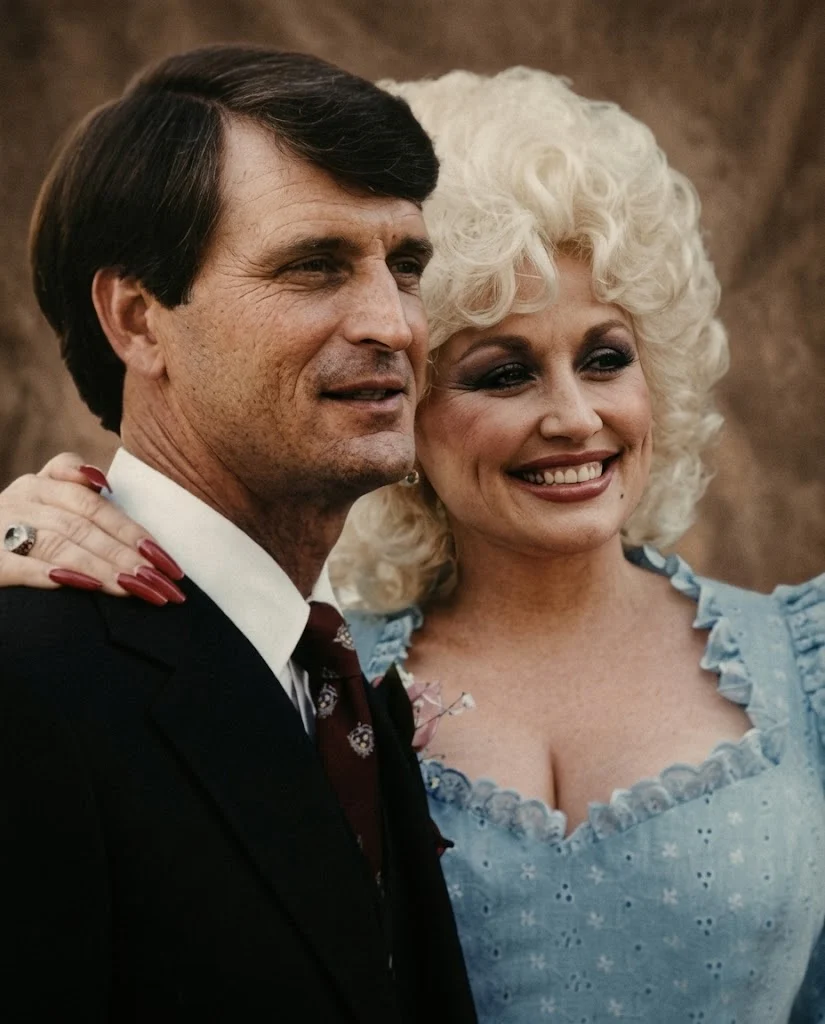
She was one of the rising stars of country music, but beneath the hits and the glamour a local bank teller brought her to her knees. Instead of fighting the other woman, Dolly Parton stripped away her fame and admitted a very ordinary fear.
Jolene, Jolene, Jolene, Jolene. I am begging of you please do not take my man.
In the early 1970s, Dolly Parton was already a familiar face on television and a rising force in Nashville. Yet off the stage, she and her husband Carl Dean were navigating the realities of a marriage pulled in two different directions. They had been married since 1966 and were still navigating the challenges of a young marriage while her career demanded constant travel and public attention. Carl preferred a quiet life away from the spotlight, running his asphalt paving business and managing his daily errands.
That routine created an unexpected crack in their foundation when a red headed teller at the local bank began paying Carl a little too much attention. He suddenly seemed a bit too eager to visit the bank, and Dolly recognized the danger. The distance created a vulnerable space, and the quiet threat to her relationship became impossible to ignore.
Rather than engaging in a bitter confrontation or storming into the lobby, she did what she knew best. She took her insecurity, sat down with her guitar, and wrote a plea. Released in late 1973, Jolene was a rare departure from the traditional country revenge anthems of the era. She did not tear the other woman down, insult her, or threaten a fight. Instead, she praised her beauty and admitted her own deep fear of being replaced.
But the song still needed a focal point. The striking physical description of ivory skin, emerald eyes, and auburn hair did not actually belong to the bank teller. That vivid imagery and the title itself were borrowed from an eight year old fan Dolly had met at a concert. While signing an autograph, Dolly told the little girl it was the prettiest name she had ever heard and promised to write a song about it, fulfilling a promise to put the beautiful name of the girl in a song.
The true weight of the record came from its raw honesty. A dazzling star known for her rhinestones, big hair, and larger than life confidence stripped away her armor to admit a very ordinary fear. She was terrified of losing the man she loved simply because another woman could take him. The vulnerability behind those words was entirely her own.
When Dolly walked into RCA Studio B in Nashville in May 1973 to cut the track, that vulnerability changed the entire atmosphere in the room. The seasoned studio musicians, accustomed to playing standard country shuffles and weeping steel guitar ballads, instinctively knew this session required a different approach.
As Dolly stepped to the microphone and began to sing the pleading words, the band responded directly to the frantic energy in her vocal delivery. Guitarist Chip Young built a driving and thumb picked acoustic riff that felt restless and urgent. It did not sound like a traditional heartbreak song. It sounded like a racing heartbeat.
The rhythm section locked into her desperation. Drummer Larrie Londin and bassist Bob Moore played with a restrained anxiety that matched the narrative of a woman standing on the edge of losing her entire world. The musicians did not overpower her. They framed her voice and carried her plea forward with an unforgettable and nervous momentum.
The recording captured a universal story and explored themes of inadequacy, the humbling nature of love, and the painful realization that sometimes even your best is not enough to compete with the natural charm of someone else. As she sang the famous chorus, she gave a voice to anyone who has ever felt outmatched in matters of the heart.
Jolene, Jolene, Jolene, Jolene
I am begging of you please do not take my man
The single reached Number One in early 1974, transforming a private crisis and a private insecurity into a timeless and permanent piece of American music history. The marriage of Dolly and Carl ultimately outlasted the incident, enduring for decades long after the bank teller faded into the background. Yet the song remains a testament to the power of honesty.
The track did not just save a piece of her marriage. It proved that sometimes the most enduring strength is found in admitting complete weakness. The intense recording sessions that captured her frantic vocals, and the way the studio musicians responded to that vulnerability, remain a fascinating piece of Nashville history. The full licensed lyrics can be found by searching for the song on Google.