
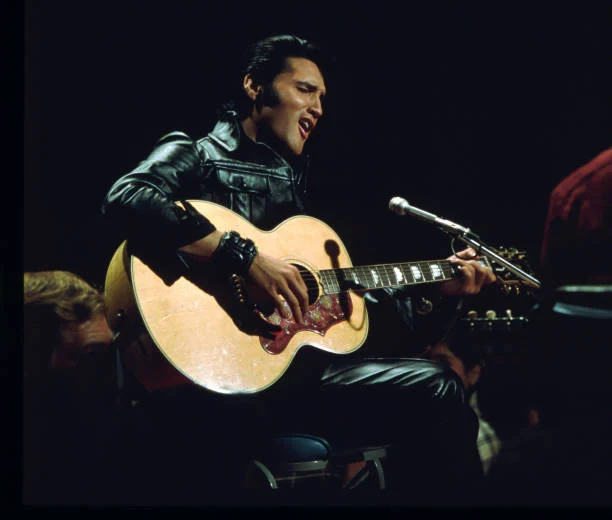
In February 1977 just six months before his death Elvis Presley reached number one on the country chart for the final time in his lifetime. The song was Moody Blue and it had been recorded a year earlier inside his own Memphis mansion because the biggest star in the world no longer wanted to travel to a traditional studio.
Introduction And Short Summary Of The Song
Released in November 1976 Moody Blue was one of the final singles of his career and the title track of his last studio album which was issued in July 1977. Written by Mark James who was the same songwriter behind his smash hit Suspicious Minds the song is a mid tempo country pop number with a smooth yet melancholy feel. It reflects themes of unpredictability and emotional distance in a relationship and compares the moods of a lover to the changing colors of blue. The track became his last chart topping country single and reached number one on the Billboard Hot Country Singles chart in early 1977. More than just another hit Moody Blue has since been remembered as a poignant symbol of his final years as a recording artist.
Origins Of The Song
Mark James was a Memphis based songwriter who penned Moody Blue in the mid 1970s. Already admired by Presley for his earlier work particularly Suspicious Minds James crafted Moody Blue as a reflection of the changing dynamics of modern relationships. Its combination of catchy hooks and smooth rhythms and subtle melancholy made it a natural fit for Presley whose catalog had always balanced fiery rockers with soulful ballads.
Presley recorded the song in February 1976 at Graceland his Memphis mansion. By this point in his career he was increasingly reluctant to travel to recording studios so RCA brought mobile recording equipment into his home and set up sessions in the famous Jungle Room. These recordings though technically imperfect captured his raw and intimate performances and became the basis for much of his final studio album.
Why Elvis Released Moody Blue
By 1976 the health and personal life of Elvis Presley were in decline but RCA and Colonel Tom Parker were eager for new material to keep his career commercially alive. Moody Blue was chosen as a single because it balanced commercial appeal with emotional depth. Its country pop sound aligned with the popularity of crossover country music in the mid 1970s while its introspective lyrics mirrored the vulnerability that fans increasingly sensed in Presley himself.
Released in November 1976 the song quickly gained traction on country radio. In February 1977 just six months before his death it topped the Billboard Hot Country Singles chart and gave him his final number one hit during his lifetime. It also reached number 31 on the Billboard Hot 100 and proved that his music still had broad appeal across genres.
The Message Conveyed In The Song
The lyrics center on a lover whose moods are unpredictable and shift like changing shades of blue.
Moody blue, tell me who I’m talking to, you’re like night and day.
Those lines capture the confusion and frustration of trying to connect with someone emotionally distant. The metaphor of moody blue suggests both sadness and changeability. While the song can be interpreted simply as a relationship lament in the context of his late career many listeners have heard a deeper resonance as a reflection of instability and longing and uncertainty in his own life.
His vocal performance is key to the emotional impact of the song. He sings with both control and warmth and his phrasing conveys frustration but also tenderness. The blend of smooth delivery and subtle strain gives the impression of someone who understands the complexities of love and the difficulty of truly connecting.
The Recording And Musical Characteristics
The recording itself reflects the unique qualities of the Jungle Room sessions. Though not as sonically refined as RCA studio recordings the Graceland sessions carried an intimacy and authenticity that came through in his vocals. Despite his physical exhaustion the voice remained unmistakable and he delivered a performance that proved he could still command a song without the lights of a Vegas stage. The magic was never in the professional studios because it was in the man himself.
Even amid personal decline his voice and interpretive power remained compelling and capable of turning simple songs into meaningful expressions of human emotion.
Cultural And Commercial Impact
Moody Blue was a commercial success particularly in the country market. Its climb to number one on the Billboard Hot Country Singles chart in February 1977 was a testament to his enduring appeal. On the pop chart it reached number 31 which was a respectable performance that underscored his continued crossover relevance. Culturally the song became closely tied to his final years. Its themes of moodiness and unpredictability coupled with its release so near the end of his life gave it a poignant weight in retrospect. Fans and critics alike have often seen it as symbolic of his personal struggles during the mid 1970s.
The Moody Blue album was released in July 1977 just one month before his death and was pressed on limited blue vinyl in addition to standard black. This marketing choice was initially a novelty and became a collector item after his passing and remains one of the most sought after pieces of Elvis memorabilia.
Legacy Of Moody Blue
Today Moody Blue is remembered not just as a country chart topper but as one of the defining tracks of his final years. While it lacks the explosive energy of his early rock and roll hits it represents the maturity and vulnerability and stylistic adaptability that marked his later work. The song remains a fan favorite and is frequently included in compilations of his 1970s recordings. Its status as his final number one hit adds to its historical importance and gives it a bittersweet place in his legacy.
More broadly Moody Blue reflects his connection to contemporary trends in the 1970s music scene. At a time when country pop crossover acts like Glen Campbell and Kenny Rogers and Olivia Newton-John were dominating the charts Presley proved that he could still compete in that space while maintaining his distinctive style. Nearly five decades later Moody Blue continues to resonate with fans as both a catchy country pop song and a symbol of his enduring artistry in the twilight of his career.