
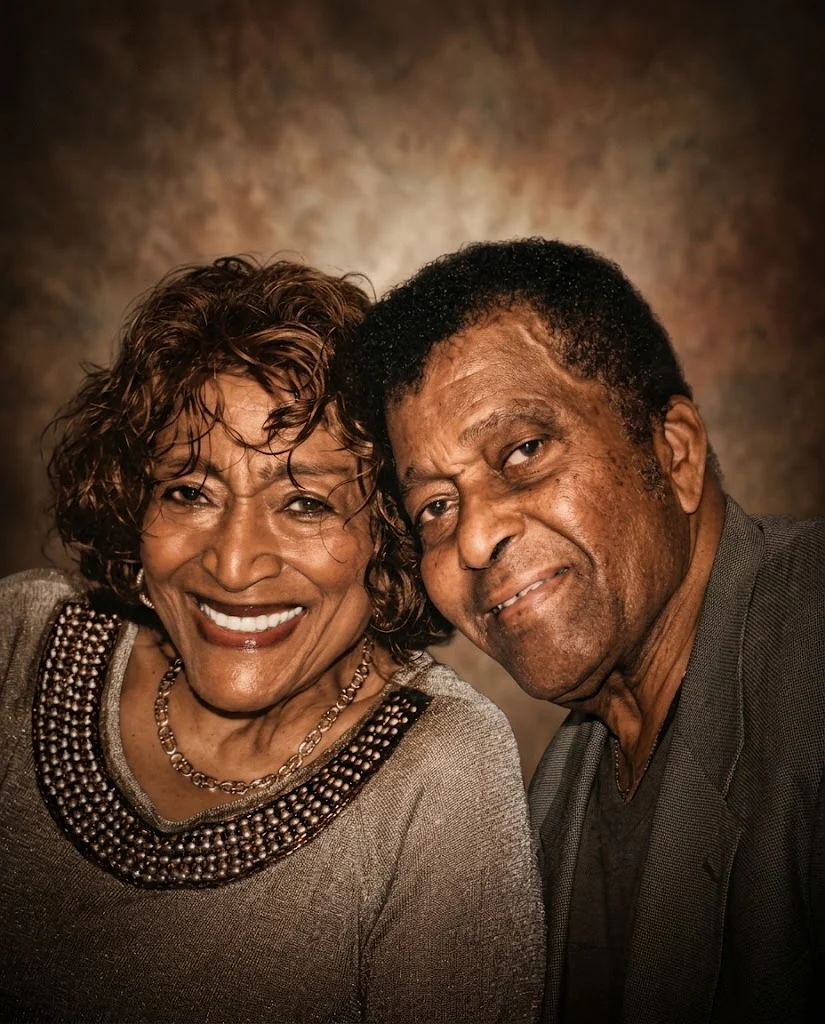
Before Charley Pride ever stood on the Grand Ole Opry stage, he stood on a segregated baseball diamond in Memphis, dreaming of the Major Leagues. It was 1956, and the young pitcher for the Negro American League’s Memphis Red Sox had no idea that a single game would change the course of his life forever.
That day, in the stands, sat Ebby Rozene Cohran—a woman with a tactical understanding of the game inherited from her father. While others chatted idly about the weather, she engaged Pride in sharp, passionate debates about pitching strategies, the rules of the diamond, and the grit required to compete. He was instantly captivated by her intellect and her fire for the sport.
Their connection wasn’t built on candlelit dinners or whispered romance. It was forged in the dust, sweat, and roar of a league that existed because the world wouldn’t let them play anywhere else. By the end of that year, they were married—a union that would become the quiet engine behind one of music’s most legendary careers.
As Pride’s baseball dreams faded in the early 1960s, the couple moved to Helena, Montana, where he took a grueling job at a zinc smelting plant to support their growing family. But even as he sang at local clubs and semi-pro games, it was Rozene who saw what he couldn’t—that his rich baritone held a future far brighter than his fading athletic ambition.
She became the architect of his transition. When Nashville came calling—when Chet Atkins and Jack Clement finally took notice—Rozene navigated the ruthless business of the recording industry. She managed contracts, protected their finances, and ensured that the leap from a Montana factory floor to a touring musician’s life never shattered the stability of their home.
In 1966, Pride entered the country music world as a Black artist in an industry entirely unprepared for him. His label initially sent out promotional records without photos, forcing radio programmers to judge him solely on his traditional sound. When he stepped onto Southern stages to face stunned, silent crowds, he performed with flawless charm—because his foundation offstage was unshakable. Rozene was his fierce protector, demanding the respect his talent deserved.
The results were staggering. Pride sold tens of millions of records, won the Country Music Association’s Entertainer of the Year award, and earned a permanent place in the Country Music Hall of Fame. Through sold-out arenas and global tours, the couple remained a tightly knit, fiercely private family in Texas. Rozene never sought the spotlight—she was the quiet, unbreakable force that allowed her husband to make history.
Their sixty-four-year partnership lasted until Pride’s passing in December 2020 at age 86. He left behind a legacy that redefined the boundaries of country music.
Nashville will always celebrate the voice that broke barriers. But the man behind that voice was built on the enduring strength of the woman who first understood his pitch on a Memphis baseball field—and never let him forget who he truly was.