
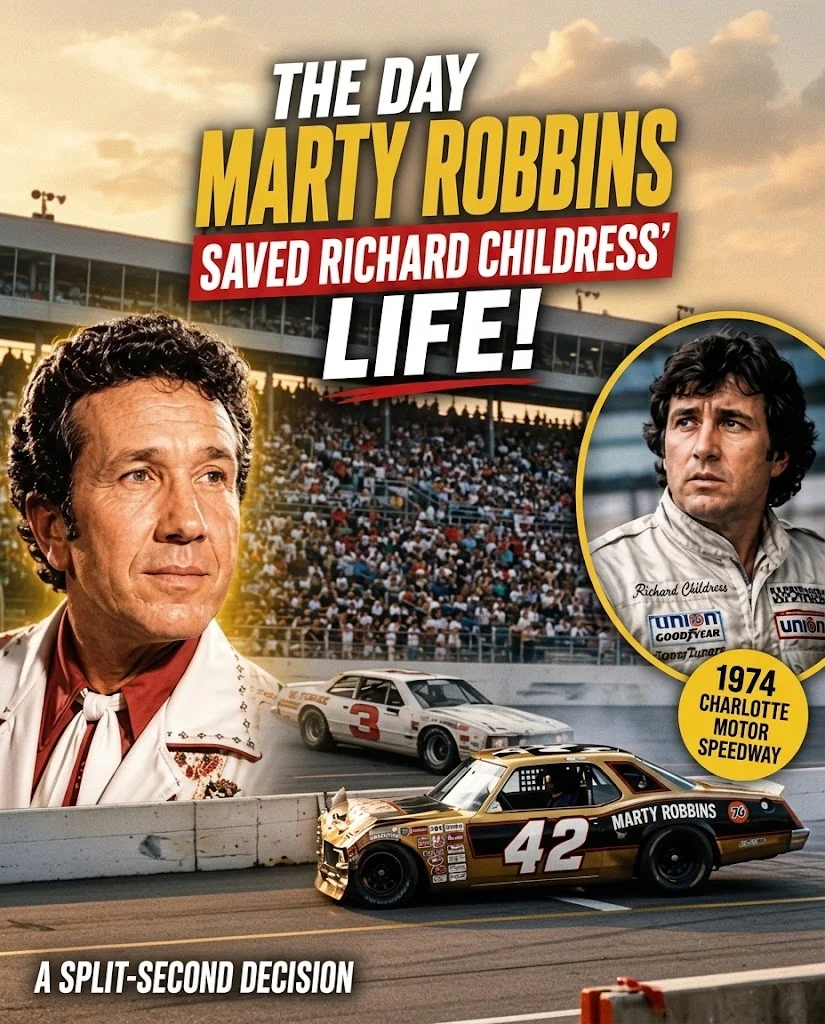
In the split second that decided everything, Richard Childress sat helpless, watching 160 miles per hour of steel and fate barrel straight toward his driver’s side door. The year was 1974, and the Charlotte 500 had turned into a nightmare on the front stretch. A multi-car pileup had left Childress’s racecar pinned sideways, a sitting duck for oncoming traffic. There were no modern barriers or restraints to save him—just a fragile door and the terrifying certainty of a fatal T-bone collision.
But the man behind the wheel of the oncoming purple and gold Dodge wasn’t just any racer. He was Marty Robbins, the Grammy-winning country music legend whose velvet voice had serenaded millions with hits like “El Paso” and “Big Iron.” Yet, inside the NASCAR garage, Robbins was no celebrity novelty. He was a respected, working-class racer who spent his weekends wrenching on his own equipment and earning the respect of giants like Richard Petty and Bobby Allison.
As Robbins emerged from the smoke, he faced an impossible choice: brake and survive while Childress perished, or wrench his wheel and take the hit himself. In a fraction of a second, he did what few would dare—he yanked his car out of the deadly trajectory and plowed head-on into the unforgiving concrete retaining wall.
The impact was brutal. The crowd fell into stunned silence as rescue crews pulled Robbins from the mangled wreckage. He had broken his tailbone, fractured two ribs, suffered severe bruising, and needed 37 stitches to close a massive gash between his eyes. But the physical toll was only half the story.
Just days after the near-fatal crash, Robbins walked back onto the stage, battered and black-eyed, and refused to cancel the show. With a grin, he joked that while movie stars left handprints in wet cement, he’d tried to leave his face in a Charlotte wall—but the wall had already dried. His courage didn’t end there. By February 1975, he was back behind the wheel at the Daytona 500, racing until just a month before his death in 1982.
Richard Childress survived that day, eventually retiring from driving to build one of the most successful ownership empires in NASCAR history. He never forgot the man who bought him the rest of his life. “There is no doubt in my mind I wouldn’t be here talking to you right now if Marty Robbins hadn’t risked his life to save me,” Childress later admitted.
Marty Robbins spent his career singing about noble outlaws and heroes who made hard choices. When his own moment of truth arrived on the asphalt, he didn’t just sing the song—he proved he was the hero of the story.