
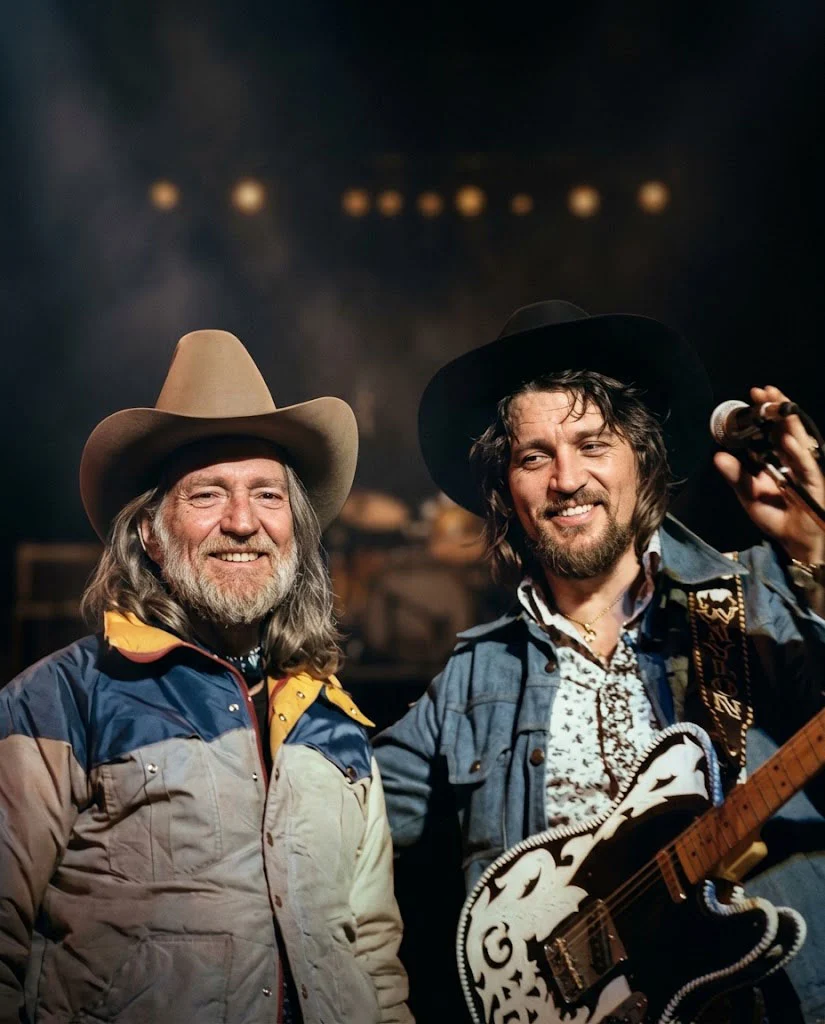
A Fort Worth poker table became the unlikely birthplace of country music rebellion. In 1969, Waylon Jennings and Willie Nelson were not chasing fame in a boardroom. They were playing cards in a motel room, surrounded by smoke and restless nerves, when a newspaper article about Ike and Tina Turner changed their path.
The article described Tina Turner as a good-hearted woman loving a two-timing man. Waylon felt the phrase hit his chest. Between hands, Willie helped him finish the lines, and the song “Good Hearted Woman” rose from the table like a confession.
They wanted their own bands, their own sound, and their own terms.
For years, Nashville ran country music like a polished factory. Producers decided the mood, the strings, and the shine of the outfit before a singer ever stepped into RCA Studio B. Artists wore sparkling Nudie suits, smiled for cameras, and left the hard choices to executives on Music Row.
Waylon Jennings and Willie Nelson refused to hand over their voices. They came from different worlds inside the same cage. Waylon carried the fire of a former bass player for Buddy Holly, raw and impatient. Willie carried the water, a brilliant songwriter whose behind-the-beat phrasing made Nashville executives uneasy.
Their brotherhood spoke to working-class listeners who felt shut out by pop-country gloss. They did not want perfect rhinestones. They wanted honest dirt roads, tired hearts, and music that sounded like real life.
Willie eventually walked away from the system and moved to Austin. He let his hair grow long, wore worn t-shirts, and played at the Armadillo World Headquarters. Cowboys and counterculture kids gathered there, finding common ground in songs that refused to be neat.
Waylon stayed in Nashville and fought back. He battled label executives until he gained creative control. He brought his own road band, The Waylors, into the studio and gave his records a heavy, driving bass pulse that sounded like freedom.
RCA Records noticed the shift. In 1976, the label released Wanted! The Outlaws, a compilation featuring Waylon, Willie, Jessi Colter, and Tompall Glaser. The cover looked like a faded wanted poster from the nineteenth century.
The executives expected a modest repackaging. Working-class listeners saw themselves in the record. By the end of 1976, Wanted! The Outlaws became the first country album ever to sell a million copies.
Two years later, Waylon and Willie won a Grammy for Best Country Vocal Performance by a Duo or Group for “Mammas Don’t Let Your Babies Grow Up to Be Cowboys.” The win proved authenticity could outsell conformity.
The true victory was not platinum or awards. It was creative freedom. They showed that an artist could keep the truth and still reach the world.
Waylon died in 2002, leaving a standard of integrity that still echoes through country music. Willie remains on stages across the country, playing Trigger, his battered guitar, exactly as he intended.
The boardroom fights have faded, but the freedom born at that poker table still stands.