
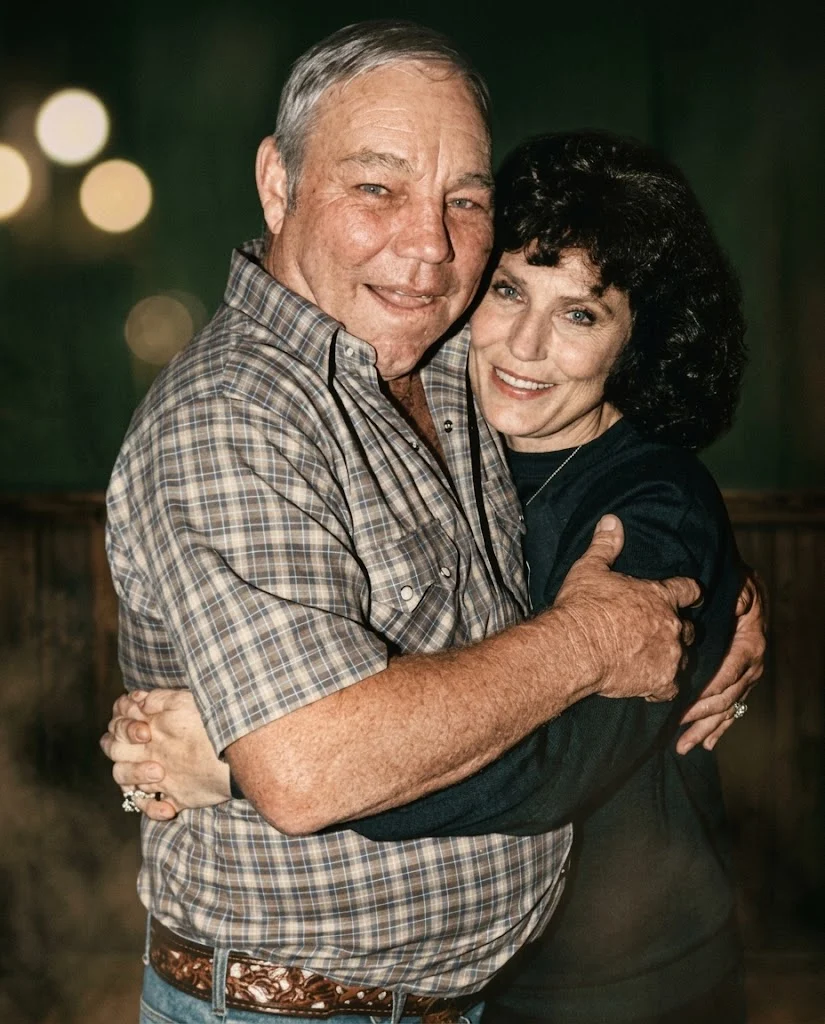
The man who gave Loretta Lynn her most famous heartbreaks was also the one who spent $17 to give her a voice 🎸💔.
Before she became a country music legend, Loretta was 21 years old and a mother of four in 1953, living in a logging camp in Custer, Washington, far from the Kentucky coal mines of her childhood.
Her days were filled with diapers, laundry, and the exhausting effort of keeping a family fed on a very small income.
Her husband Oliver Doolittle Lynn heard her singing while she rocked their babies to sleep.
That moment led him to order a cheap Harmony acoustic guitar from a Sears Roebuck catalog.
For a family that struggled to buy basic groceries, the $17 price tag was a massive gamble.
The guitar arrived with stiff steel strings and a high action that made it painfully difficult to play.
Late at night, after the children finally slept, Loretta sat at the kitchen table and taught herself basic chords from a small instruction book.
Her fingers, already rough and split from scrubbing clothes by hand, blistered and bled against the steel.
She was painfully shy and kept her music inside the four walls of their modest home.
But Doo eventually pushed her out the door to perform at local Grange halls and roughneck honky tonks along the Pacific Northwest coast.
Their marriage was deeply flawed, turbulent, and often marked by tears.
Yet the man who caused the pain was the exact same man who bought the tool she used to write about it.
How a timid young mother carried that mail order guitar from Washington state all the way to the stage of the Grand Ole Opry remains one of the most grueling grassroots climbs in country music history.
It did not happen through industry connections or a polished Nashville producer.
It happened because of a 1956 Ford and a stack of 45 rpm records.
In 1960, after Loretta recorded her debut single I’m a Honky Tonk Girl on a small independent label, she and Doo packed up their car and launched a relentless three month promotional tour across the country.
They slept in the front seat and survived on bologna sandwiches to save money.
At every small town country radio station they passed, Loretta walked in wearing a fringed cowgirl outfit she had sewn herself and charmed the local disc jockeys into spinning her record.
The sheer willpower of that road trip worked.
The song began climbing the Billboard country chart and caught the attention of the Nashville establishment.
On October 15 1960, the exhausted but determined mother stepped into the wooden circle at the Ryman Auditorium for her Grand Ole Opry debut.
She would go on to release signature hits like Coal Miner’s Daughter, a track that cemented her legacy by painting an unflinching and completely authentic portrait of poverty, pride, and rural family love.
The song resonated deeply because it did not rely on poetic metaphors or polished Nashville fantasies.
It reflected the exact unvarnished struggles of working class women across America.
She became a legend because she refused to sing about a perfect life she did not have.
Instead, she took the realities of her hardscrabble existence and turned them into an anthem for millions of women who had never heard their own daily struggles broadcast on the radio.
That $17 piece of wood did not fix her hardships.
It simply gave her a way to make the rest of the world listen to them.