
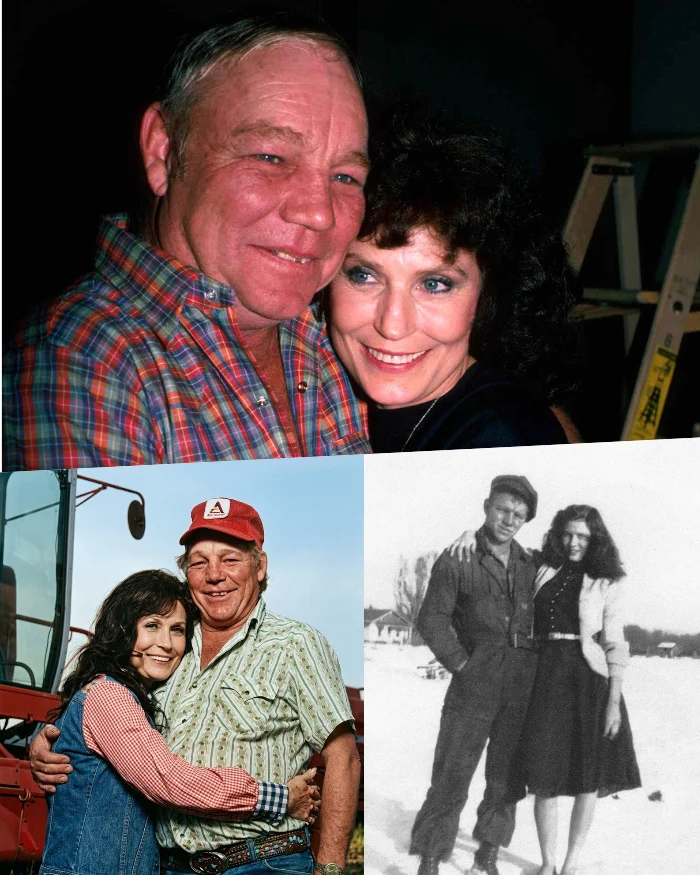
Before the world heard her name, Loretta Lynn sat in a cold Washington home with callused hands and a young heart carrying too much weight.
She was fifteen when she married Oliver “Doolittle” Lynn in January 1948 in Dickenson County, Virginia, after knowing him for barely thirty days.
Oliver was a twenty-one-year-old war veteran who soon packed their few belongings and moved the young bride thousands of miles from Butcher Hollow, Kentucky, to Custer, Washington.
Life in the Pacific Northwest was quiet, cold, and demanding. Loretta became a mother before turning sixteen and cared for four young children before her twentieth birthday.
Days were consumed by washing, cooking, and endless chores in a drafty house, while the volatile marriage carried drinking, fierce arguments, and painful betrayals.
Then came the gift that changed everything.
In 1953, Doolittle brought home a seventeen-dollar Harmony guitar from Sears. He placed it in her hands, told her she could sing as well as anyone on the radio, and urged her to write songs drawn from her own experiences.
You can sing as well as anyone on the radio.
Instead of breaking under the weight of an unpredictable home, she used her private hurts to create plainspoken, unyielding country music.
Loretta taught herself basic chords by callusing her fingers late into the night after her children were asleep.
She began composing simple, piercing melodies drawn from daily survival, her husband’s infidelities, and the exhaustion of rural homemaking.
Doolittle pushed her further, setting up her first live appearances at local Grange halls and taverns with a band called the Trailblazers.
Her breakthrough gathered momentum in early 1960 when Canadian businessman Norm Burley heard her perform in Tacoma and offered to finance a recording session in Los Angeles.
Loretta recorded her debut single, “I’m a Honky Tonk Girl,” on the small Zero Records label, backed by musicians who recognized her raw authenticity.
With several hundred vinyl copies packed into the trunk of their beaten-up 1956 Mercury sedan, Loretta and Oliver embarked on an audacious grass-roots road trip toward Tennessee.
They drove county to county, sleeping at roadside rest stops and eating canned sardines while walking unannounced into small-town radio stations to plead with disc jockeys to spin the record.
By the time they rolled down Broadway in Nashville, the independent single had climbed into the national country top twenty.
That momentum carried Loretta straight to the Grand Ole Opry stage in September 1960, earning multiple encores and leading to an enduring contract with Decca Records under legendary producer Owen Bradley.
Bradley refined her arrangements while keeping the unapologetic honesty that became her signature across landmark hits like “Don’t Come Home A-Drinkin’” and “Coal Miner’s Daughter.”
Their complicated union spanned forty-eight years until Oliver’s death in 1996, bound by grit, mutual dependence, and painful compromises.
Doolittle Lynn broke her heart repeatedly across five decades, yet he also bought the seventeen-dollar instrument and drove the old Mercury that carried her straight to the center of country music history.