
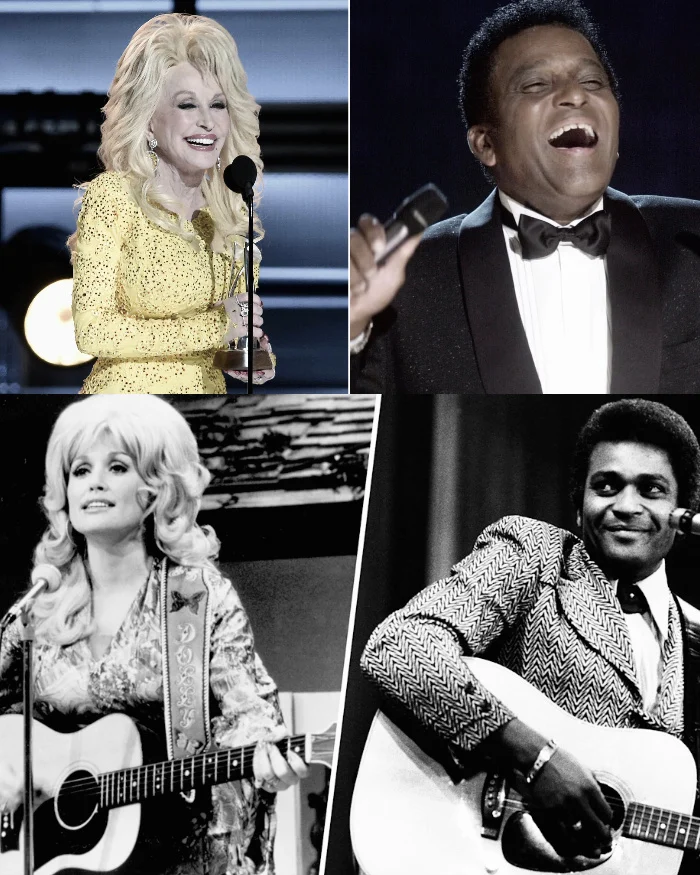
Thirty country stars stepped onto Nashville soundstages in 2016 to film the historic mashup Forever Country for the 50th CMA Awards, but the project gained its real authority from two artists who had spent fifty years shaping the format from the ground up. Charley Pride and Dolly Parton stood tall before the camera, and their presence carried a weight no visual effect could manufacture.
Director Joseph Kahn oversaw the production as a sweeping celebration. The ambitious medley wove together three definitive American recordings, John Denver’s “Take Me Home, Country Roads,” Willie Nelson’s “On the Road Again,” and Dolly Parton’s “I Will Always Love You.” The single debuted at number one on Billboard’s Hot Country Songs chart. Modern chart-toppers appeared alongside veteran performers against shifting digital projections of small towns, mountain ridges, and rolling highway lanes.
Producer Shane McAnally arranged thirty distinct vocal tracks, coordinating individual studio sessions in Nashville and piecing together lines recorded separately by artists spread across demanding touring schedules. Yet long before the high-tech polish, Pride and Parton had arrived in Nashville under circumstances that offered little guarantee of a future.
Parton came to town from Sevier County, Tennessee, in 1964, unpacking her bags the day after graduating high school. Pride grew up in a sharecropping family in Sledge, Mississippi, and entered Nashville studios in the mid-1960s after stints pitching in the Negro American League and working in a Montana lead smelting plant.
Pride faced an industry that had never witnessed an African American artist achieve mainstream country stardom, while Parton fought to maintain ownership of her publishing and autonomy over her career during an era that frequently sidelined female songwriters. Each would eventually receive the prestigious Willie Nelson Lifetime Achievement Award, Dolly in 2016 and Charley in 2020.
Their breakthroughs occurred side by side in the late 1960s and early 1970s on RCA Victor, working under the watchful eye of executive Chet Atkins. Parton built a national television following alongside Porter Wagoner and began releasing landmark solo compositions. Pride steadily accumulated twenty-nine number-one singles, beginning with early hits like “All I Have to Offer You (Is Me)” in 1969.
In 1971, both artists reached defining career milestones. Pride won the CMA Entertainer of the Year award, becoming the first Black performer to earn the organization’s highest individual honor. That same year, Parton scored her first solo chart-topper with “Joshua,” confirming her viability as an independent headliner.
Throughout the decades that followed, the two maintained parallel reputations for creative stubbornness and steady personal dignity. They navigated the changing mechanics of commercial radio without altering their core vocal identities. Recognition arrived in tandem as the century closed, when the Country Music Hall of Fame inducted Parton in 1999 and Pride in 2000, exactly one year apart.
That shared history gave the 2016 production a quiet resonance behind the scenes. When Kahn filmed the visual elements, he placed Parton and Pride in positions that grounded the production’s high-tech polish in tangible historical truth. Standing on a Nashville studio floor, separated by only a few feet of green screen and half a century of shared labor, they carried the full weight of the tradition they had helped build.
Their participation also marked a rare convergence of CMA lifetime honors. Parton accepted the Willie Nelson Lifetime Achievement Award during the 50th Annual CMA Awards broadcast. Pride received that identical honor in November 2020, during what became his final public performance before his death in December 2020 from complications of COVID-19.
Country music found its soul through artists who earned their place one stage at a time
Seeing them stand tall before the camera carried a weight no visual effect could manufacture. Pride’s passing made the collaboration one of the final times audiences saw him share a national spotlight with Parton. Their presence anchored thirty voices in a lived history of perseverance, reminding listeners that country music found its soul through artists who earned their place one stage at a time.