
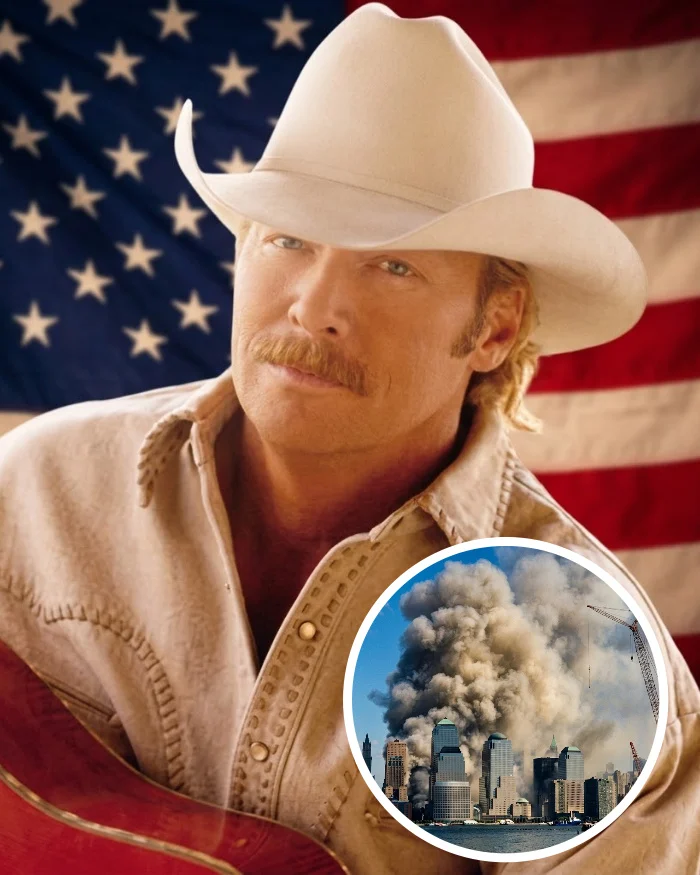
The Grand Ole Opry House sat in breathless silence after Alan Jackson’s last acoustic chord faded into a November night in 2001.
Seconds later the audience rose as one.
It was a country music awards show built for industry celebration, yet Jackson stepped to the microphone with something unreleased and deeply human.
He wore a low drawn white hat and carried only a guitar.
In the uncertain weeks after September 11 country radio had filled with loud calls to action and defiant anthems.
Alan Jackson did not sing about payback or military might.
He sat on a stool and offered a quiet reflection about watching the morning news, feeling small, and trying to make sense of a world turned upside down.
The song arrived from a sleepless moment.
On Sunday October 28 2001 Jackson woke at four in the morning with a complete melody in his mind.
Before his house stirred he went to his study and sang the rough idea into a handheld digital recorder so it would not slip away.
He did not want to make it a commercial single.
He feared releasing the track would seem like capitalizing on collective national mourning.
That hesitation softened after he played the rough tape for his wife Denise and his longtime producer Keith Stegall.
Stegall heard the weight of the writing and later played the finished track for executives at the RCA Label Group.
According to label chairman Joe Galante the room sat in stunned silence for a full minute.
On November 7 Jackson introduced “Where Were You When the World Stopped Turning” at the CMA Awards.
He set aside the commercial flair expected of a major broadcast.
His sparse arrangement carried faith, human frailty, and the shared confusion of ordinary people watching their world change forever.
By refusing to stoke anger Alan Jackson gave a shaken nation permission to feel vulnerable.
The response became an immediate logistical challenge for the music industry.
By the next morning radio programmers across the country did not wait for Arista Nashville to issue an official polished single.
Stations independently pulled raw live audio directly from the television broadcast and put it on the air to meet sudden public demand.
Caught off guard by the organic phenomenon the label scrambled to record and service a pristine studio cut.
The unvarnished television performance had already claimed its place in American history.
The song climbed straight to No. 1 on the Billboard Hot Country Singles & Tracks chart and crossed over to mainstream pop listeners.
It eventually earned Jackson the first Grammy Award of his career for Best Country Song.
For ordinary families holding each other a little closer it became a permanent home.