
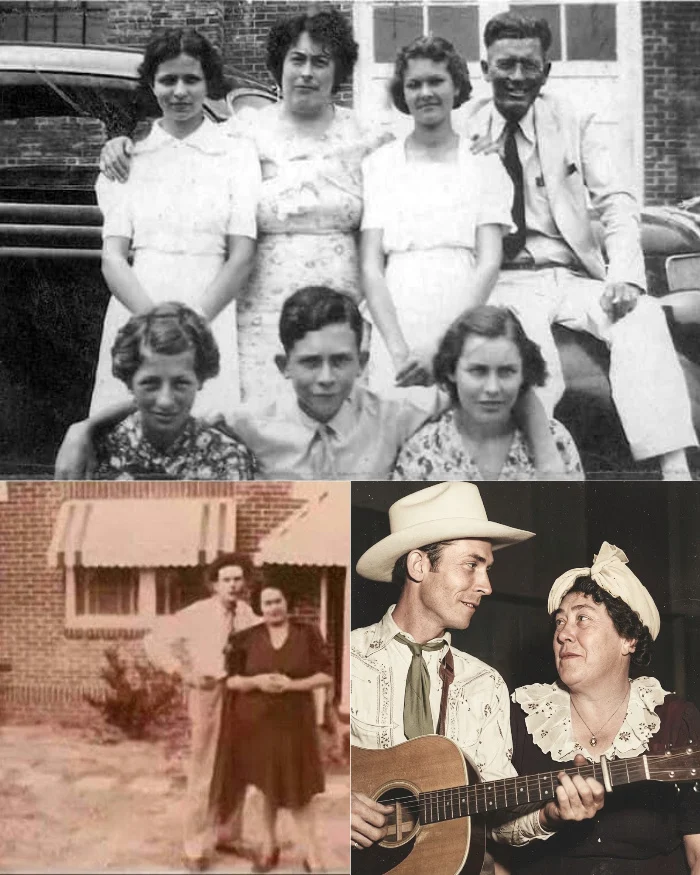
The smoke over Georgiana, Alabama, did not just destroy a house. It turned a child into a witness of hunger, charity, and sudden ruin. The boy standing in the ash would become Hank Williams, and the ache of that night would later give country music a voice for broken homes and lonely roads.
In the early years of the Great Depression, the Williams family had little to spare even before the fire. Hiram’s father, Lon, was away receiving treatment in a veterans’ hospital. That absence left Lillie to carry the weight of survival alone. When their frail wooden house burned down, it took their few possessions and the feeling of safety with it. Lillie, Hiram, and his sister Irene were left with almost nothing.
The community around them was already crushed by hard times. Neighbors who had barely enough gave what they could. Hand-me-down clothes and a daily meal became proof that charity was not a small thing in a town where everyone was struggling. Lillie anchored the family while moving through a patchwork of rural southern towns. She took any work she could find and later ran a series of boarding houses to keep a roof over their heads.
That loss stripped away the roots of a normal childhood. It also pushed the boy out into a wider world. In Georgiana, he crossed paths with Rufus “Tee Tot” Payne, a blues street musician who moved between railroad camps and town squares. Payne saw the fascination in the boy’s eyes and taught him the basics of the guitar and the heavy rhythmic sorrow of the blues.
The family had almost no money, so Lillie sometimes paid for the lessons with meals. From those exchanges Hank learned that music was more than entertainment. It was a way to process a hard life and a means to survive it.
When a boy hears his first sorrowful note, the wound can become a doorway.
When the family found a measure of stability in Montgomery in 1937, Hank took his guitar to the sidewalks outside local radio stations and theaters. He was not playing for fame. He was busking for spare change to help his mother pay for groceries.
Those years of rural poverty shaped the architecture of his songwriting. The ashes of that house left a permanent ache in him. They created a sense of not belonging anywhere. When he began writing his own material, he pulled from desperation that had lived inside him long before he knew how to construct a melody.
He often wrote about the stark divide between the wealthy and the working class. That perspective was born from wearing donated clothes while watching others live comfortably. He understood the visual contrast between a grand estate on a hill and a rundown shack. He used those class differences to illustrate romantic rejection and societal isolation.
The loss of his childhood home also turned him into a permanent drifter in his own mind. Long before he was touring the country, he was writing about endless highways, wandering souls, and the heavy burden of traveling alone. The lonesome drifting he sang about was not a manufactured persona. It was the reality of a boy who watched his only safe harbor turn to ash.
When he finally reached the stage of the Grand Ole Opry, he wore dazzling rhinestone suits that masked his impoverished origins. But the audience connected with the raw pain underneath the western tailoring. He sang with the conviction of a man who knew exactly what it meant to lose everything in a single night.
Listeners did not just hear a polished entertainer. They heard the authentic crack of a voice that had sung for supper on the streets of Montgomery. His ability to articulate profound loss made him a voice for the working class. He translated private childhood trauma into a universal language.
The fire in Alabama took away his home. The wandering that followed gave him his sound. He built an enduring musical legacy out of the ashes, turning ultimate instability into a catalog of truth that would outlast him by generations.