
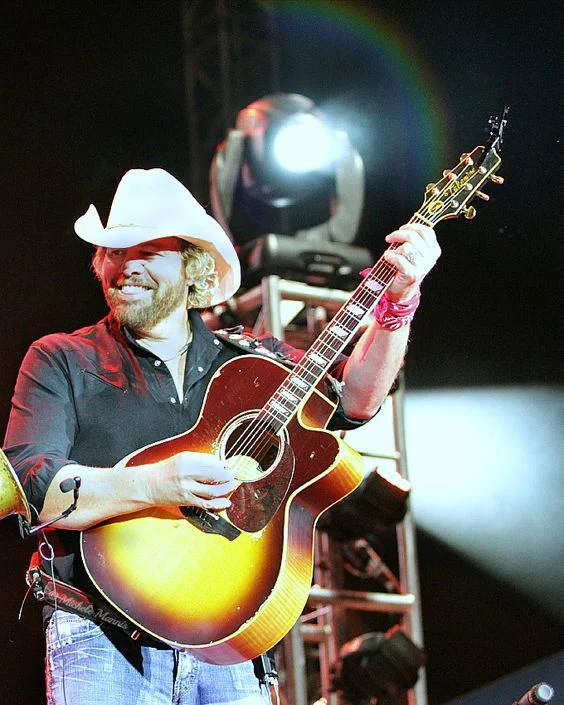
On a scorching afternoon two decades after its release, a construction crew takes a lunch break on a suburban strip. Their truck stereos duke it out across the asphalt—one channel spitting rock, another pumping country—until Toby Keith ′s machine‑gun verses cut through like a juggler strolling onto a crowded stage. One worker starts mimicking the rapid‑fire cadence, slightly offbeat, while another hurls the chorus back at him. The song becomes a social object again, a call‑and‑response ritual that breaks up the noon heat. Humor becomes durable when the groove carries it. This track laughs, but it also sticks to your shoe.
That groove was no accident. “I Wanna Talk About Me” landed in 2001 on Keith ′s album Pull My Chain, the follow‑up to his career‑reviving How Do You Like Me Now?! era. After years on Mercury, he was deep into his DreamWorks Records Nashville run, working with producer James Stroud, whose radio instincts kept the edges aerodynamic. The song itself was penned by veteran hitmaker Bobby Braddock, a master of the sly perspective shift. His pen fashioned a tightrope walk – a male narrator complaining with such cartoonish charm that the satire stays buoyant. The single topped the country chart later that year, and it still feels like a snapshot of the early 2000s moment when mainstream country welcomed speed‑talk, winked humor, and grooves that hit like a tailgate tapping the curb.
The arrangement does a lot of that smiling heavy lifting. Drums land with a clean, gate‑friendly punch: kick in the middle, snare with a neat crack, cymbals laid back to keep the verses uncluttered. A chugging rhythm section pulls like a small outboard motor – no overkill, just steady propulsion. Electric textures lock to the pocket while a bright acoustic strum keeps the contagion percussive. The mix shines with a well‑focused midrange: the vocal sits very close, almost as if the mic is inches from a confident grin. At the chorus, the track widens subtly, harmony vocals bloom around the hook, and the bass fattens with just a bit more air under it. You can hear the band leaving space for the talk‑sung verses – guitars are rhythmic rather than ornamental, clipped and crisp, designed to shade syllables without stealing momentum. A faint keyboard pad and a light piano figure add glue, rounding edges without waving for attention.
Calling it “talk‑rap” sells its musicality short, but the verses move like a modern patter song. Phrasing is machine‑stitched: short bursts, clenched rhymes, a smile you can hear. Keith′s delivery is half‑wink, half‑strut. He never tips into parody – he stays warm even when the lyric catalogs the lopsidedness of a one‑sided conversation. That′s where Braddock′s veteran seasoning shows. The humor is observational, not mean. The title line is a plea, but the performance makes it sound like a dance step – two beats forward, one beat back, everybody hops on the chorus.
“I like talking about you, you, you, you usually. But occasionally, I wanna talk about me.”
It helps to remember where Keith stood in 2001. He′d just shifted from solid ‗90s presence to a rafter‑rattling headliner whose songs could command both barroom sing‑alongs and office radios. Pull My Chain showcases a star confident enough to stretch. “I Wanna Talk About Me” is a novelty that isn′t only a novelty. It′s a lesson in mainstream craft: big hook, efficient runtime, elastic cadence, verses that land laughs even on the tenth spin. You can feel the label′s savvy – DreamWorks Nashville was adept at cutting through playlist clutter – and you can hear Stroud′s clarity in the way the track shakes hands with pop structure without losing its country handshake.
On the sonic surface, it′s a bouncy, grinning piece of music. Underneath, it illustrates something about couples and communication that′s still recognizable. The narrator is listless from listening – he wants a turn at the microphone. The song doesn′t wag a finger; it gets the grin first, and the subtext second. In that way, it belongs to a tradition of country humor where the joke is affectionate. The narrator wants attention, sure, but the affection is built in – this is a man who cares enough to keep showing up, rambling as he goes. The chorus becomes catharsis and a wry negotiation: your stories, then my stories, and we keep the beat together.
The production′s dynamics are subtle but meticulous. Verses sit slightly drier and narrower, with the rhythm section center‑weighted to emphasize speech. The chorus lifts with stereo widening – backing vocals open up, a supporting instrument brightens, the low end gets a touch more bloom. That shift is carefully rationed. The song doesn′t rely on a bridge to justify itself – it relies on repetition and contrast. That′s also why it wears so well on radio: the curve of energy resets every thirty seconds, a small recharge that flatters short attention spans without becoming shallow.
Late one night in a grocery store, a retired couple stood in the cereal aisle debating raisins. Over the ceiling speakers, the chorus ambled in, and they both started bobbing almost imperceptibly. Maybe they remembered a younger argument. Maybe they were just happy someone out there was moaning about not getting to talk for a change. The song is light, but it hangs around like a grin you rediscover in a drawer.
There′s also something instructive in the hybrid feel. Long before “country‑rap” became a talking point, this was a mainstream hit that normalized talk‑sung swagger inside a country frame. The trick is the chorus – melodically buoyant, pinning the verses to a tuneful home base. Without that, the patter would feel like a stunt. With it, the track breathes like a two‑room house: one room for chatter, one room for sing‑along, doors open between them. The groove is sturdy enough that you could imagine swapping out textures – more banjo, more steel – and it would still hold. The skeleton is that strong.
“Novelty” used to be a banishment word, but novelty is hard. Precision humor in three minutes, architected to be replayable, is craftsmanship. You can hear the craft everywhere: in how the pre‑chorus tilts into the hook, in how the rhyme schemes stack like cups, in the way the vocal rides the snare so vowels never get smeared. Listen with a good pair of headphones – the balance work gets even clearer, little fader moves that guide your ear, faint rhythmic accents you feel more than hear. This is a single that knows how to sit on a playlist and yet jump out of it.
Historically, the track also carries the footnote that Braddock originally offered it elsewhere. Blake Shelton had a pass at it early in his career before it landed with Keith. You can imagine alternate histories, different voices, different shades of mischief. But in this timeline, Keith′s specific mix of baritone poke and affable smirk was the right glove for the hand. He sounds like the guy at the end of the bar who′s complained just enough to be endearing, who knows precisely when to turn the mirror and make himself the punchline.
What about instrumentation beyond the obvious? You′ll catch small flecks: a lick here that answers a punchline, a brief slide that tilts a syllable toward a grin, a tidying keyboard layer gluing chorus edges. The piano is not the featured star, yet its presence rounds out the high‑mid sheen, cushioning the hook so it lands like a trampoline rather than a plank. Country radio in 2001 prized a certain forward brightness – this track gives you that, but its sense of dynamics keeps fatigue at bay.
Thematically, it′s easy to flatten the song into a caricature. The record is smarter than that. It understands that attention is the currency of intimacy, and it jokes in a way that both parties can enjoy. The chorus is not a decree but an invitation to reset the balance, if only for three minutes at a time. That′s why the humor stays buoyant – it′s anchored in recognition rather than scorn.
Culturally, “I Wanna Talk About Me” belongs to a latticework of early‑2000s country singles that learned to grin harder while the world was learning to worry more. Released in 2001, it lived in an autumn when the radio dial needed both ballast and escape. The record offered the latter without feeling frivolous. It′s bubblegum with calluses, as if someone lacquered a picket fence and then leaned boots against it.
From a listener′s standpoint, the song survives the migration from FM to phones. On a tiny speaker, the upper mids carry the wit. On a car system, the kick drum pins your knee. On a living‑room setup, the harmonies gain warmth. For home‑audio enthusiasts, the chorus stacking feels fuller than the verses by design – a gentle trick that keeps your focus toggling along with the form. If you search for “how did this become so catchy,” the answer is repetition polished to a shine. Hooks aren′t only melody – they′re phrasing patterns, vowel shapes, drums that never crowd the mouth.
It′s worth walking back to the career arc. Pull My Chain isn′t just a waypoint – it′s a statement. Keith and Stroud had found a commercial lane that fused barstool humor to stadium‑friendly choruses. The album leans into everyday language and clean production, and this single functions as both comic relief and brand signature. By the end of 2001, his path to arena headliner was paved not only with chest‑out anthems but with this kind of smirking, conversational jam that made him feel like a buddy – just a very loud buddy with a microphone.
If you′re the type to explore further, trace how the song balances textures. The snare has a sturdy attack and brisk decay, avoiding splash that would muddy the syllables. The bass is present but reined in, more tight belt than elastic band. Guitar figures either chime on top or mesh with the drums to act like additional hi‑hats – arrangement as crowd management, getting bodies to move without calling undue attention to any one dancer. The whole record is an object lesson in “don′t clutter the joke.”
And the hook – let′s talk about the hook. The title phrase is both headline and thesis, the kind of line that practically asks for air quotes. It lands the first time because the verses set it up like a comedian setting a trap. You feel it coming, you want it to arrive, and the melody delivers relief. That′s why the record keeps working at wedding receptions and office mixes and interstate playlist detours. The structure is simple, but the payoff math is exact.
Here′s the paradox that keeps me returning: for a song about wanting to monopolize the conversation, “I Wanna Talk About Me” leaves room for you. It′s participatory. You can sing along as the aggrieved narrator, or you can laugh at him and harmonize anyway. Comedy takes courage. Pop takes timing. Country thrives on both. This track has all three.
“Humor becomes durable when the groove carries it – this single laughs, but it also sticks to your shoe.”
Some parting pragmatics for curious listeners: try one pass in a quiet room, volume down a notch, to hear how the consonants click together. Try another with volume up, windows down, to feel how the chorus widens. If you want to hear the production scaffolding, a high‑quality stream will reveal the careful layering of voices in the refrain. If you′re studying delivery, the talk‑sung verses are a seminar in enunciation that stays musical without straining. It isn′t a technical showpiece, but it shows technique.
A final thought about the lyric. By making the narrator just a tad ridiculous, the song gives everyone else permission to recognize their own conversational greed. It′s a light lift toward self‑awareness, which might be why it feels oddly humane two decades on. In a world of endless feeds, the idea of asking for your turn is both funny and true. The record doesn′t moralize – it smiles. And then, if you′re not careful, you′re smiling back.
As the last chorus fades, the track doesn′t exhaust you – it resets you. You can play it again without feeling like you′ve eaten too much sugar, because the balance between chatter and tune, between joke and craft, stays honest. That′s the line the single walked in 2001, and it still walks it now. If it′s been a while since you heard it, give it another spin. It might not change your mind about anything grand, but it will change your afternoon.
Listening Recommendations
- Brad Paisley – “Online” — Similar humor‑forward storytelling with sleek 2000s Nashville polish and a chorus that blooms wide.
- Blake Shelton – “Some Beach” — Deadpan verses with a big sing‑along hook, capturing everyday gripes with a grin.
- Big & Rich – “Save a Horse (Ride a Cowboy)” — Talk‑sung swagger meets party‑band energy for a hybrid stomp that mirrors the era′s blend.
- Joe Diffie – “Pickup Man” — Classic novelty charm with airtight phrasing and a hook designed for communal choruses.
- Toby Keith & Willie Nelson – “Beer for My Horses” — Story‑driven, plainly phrased verses that snap into a memorable refrain, adjacent in spirit and era.
Video
Lyrics
Yeah, yeah
That′s right
We talk about your work, how your boss is a jerk
We talk about your church, and your head when it hurts
We talk about the troubles you been having with your brother
About your daddy and your mother and your crazy ex‑lover
We talk about your friends, and the places that you′ve been
We talk about your skin and the devils on your chin
The polish on your toes and the run in your hose
And god knows we′re gonna talk about your clothes
You know talking about you makes me smile
But every once in a while
I wanna talk about me, wanna talk about i
Wanna talk about number one, oh my, me my
What I think, what I like, what I know, what I want, what I see
I like talking about you, you, you, you usually
But occasionally, I wanna talk about me (me, me, me, me)
I wanna talk about me (me, me)
We talk about your dreams, and we talk about your schemes
Your high school team and your moisturizing cream
We talk about your nanny up in Muncie, Indiana
We talk about your grandma down in Alabama
We talk about your guys of every shape and size
The ones that you despise and the ones you idolize
We talk about your heart, ′bout your brain and your smarts
And your medical charts and when you start
You know talking about you makes me grin
But every now and then
I wanna talk about me, wanna talk about i
Wanna talk about number one, oh my, me my
What I think, what I like, what I know, what I want, what I see
I like talking about you, you, you, you usually
But occasionally, I wanna talk about me (me, me, me, me)
I wanna talk about me (me, me)
I wanna talk about me (me, me, me, me, me)
I wanna talk about me (me, me, me, me, me)
You, you, you, you, you, you, you, you, you, you, you, you, you
I wanna talk about me
I wanna talk about me, wanna talk about i
Wanna talk about number one, oh my, me my
What I think, what I like, what I know, what I want, what I see
I like talking about you, you, you, you usually
But occasionally, I wanna talk about me (me, me, me, me)
I wanna talk about me (me, me)
I wanna talk about me (me, me, me, me)
Oh, me (me, me, me, me)