
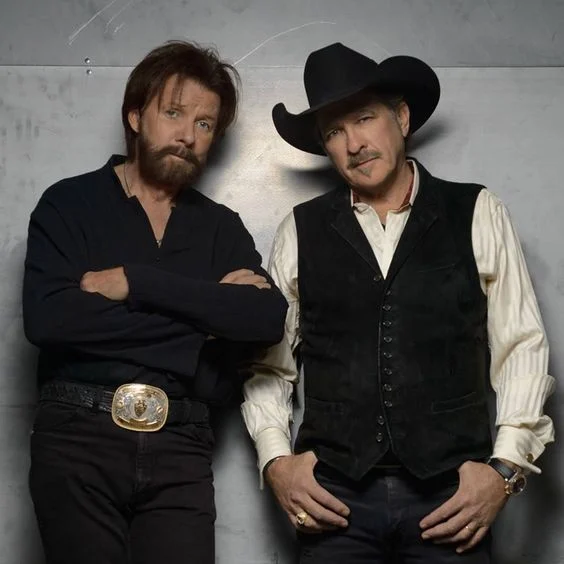
There is no single moment when Ronnie Dunn’s voice enters “Neon Moon.” It arrives like a slow exhale, a sound that has already accepted the weight of the room before the first word is sung. The song doesn’t announce itself with a flourish. It eases in, a clean electric figure tracing the outline of an empty bar, a few notes that feel less like an introduction and more like a memory you didn’t know you had. For the listener on a long highway, or the one sitting in a parked car at the edge of a parking lot, it becomes something more than a track. It becomes a quiet companion.
Released in 1992 from the duo’s landmark debut album Brand New Man, the song was a solo write for Dunn and produced by Don Cook and Scott Hendricks. It climbed quickly to the top of the country charts, but its real success has little to do with numbers. It has to do with the space it occupies in the mind. Where other hits from that era leaned into bombast and arena-sized hooks, “Neon Moon” leaned back. It trusted the silence between notes. It trusted the listener to meet it halfway.
There is a remarkable economy to the arrangement. Nothing rushes. The pedal steel moves like steam rising from a cup left too long on the bar top. The bass walks with the patience of a bartender who has heard every story before. The drums mark time without insistence. Kix Brooks folds his harmony around Dunn’s tenor like a friend who knows that words are sometimes less important than presence. The mix is wide enough to let every instrument breathe, but intimate enough that you feel the room. If music could be architecture, this song would be a booth in the back corner, upholstered in worn vinyl, beneath a flickering sign.
Dunn’s vocal is the center that holds everything in orbit. He is known for power, for the kind of voice that can fill a stadium without a microphone. But here, he practices restraint. He sustains phrases as if balancing a glass, not a drop wasted. The vibrato is measured. The phrasing respects the plain-spoken ache of the lyric. In a genre that often celebrates the grand gesture, “Neon Moon” favors the small human movements: the glance out a window, the hand around a bottle, the slow turn of a barstool. It is a song that understands the gravity of everyday ritual.
The imagery is archetypal without being generic. Neon is kitsch and chrism at once, cold to the touch but warmer than darkness. The song knows both sides. When Dunn sings, he inhabits a paradox: the solitude that becomes communal precisely because everyone else in the bar is practicing the same solitude. Under that light, no one needs to pretend. The beauty of “Neon Moon” is that it does not judge the ritual. It just documents it.
From a technical perspective, the track rewards careful listening. The panning is sensible. Instruments occupy defined lanes. The vocal sits front-center without crowding. The midrange is where the magic lives: that is where the voice glides, where the steel curls, where the room tone lingers. The high end is smooth. The low end is supportive but not swollen. This is one reason the song has aged so well. Production trends shift. Compression fads come and go. But a balanced spectrum and elegant separation never date.
“Neon Moon” also works because it invites the listener to be the final instrument. The lyric leaves space for projection. The bar is a place and a metaphor. The neon moon is a witness. What your mind supplies completes the image. This is storytelling the old way, with the audience as collaborator.
Consider the scenes that unfold around this song. A night-shift hospital worker sits in a parked car, queuing the track before heading home, taking a quiet minute to let the neon concept become a small sanctuary before morning breaks. A couple in their forties cleans up after a birthday party and puts on the song because it is short and familiar. Halfway through, they slow without discussing it, turning the kitchen into a dance floor. Memory tethers to melody, and the room warms. A traveler in a motel off the interstate, curtains cracked so that a real neon sign throws pink across the bedspread, hears the harmony on the chorus and picks up the phone to call a friend they have not spoken to in a year. The music did not fix anything. It simply made a space where reaching out felt possible.
This is the quiet keystone of the Brooks & Dunn catalog. The duo had flashier singles, bigger crescendos. But if you ask fans for the one that finds them when the night quiets down, they often point to this. It solidified Dunn’s reputation as one of the era’s most affecting vocalists. It framed Brooks as a harmony partner who understood when to let the story lead. Together, they made a promise on their debut: we can fill arenas and still sing to the last booth at the back.
From a compositional standpoint, the contours are logical. The verse lines ascend slightly, as if lifting the gaze to the sign. The chorus resolves by grounding the melody in a more stable figure. The hook is strong enough to anchor the entire narrative without overexposure. Even the bridge, more a gentle pivot than a full scenic detour, honors the song’s stoic temperament. If you are learning to sing the melody or pick the part, you discover that simplicity asks for humility. The line does not need ornaments. It needs belief.
The track has inspired covers across genres. Its melodic bones are sturdy enough to support different dressings: acoustic campfire versions, pop crossovers, even dance-adjacent reinterpretations. That is a sign of a song that lives beyond its era. It is not just nostalgia. It is architecture flexible enough to be redecorated without collapsing.
Revisiting “Neon Moon” today, what stands out is how it avoids cynicism. The narrator is wounded, not bitter. There is a dignity in that distinction. The melody does the escorting. The imagery does the hosting. You walk in empty, and you leave recognized. The song promises not resolution, but reflection. And that promise has held for more than three decades.
If you are hearing the song for the first time, listen for the way the vocal breathes at the end of lines. Notice how the steel lifts without sobbing. Pay attention to the single accent notes the electric guitar places like coasters under glasses. And when the chorus returns, compare your posture to the first time it arrived. Odds are you will be a little more still, a little more present with whatever you brought into the room.
Play it at conversational volume. Let the room shape the sound. The hymn here is in the hush. “Neon Moon” glows not because it is bright, but because it is honest about the dark around it.
Neon Moon glows not because it’s bright, but because it’s honest about the dark around it.
Listening Recommendations
George Jones — “He Stopped Loving Her Today”: A benchmark of country heartbreak with string swells and stoic pacing that echoes “Neon Moon”’s poise.
Alan Jackson — “Midnight in Montgomery”: Nocturnal atmosphere and restrained storytelling that turns the night itself into a character.
Brooks & Dunn — “My Next Broken Heart”: Same era, brisker tempo; shows the duo’s range from tear-stained barroom to radio-ready strut.
LeAnn Rimes — “Blue”: A classic torch feel with pedal steel sighs, adjacent in mood and vintage color.
Blake Shelton — “Neon Light”: A later-generation answer song that plays with neon imagery and modern production while tipping its hat to tradition.