
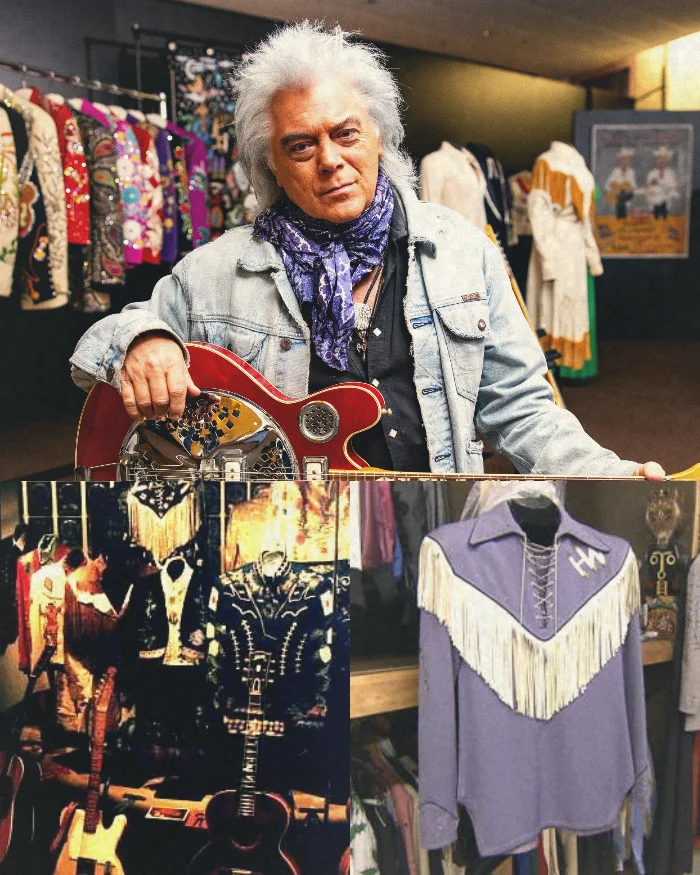
Marty Stuart spent decades quietly pulling country music history out of curbside trash cans and damp basements with his own hands, long before anyone in Nashville called it a mission. He began saving tiny relics at thirteen while riding with Lester Flatt’s touring band. Tour laminates and backstage tokens were the first pieces of a collection that would grow beyond twenty thousand artifacts.
By the late 1980s and the 1990s, Music Row was cleaning out basements and tossing physical history into dumpsters. Record labels discarded master tapes. Families parted with heirlooms. Stuart drove his pickup across Tennessee with personal savings in hand, buying up neglected estate-sale items and rescuing handwritten song drafts, original negative strips, stage clothes destined for local landfills, and yellowed paper that legends had left behind.
He saved the worn road boots Patsy Cline traveled in and the handwritten lyrics of Hank Williams. He gathered Hank Williams’s Martin acoustic guitar, Clarence White’s landmark 1954 B-Bender Fender Telecaster, and hundreds of rhinestone suits stitched by Nudie Cohn.
He did not collect relics as a dealer. He carried them as sacred cultural heritage.
When veteran artists saw that devotion, they bypassed commercial institutions and gave Stuart their belongings directly. Bill Monroe handed him instruments. Johnny Cash and June Carter entrusted him with stage wear, private letters, and treasured guitars because they knew the pieces would never be sold for profit.
Instead of locking the archive in a private vault or hiding it in climate-controlled storage outside Nashville, Stuart brought every instrument, photograph, and notebook back home to Philadelphia, Mississippi.
That choice became Marty Stuart’s Congress of Country Music, a 50,000-square-foot cultural campus on Byrd Avenue designed to bring American roots music to rural working families. The project was developed with the state of Mississippi, local civic leaders, and the Smithsonian Institution.
The first phase centered on the Ellis Theater, a 1926 cinema and performance hall that had fallen into deep disrepair. Stuart led a multi-million-dollar restoration that turned the building into a 500-seat acoustic theater with state-of-the-art sound engineering and broadcast recording capabilities.
When the Ellis Theater opened in December 2022, Stuart did not make the stage an exclusive showpiece. He launched a year-round calendar of live performances that brought Hall of Fame members, bluegrass masters, blues musicians, and local gospel groups to Neshoba County.
The road kid who learned from legends built an enduring home for the people who built him.
Behind the theater, the broader campus continues to unfold as a public place where young musicians and working families can touch the roots of the music that shaped America.