
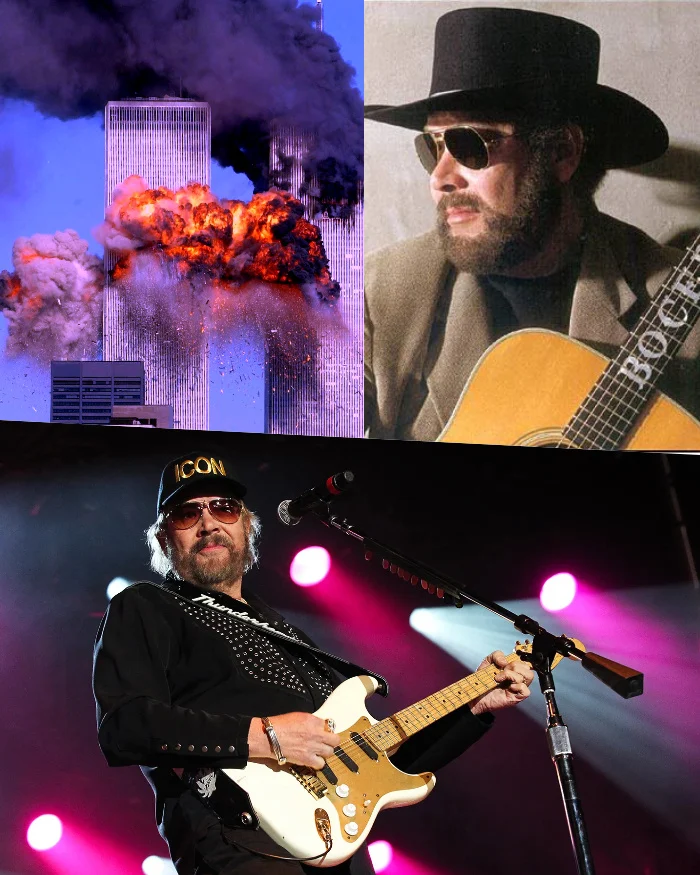
The night the nation felt exposed, a familiar country voice did not shout. He picked up a guitar and turned a stubborn rural anthem into a shared promise. That quiet choice helped many listeners breathe through grief.
Hank Williams Jr. built his career on swagger, but the recording that carried him into a mourning nation came from a weathered one-room brick building near Troy, Alabama. The space was an old roadside juke joint where his father had played in the late 1940s. Williams bought the property and brought a small acoustic band into the room. He used vintage equipment and kept overdubs minimal, so the creak of floorboards and the natural resonance of the walls became part of the music.
Those sessions shaped what became The Almeria Club Recordings, released in January 2002. Williams set aside the big arena arrangements that had fueled his multi-platinum peak in the 1980s. Circle playing, acoustic guitars, dobro, fiddle, and spontaneous first takes replaced studio gloss. The result felt closer to memory than marketing.
Then the attacks of September 11 shattered the country’s sense of safety. Across the nation, listeners searched for reassurance, and country music answered with pride and shared mourning. In those weeks, Williams returned to one of his most recognizable songs, A Country Boy Can Survive, originally released in January 1982. He did not ask another writer for help. He sat with his own classic and carefully changed its meaning.
The new version became America Will Survive. The lyrics moved away from solitary backwoods defiance and toward national resolve. The song now honored workers, first responders, and a country trying to stand together. Williams placed it as the thirteenth and final track on the album. After twelve songs steeped in delta blues, country tradition, and Southern history, the acoustic closer arrived like a hand on the shoulder.
The familiar melody offered safety when the world felt unstable, and the rewritten message turned personal grit into collective endurance.
Released to radio late in 2001, the song entered the Billboard Hot Country Singles and Tracks chart and climbed to number 45. It did not match the runaway heights of his 1980s anthems, yet its power was measured in rooms where people came to remember. Williams brought it to national fundraisers and memorial stages, standing before first responders and working-class crowds. The song became a sonic monument, a place where grief could settle without being softened.
What made the moment endure was not volume. It was the plain, steady sound built in that Alabama room. The acoustic foundation carried straight into the reworking, giving the performance a measured tone rather than brassy arena bluster. In a time of fear, a rural individualist anthem became a national hymn of survival.