
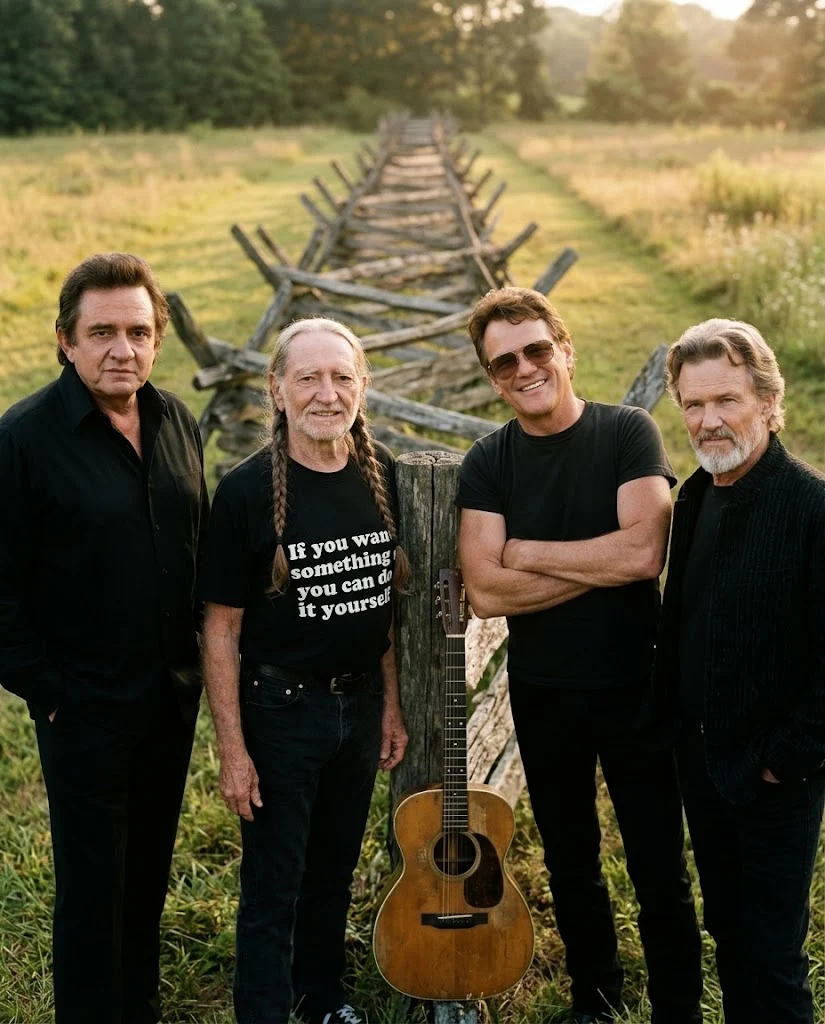
The microphone became a confession booth in 1985 when Johnny Cash, Waylon Jennings, Willie Nelson, and Kris Kristofferson stood shoulder to shoulder and sang about age, regret, and a train that might not wait.
They had already conquered Nashville with “Highwayman,” a number one anthem that made their outlaw brotherhood feel immortal. Yet the follow-up chose a quieter and more dangerous truth. The four men turned to Guy Clark’s “Desperados Waiting for a Train”, a 1975 ballad about a young narrator watching an aging oil-field worker. It appeared on their 1985 debut collaborative album and later climbed into the Top 20 on the Billboard Hot Country Singles chart.
Clark originally wrote the song about a man named Jack, a steady figure in his life and his grandmother’s companion. The original portrait was tender and personal. Then the recording changed everything. A solitary memory became a shared confession.
At Moman’s Recording in Nashville, producer Chips Moman divided the verses among the four singers. Kristofferson began, Jennings carried the weight forward, Nelson deepened the ache, and Cash arrived with the sharpest line about an old hero nearing eighty.
“One day I looked up and he’s pushin’ eighty / And there’s brown tobacco stains all down his chin.”
When Nelson and Cash joined for the final verse about visiting the old hero the day before he died, they were no longer playing characters. They were singing to one another.
That moment reframed the song. It stopped being a story about another man and became a mirror held up by four exhausted legends.
By the mid-1980s, country radio was drifting toward younger faces and smoother production. Cash, Jennings, Nelson, and Kristofferson did the opposite. They leaned into their miles, their damaged voices, their battles with addiction, their failing health, their broken marriages, their graying hair, and the fatigue in their bones.
The image of aging gunfighters waiting on a dusty platform fit them perfectly. They had spent the 1970s attacking Nashville’s polished machine. Now they were confronting mortality, the one rule no outlaw could break.
The track’s deeper victory was emotional. It let millions of listeners watch the outlaws grow old without pretending they were still bulletproof.
Decades later, with Cash, Jennings, and Kristofferson gone, the recording feels like a quiet prophecy. It is not simply a performance. It is four road-worn brothers closing their eyes and waiting for the train.