
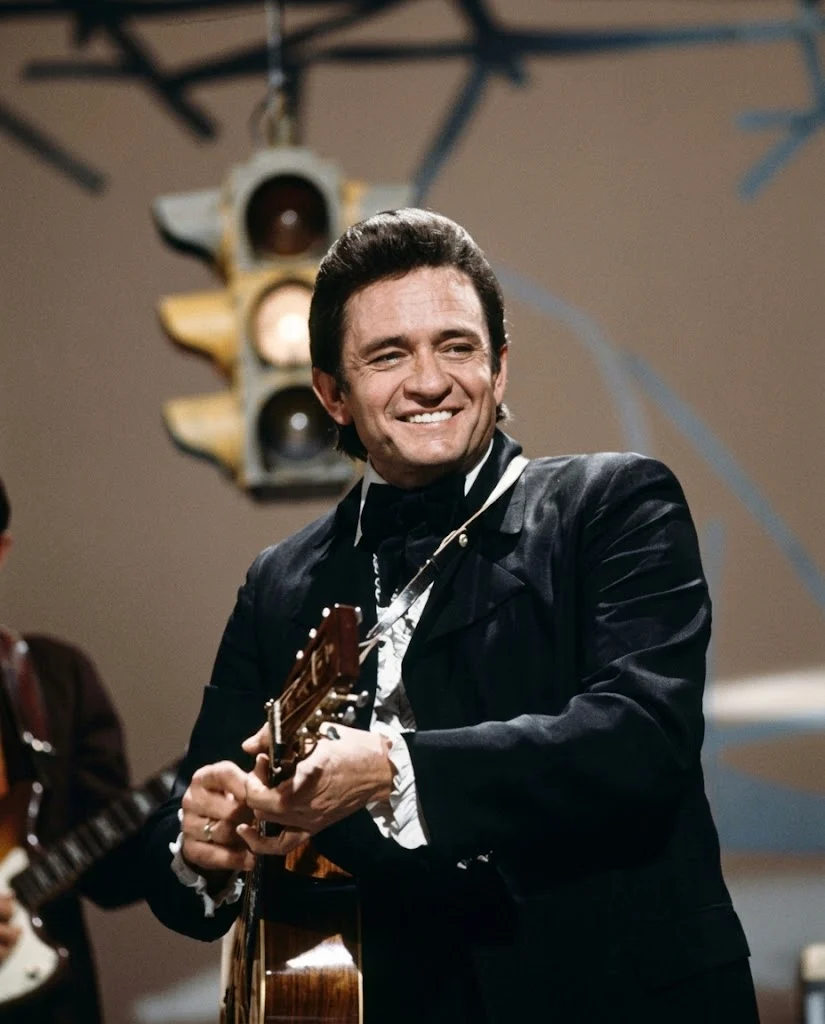
In a quiet California house, Vivian Liberto sat alone while her husband’s voice floated from the radio, swearing fidelity to the whole country. Johnny Cash had become the Man in Black, yet the vow he sang to millions was already breaking the woman it was meant to save.
Before the legend, he was J.R. Cash, an eighteen-year-old Air Force recruit who fell for seventeen-year-old Vivian at a San Antonio roller rink in the summer of 1951. They had only three weeks together before he crossed the Atlantic to Landsberg, Germany, for a three-year deployment.
With an ocean between them, their love lived in handwritten pages. Cash wrote almost every day, and Vivian kept more than 10,000 pages of his letters. Those faded sheets reveal a different young man, not an outlaw, but a homesick soldier terrified of losing her.
He promised her a simple life after the uniform. He came home in 1954, married her within a month, and settled in Memphis, Tennessee, hoping to build the quiet future he had sworn to protect.
Then Sun Records changed everything. By 1956, Cash was a rising star trapped in the relentless machinery of the music business. Backstage in Gladewater, Texas, he wrote a song as a musical tether to Vivian, a public vow that he would remain faithful despite the miles.
“I Walk the Line” was not merely a hit. It was a husband reaching through the noise of fame, begging his marriage to survive.
The song soared, and so did the pressure. Cash played up to 300 shows a year, leaned on amphetamines to keep moving, and pulled Vivian and their four daughters to a sprawling property in Casitas Springs, California. He wanted peace. She got isolation.
While audiences cheered under bright lights, Vivian raised their children alone in an empty house. The cruel irony arrived through the airwaves, her husband singing his pledge to strangers while smoke, pills, and absence hollowed out their marriage.
By 1966, the vow could not bridge the chasm. Vivian filed for divorce to protect her daughters, ending the marriage that the song had once tried to save.
“I Walk the Line” remains a timeless anthem of devotion, beloved by generations who know the melody but not the woman behind it. The world kept the song, and Vivian kept the letters, the fading proof that before fame, before addiction, before the stage lights, his promise was once real.