
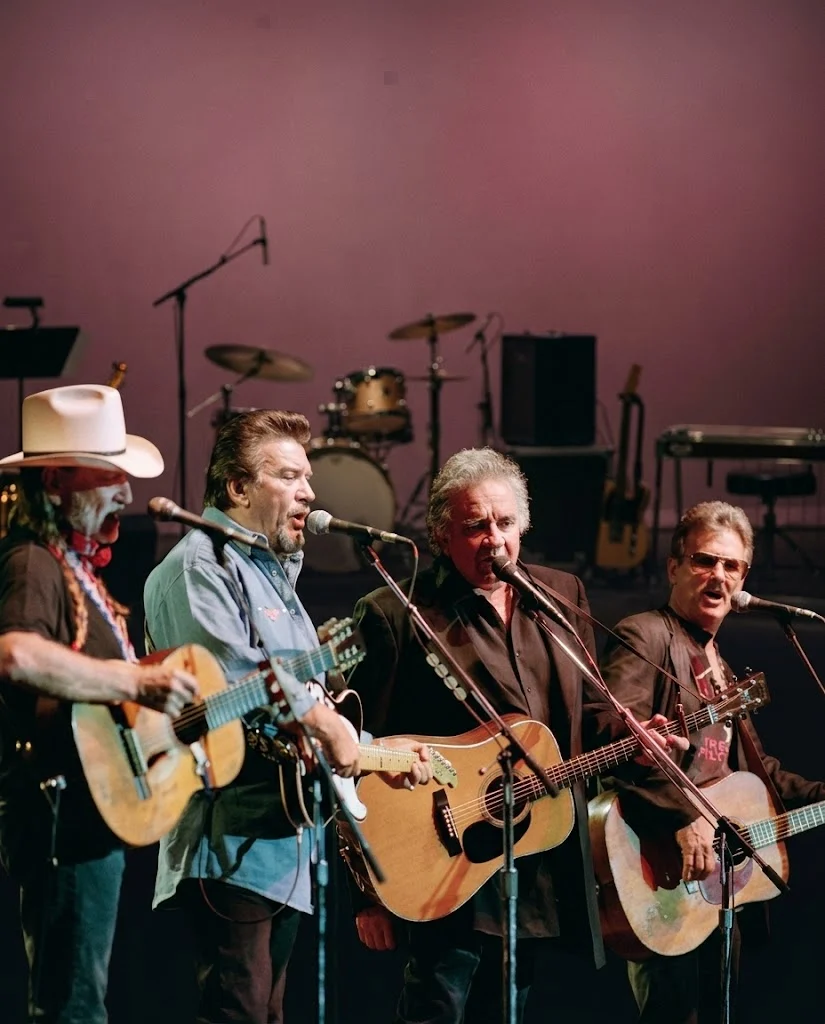
Four aging rebels stood shoulder to shoulder in a Nashville booth and sang about cheating death itself. The moment felt less like a recording session and more like a confession among survivors.
Johnny Cash, Willie Nelson, Waylon Jennings, and Kris Kristofferson had already fought Music Row, chased hard living, and carried public scars. In 1985 they turned Jimmy Webb’s forgotten dream into “Highwayman.”
Webb had woken in a London hotel room with sweat on his skin and a song in his head. The dream had arrived after a night out with songwriter Harry Nilsson. He wrote a soul moving through time as a thief, a sailor, a dam builder, and an astronaut.
Webb recorded it in 1977. Glen Campbell covered it two years later. Both versions drifted quietly through the country landscape.
The idea waited until 1984. Cash, Nelson, Jennings, and Kristofferson were in Switzerland filming a holiday special and decided to make an album together. Returning home, they needed material. Campbell first played the forgotten track for Cash. Marty Stuart also urged Cash to record it, noting the spiritual math in the song. Four verses. Four souls. Four men.
The parts matched the men almost too perfectly. Nelson became the wandering thief holding up travelers on old roads. His voice moved with the restless freedom he had lived on the highway.
Kristofferson became the sailor in a violent storm. The former military helicopter pilot and Rhodes Scholar gave the second verse a weathered intensity.
Jennings sang as the builder who fell into the foundation of the Hoover Dam. His delivery carried the unyielding weight of a man who helped build the Outlaw movement.
Cash took the final turn as the starship captain looking across space. His deep baritone closed the song with the gravity of someone who had walked through fire and found peace.
Webb later said he never learned exactly how the men chose their verses. He felt Cash’s closing voice was like the voice of God ending the track.
The record rose to the top of the Billboard Hot Country Songs chart and stayed there for 20 weeks. It won the Grammy Award for Best Country Song in 1986. It also gave the quartet their official name, The Highwaymen.
The true power came from the people at the microphone. These were not hired characters. They were four men singing about survival while their own survival was already written into the sound.
Webb’s forgotten dream had finally found its body. In the hands of four aging rebels, it became a permanent testament to refusing to fade away.