
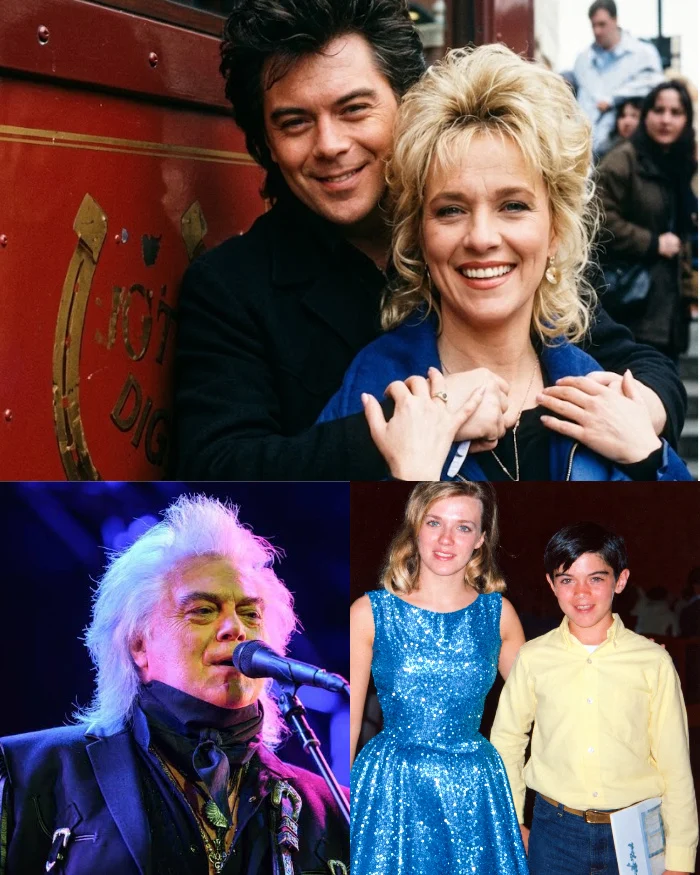
On July 8, 1997, Marty Stuart and Connie Smith married in Nashville and turned a childhood vow into a living partnership. The story behind that wedding did not begin with a polished industry introduction. It began in a Mississippi summer with a boy in a bright yellow shirt who believed he could be seen by the singer he loved.
In the summer of 1970, eleven-year-old Marty Stuart asked his mother, Hilda, for the brightest yellow shirt she could find. Connie Smith was scheduled to perform at Choctaw High School in Philadelphia, Mississippi. Marty already felt pulled toward her voice, and he feared being swallowed by a huge crowd.
His plan was simple and fiercely innocent. If he wore a blinding color, he reasoned, the star on the stage would have no choice but to look down and notice him. The yellow shirt became a small beacon of hope under the stadium lights.
“The yellow shirt became a small beacon of hope under the stadium lights.”
The shirt worked. Marty pushed to the front, caught Connie Smith’s eye, and secured a brief backstage meeting with an autograph. When he went home, he told Hilda that he was going to marry Connie Smith one day.
“He was going to marry Connie Smith one day.”
Most childhood promises fade. Marty Stuart’s did not. By thirteen, he was touring professionally with bluegrass legend Lester Flatt. Later, he spent a decade playing guitar in Johnny Cash’s band.
Connie Smith remained one of the genre’s most respected voices. Dolly Parton famously declared that there were only three real female singers in the world, Barbra Streisand, Linda Ronstadt, and Connie Smith. As Marty built his own reputation in Nashville, the woman from his childhood memory stayed woven through his path.
Nearly twenty-five years after that first meeting, the pair reconnected professionally while preparing new material for Connie Smith’s projects. The writing room quickly became a place where professional boundaries softened and personal truth emerged.
The romance faced obstacles. Connie Smith was seventeen years older than Marty Stuart, and both had navigated previous divorces under public pressure. Nashville could be unforgiving toward unconventional love. Yet the creative alignment between them mattered more than the numbers on paper.
When they married, two distinct eras of country music joined households and stages. Marty Stuart did not step back from his own career, and he did not step over hers either. He became one of her strongest supporters.
He served as the primary producer for her critically acclaimed 1998 comeback album, “Connie Smith,” and they co-wrote the majority of the project’s tracks. The studio became a shared language, and that language shaped the next two decades of their life together.
As Marty Stuart became a fierce guardian of traditional country music and an archivist of its physical history, Connie Smith remained a vital presence in his daily work. When he launched “The Marty Stuart Show” on RFD-TV in 2008, she did not become a background name. She became a permanent resident cast member.
Week after week, she brought her unmistakable vocal power to television audiences and proved that her voice remained entirely intact. Their public partnership was not a costume. It was a working marriage built on respect.
Their artistic conversation deepened with time. In 2021, Connie Smith released “The Cry of the Heart,” her fifty-fourth studio album and her first release in a decade. Marty Stuart was once again behind the production console. They wrote the material together and continued a shared musical dialogue that outlasted decades of shifting trends.
Today, their partnership spans more than a quarter of a century of shared stages, writing rooms, and Grand Ole Opry appearances. The age gap never dictated their daily reality. They functioned as devoted spouses and trusted collaborators, absorbing the pressures of the entertainment business.
The enduring marriage did not start with glamour or strategy. It started because a young boy believed enough in his own future to wear a bright yellow shirt and demand to be seen by the singer he loved.