
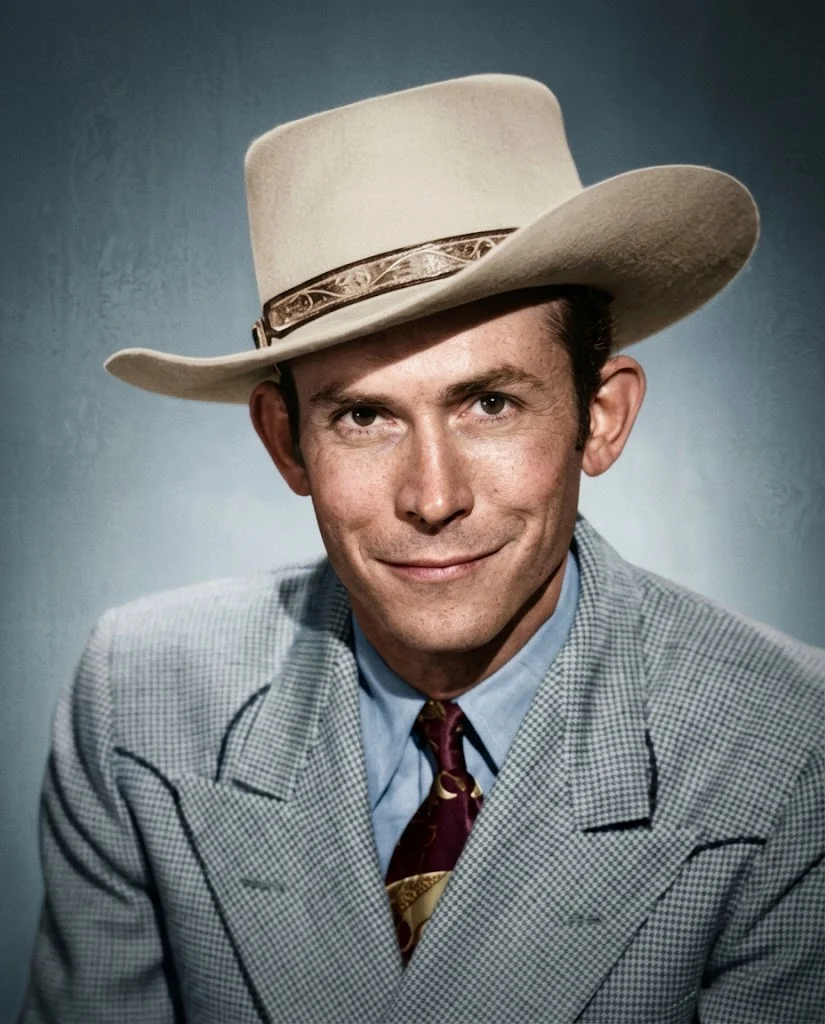
January 1 1953 brought a frozen car, a dead twenty-nine-year-old country legend, and a body held together by pain, braces, and borrowed chemical relief. Hank Williams gave the world a voice made of heartache, and his last year on the road reveals a fragile spine, failed surgery, predatory medical care, and a man who kept performing while his body gave out.
Born with spina bifida occulta, Williams carried a silent spinal defect from the beginning. The condition left his lower vertebrae vulnerable and made chronic back trouble a familiar companion through his youth and early touring years.
By the early 1950s he had become the defining figure of American country music. From the Ryman Auditorium to packed roadhouses across the South, the Alabama singer commanded attention in custom western suits crafted by Nudie Cohn. The rhinestones and embroidered designs made him look larger than life, but the stage costume also concealed a rigid medical back brace strapped around his torso.
The hidden brace was not vanity or flair. It was support for a spine that had been pushed past its limits. In late 1951, while hunting near Franklin Tennessee, Williams slipped and fell from an elevated deer stand. The impact struck already damaged vertebrae and created severe spinal trauma.
In December 1951, doctors at Vanderbilt University Hospital in Nashville operated on him. The surgery did not relieve the pain. It left persistent nerve problems, muscle spasms, and worsening mobility, while the touring calendar offered no mercy.
He did not take the microphone because the pain had stopped. He took it because the contract had not stopped.
Desperate to keep working, Williams turned to Horace Marshall, an unlicensed practitioner who presented himself as a doctor. Marshall supplied heavy doses of morphine, chloral hydrate, and strong sedatives. Those substances were not a carefree lifestyle choice. They became a daily shield against unbearable physical pain.
Alcohol and prescription drugs worsened the danger, yet promoters and venue managers mostly saw a difficult artist. They did not see the untreated spinal trauma that made walking between dressing rooms an agonizing effort. His weight dropped, his hands trembled, and bandmates steadied him backstage.
Even then, he honored his obligations night after night. He walked onto bandstands and sang his most famous songs with emotional conviction while his body fought him with every step.
The final journey came through freezing weather as Williams traveled to a New Year’s Day concert in Canton Ohio. He died from heart failure in the backseat of his car on January 1 1953 at age twenty-nine. The physical toll of those last twelve months and the medical deception around his care remain among the most sobering chapters in American country music history.